






Pink Floyd – Money
Roger Waters built the opening of “Money” out of household sounds — clinking coins, a torn page, a cash register — spliced into a seven-beat loop. It became the unlikely hit single that finally broke Pink Floyd in America.
The first thing a listener hears on “Money” is not a musical instrument. It is a cash register, followed by a jingle of coins, a tearing page, the click of a counting machine — a rhythmic sequence of money-related sounds that loops for several bars before the bass line arrives. Roger Waters, Pink Floyd’s bassist and the writer of the song, built that loop by hand. He recorded the individual sounds separately, cut the tape into pieces, and spliced them back together into a seven-beat effects loop, the lengths measured so the sounds would fall precisely on the beat. The clinking coins were made by Nick Mason, the band’s drummer, in 1972 — he assembled a string of pre-decimal British coins, including old penny and threepenny denominations, and the physical string of coins was kept afterward by his then-wife Lindy Mason. The loop is not decoration. It functions as the song’s count-in: it sets the tempo before a single note is played, and then runs underneath the track as a reminder of exactly what the song is about.
What it is about is money, and Waters did not intend the treatment to be flattering. He wrote the song in the garden of his home and brought the band what he later called a “prissy” demo — a complete set of verses and lyrics built on a guitar riff in an unusual time signature. Most rock and pop is in 4/4: four beats to the bar, square and resolved. The verse of “Money” is in 7/4 — seven beats to the bar — which leaves the listener slightly off balance at the end of every measure, the ear waiting for an eighth beat that never comes. David Gilmour confirmed the count in a 1993 interview with Guitar World: “It’s Roger’s riff. Roger came in with the verses and lyrics for ‘Money’ more or less completed. And we just made up middle sections, guitar solos and all that stuff.” For the extended guitar solo, the band did something deliberate: they shifted the song into a standard 4/4, gave it a conventional twelve-bar blues progression doubled to twenty-four bars, and — as Gilmour put it — “made the poor saxophone player play in 7/4” when the song returned to its home meter. The off-kilter verse and the squared-up solo are the song’s two halves, and the contrast between them is the structure.
The studio where Pink Floyd learned to use everything
“Money” was recorded at EMI Studios in London — the Abbey Road building — between June 1972 and January 1973, as part of the sessions for The Dark Side of the Moon, the band’s eighth studio album. Those sessions were where Pink Floyd committed fully to treating the recording studio as an instrument. The saxophone solo that precedes the guitar solo was played by Dick Parry, a session musician and old acquaintance of Gilmour’s; “Money” and “Us and Them” were the two tracks on the album to use a saxophone, part of the band’s decision to bring new textures into the record. Gilmour’s guitar solo was mixed in alternating “wet” and “dry” sections — passages thick with reverb and delay set against passages where the effects are suddenly stripped away, pulling the listener into a smaller, more intimate space. For the piercing high notes at the climax of the solo, Gilmour played a customized Lewis guitar fitted with twenty-four frets, giving him a full four-octave range. The same album sessions produced the spoken voices that drift through The Dark Side of the Moon: Waters wrote philosophical questions on flashcards, showed them to people around the studio — a doorman, a roadie, the band’s road crew, and, on one occasion, Paul McCartney — and recorded the answers, keeping the ones the band liked.
The Dark Side of the Moon was released on March 1, 1973. “Money” opened side two of the original vinyl LP, and on May 7, 1973, it was released as a single on Harvest, with “Any Colour You Like” on the B-side. The choice of “Money” as the single was, on its face, unlikely — a six-minute-plus album track in an irregular time signature, with a saxophone solo and a tape loop of cash registers, was not the obvious candidate for radio. It worked anyway. “Money” reached No. 13 on the Billboard Hot 100 and No. 10 in Cash Box, becoming Pink Floyd’s first genuine hit single in the United States and the only track from The Dark Side of the Moon to enter the American Top 20. The single’s success in America was a significant part of what turned the album into the commercial phenomenon it became — a record that would spend 736 consecutive weeks on the Billboard 200 and sell tens of millions of copies worldwide.
The song that made its writer the thing he was singing about
The irony of “Money” has been noted for fifty years, usually by Waters himself. A song written as a critique of greed and the corrupting weight of wealth became, through the colossal sales of the album it anchored, one of the most lucrative recordings of its era — it made Pink Floyd a great deal of money. The line “Money, it’s a gas” was widely misread as a celebration; the song is the opposite of a celebration, a character study of acquisitiveness delivered with enough swagger that the satire slips past listeners who are not paying attention. The song’s commercial life had one more twist. In 1981, when Capitol Records, which held the US rights to The Dark Side of the Moon, refused to license the original recording to Columbia for the compilation A Collection of Great Dance Songs, Gilmour simply re-recorded “Money” almost single-handedly with producer James Guthrie, so the band could include a version it controlled.
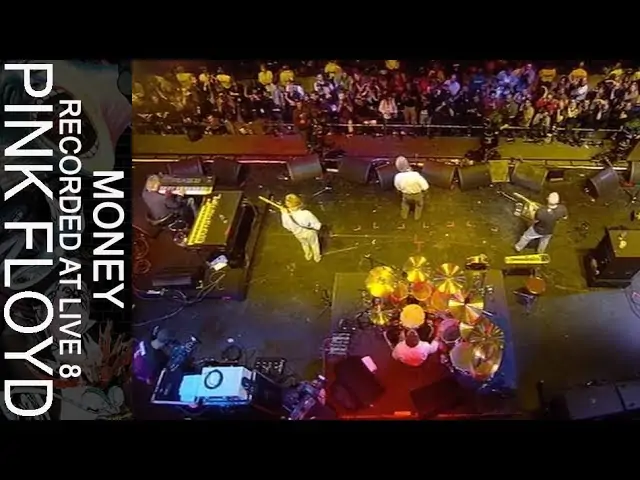
Pink Floyd performed “Money” on nearly every tour from 1972 onward, and both Gilmour and Waters have continued to play it on their separate solo tours through the decades since the band’s working life ended. Richard Wright, the keyboardist whose playing threads through the track, died in 2008. In 2023, for the album’s fiftieth anniversary, Waters re-recorded the whole of The Dark Side of the Moon as a solo project, releasing a slowed, spoken-word version of “Money” as its first single — a 79-year-old man revisiting a song he had written in his garden at 29. The original recording, the one with the hand-spliced loop of coins and the saxophone playing against the seven-beat meter, remains exactly where it was placed at the start of side two in 1973 — the unlikely hit that carried Pink Floyd into America, built out of a cash register and a critique of the thing it went on to generate.