









Ace of Base – The Sign
The demo was meant for the next album. Then Arista boss Clive Davis heard it on a flight, and a Gothenburg pop group with a misheard chorus became the biggest US single of 1994.
“The Sign” was not supposed to be on the record. Ace of Base had already broken Europe with “All That She Wants” through the small Danish label Mega, and their debut album Happy Nation had reached every chart that mattered in Germany, Denmark, the United Kingdom, and Sweden. Jonas Berggren — the Gothenburg songwriter who anchored the band alongside his sisters Linn and Jenny and his school friend Ulf Ekberg — was holding “The Sign” back for a future project. Then Clive Davis, the Arista Records president who had personally signed the band’s American distribution deal after hearing “All That She Wants” on a yacht radio, listened to the demo and decided the song was the one. The American album would be delayed. Two new tracks would be added. The whole release would be retitled The Sign.
The demo Davis heard had a problem. Berggren had built it as an instrumental — keyboards, the cod-reggae backbeat the band had been working with since 1992, and a vocal melody that had no lyric yet. When Berggren passed the demo to Swedish producers Denniz Pop and Douglas Carr at Cheiron Studios in Stockholm, Pop misheard the structure. He thought the verse was the chorus. Pop arranged the song around that mistake, treating the rising melodic line — the one that would become “I, I got a new life” — as the hook. The misreading is what gave the song its forward lean. By the time Berggren and the producers had finished the arrangement, the verse-as-chorus accident had been worked back into a conventional structure, but the energy of the original confusion stayed in the master. Pop, Carr, and Berggren mixed it at Cheiron in mid-1993; in mastering they had to lower the overall level by three decibels because the band had tracked everything hot.
A duet, built from a solo demo
The vocal arrangement was the sisters’ work. Linn Berggren, the older of the two, had handled lead vocals on “All That She Wants” and “Wheel of Fortune”; for “The Sign,” Linn and Jenny rebuilt the song as a duet, splitting the chorus in two so that one voice answered the other across the second and fourth phrases. Jenny composed the closing harmonies. The split has a practical consequence the listener feels but rarely registers: because the chorus runs without a natural breathing point, neither sister could have sustained the whole line solo. Cut into halves between two voices, the chorus delivers its hook at full velocity from beginning to end. Berggren later told Billboard that the original track had been “a bit too merry,” and that the band slipped a minor-key counter-figure underneath the major-key melody — the “da na-na na-na na-na” line — to give the song the bittersweet edge that the lyric, a breakup song dressed as sunshine, needed.
“The Sign” was released as a single in Europe on November 1, 1993, on Mega, and in the United States on December 14, 1993, on Arista. The North American version of the album followed on November 23, 1993. The single entered the Billboard Hot 100 in the United States in January 1994 and reached number one on the chart dated March 12, 1994. It held the top position for six non-consecutive weeks. The accompanying album The Sign reached number one on the Billboard 200 the same spring, making Ace of Base the first Swedish group to hold the top of both the Hot 100 and the Billboard 200 simultaneously. The single also went to number one in Australia, Canada, Germany, New Zealand, Israel, and Zimbabwe.
Second in the UK, first everywhere else
In the United Kingdom, “The Sign” peaked at number two on the singles chart and stayed in the top 75 for sixteen weeks. The number-one position it could not take was held by Mariah Carey’s cover of “Without You,” which spent four weeks at the top in February 1994. The British runner-up finish was the only major territory where the song stopped short of the top. By the end of 1994, “The Sign” was Billboard magazine’s number-one song of the year on the year-end Hot 100 chart — the first time a Swedish act had taken that distinction. The album The Sign ended 1994 as the year’s number-one album on the year-end Billboard 200, a double Ace of Base remains the only Swedish act to have achieved. At the 37th Annual Grammy Awards in March 1995, the song was nominated for Best Pop Performance by a Duo or Group with Vocals; the band lost to All-4-One for “I Swear.” The Guinness Book of World Records would name The Sign the best-selling debut album of all time, a record the album held until Guns N’ Roses’ Appetite for Destruction overtook it later in the decade.
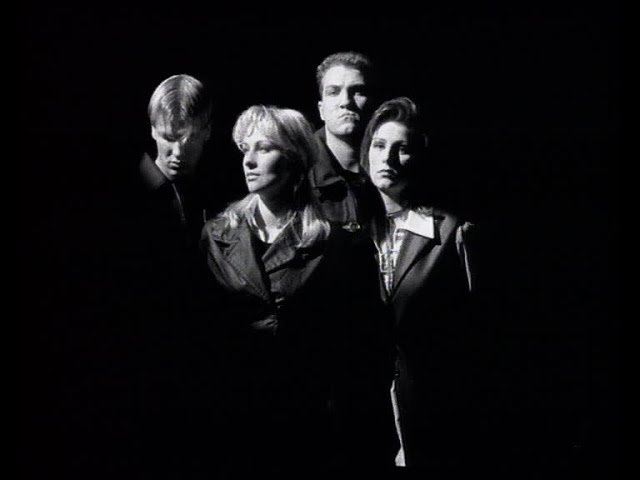
The accompanying music video, directed by Mathias Julien and filmed at Filmhuset in Stockholm in November 1993, was nominated at the 1994 Billboard Music Video Awards. Its opening shot — a close framing of Linn Berggren’s face emerging from darkness — was a deliberate homage to Anton Corbijn’s video for Depeche Mode’s “Enjoy the Silence” from 1990, and the visual language of cool European synth-pop is what carried the song into MTV’s heavy rotation through the spring and summer of 1994. The video has now passed 157 million views on YouTube. The song’s 96.7 bpm groove and its chorus splitting between two voices were features that the Cheiron production team — Denniz Pop, Douglas Carr, and the rising staff producer Martin Sandberg, soon to be known as Max Martin — would carry forward as the template for the next ten years of Swedish pop export. The DNA that runs through everything from Britney Spears’ “…Baby One More Time” to The Weeknd’s “Blinding Lights” traces back to the Cheiron sessions of 1993, and “The Sign” is the record where the formula first cleared American radio at scale.
The catalogue around “The Sign” stayed busy for the rest of the decade. The album The Sign sold more than 21 million copies worldwide and remained in the Billboard 200 for 102 weeks. The band’s follow-up, 1995’s The Bridge, went platinum but never approached the debut’s reach. Linn Berggren stepped back from touring in 1998 and left the group in 2007; Jenny Berggren departed in 2009. Jonas Berggren and Ulf Ekberg have continued as Ace of Base since, with two new vocalists for 2010’s The Golden Ratio and as a duo thereafter. In 2023, Billboard ranked “The Sign” at number 223 on its list of the 500 Best Pop Songs of All Time, describing the record as a song sitting between Europop, techno, and reggae-pop, and a quintessential staple of 1990s playlists. The misheard demo, the duet built from a solo line, the song held back for the next album — all of it ended up as the biggest pop record of 1994.
SONG INFORMATION
Related videos
 Watch LaterAdded
04:05
Watch LaterAdded
04:05  Watch LaterAdded
02:57
Watch LaterAdded
02:57  Watch LaterAdded
03:04
Watch LaterAdded
03:04