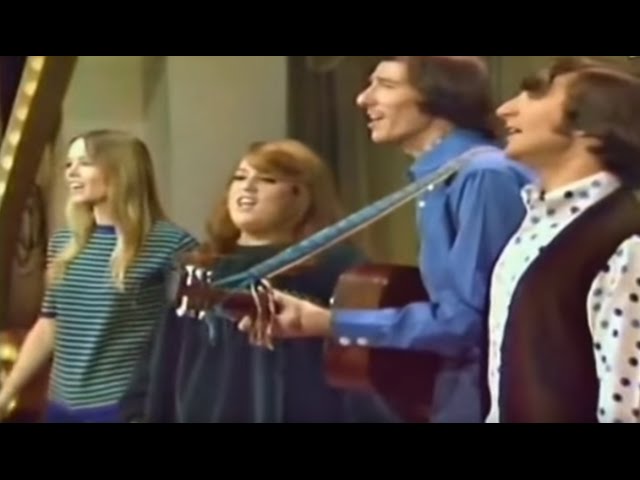
The backing track was already on tape — Barry McGuire had recorded it first, and the Mamas & the Papas simply sang over the top.
The music you hear on California Dreamin’ was recorded for another man. Barry McGuire, fresh off the doom-laden hit Eve of Destruction, cut the first version of the song in 1965 with the Mamas & the Papas standing behind him on backing vocals. The instrumental bed — the acoustic guitar, the rhythm section, the harmonies — was captured for his record. When the group decided the song was too good to give away, they didn’t start over. They kept the tape, wiped McGuire’s lead, and sang across the music that was already there.
The song was born two years earlier and a continent away from the California it longed for. John and Michelle Phillips wrote it in the winter of 1963, living in New York City and running cold. Michelle, a California native, was homesick for the light and the warmth; John, a Virginian, turned her longing into a lyric. He worked at night and woke her one morning with the opening lines. “All the leaves are brown and the sky is grey” was not a metaphor — it was the view from the window. At the time the two were part of the folk group the New Journeymen, the outfit that would soon reshape itself into the Mamas & the Papas.
They earned their first record deal through McGuire, who introduced them to Lou Adler, the head of Dunhill Records. In gratitude, the four sang backing vocals on McGuire’s album This Precious Time, including on his cut of the Phillips song. But Adler and the group heard something in the material that outstripped its intended owner. Denny Doherty took the lead vocal, reworking the phrasing after session guitarist P.F. Sloan played him Walk, Don’t Run by the Ventures. Sloan supplied the descending guitar figure that opens the record. If you listen to the far left channel at the very start, McGuire’s original vocal is still faintly there, never fully erased — a ghost from the first session bleeding into the second.
The flute that almost wasn’t
The one wholly new element was the solo. Bud Shank, a West Coast jazz player, was brought in to add an alto flute break, a late addition that gave the record a cool, searching quality nothing else on the radio had in 1965. The session took place on November 4, 1965, at United Western Recorders in Hollywood — the same room where the Beach Boys built Pet Sounds. The players were the cream of the Los Angeles studio scene, the group of musicians later known as the Wrecking Crew: Hal Blaine on drums, Larry Knechtel on keyboards, Joe Osborn on bass. Blaine’s crisp, driving pattern is one of the most quoted performances of his enormous career.
Dunhill held McGuire’s version back so an established act wouldn’t compete with the newcomers. The group’s actual first single, Go Where You Wanna Go, went nowhere and was quickly pulled; the A-side was reassigned, and California Dreamin’ was issued in its place on December 8, 1965, with Somebody Groovy on the flip. It was not an overnight hit. The record climbed slowly through the early months of 1966, finally reaching number four on the Billboard Hot 100 and number 23 in the United Kingdom. It sold more than a million copies and ranked among the ten biggest songs of the entire year.
What it launched was larger than a chart run. The song became a signpost for the counterculture taking shape on the West Coast, the sound of a generation deciding that the light was better somewhere else. It carried the group’s parent album, If You Can Believe Your Eyes and Ears, to number one, and when listeners wanted more, radio pulled Monday, Monday off the same record — a song that went all the way to the top. The Mamas & the Papas had a string of hits before splitting in 1968, and Cass Elliot’s death in 1974 closed the door on any full reunion. The song itself kept going: certified triple platinum by the RIAA in 2023, inducted into the Grammy Hall of Fame in 2001, and placed among Rolling Stone’s greatest songs ever recorded. Not bad for a track the band never meant to make its own.
SONG INFORMATION
Artist: The Mamas & the Papas
Song: “California Dreamin'”
Album:If You Can Believe Your Eyes and Ears
B-side: “Somebody Groovy”
Released: December 8, 1965
Recorded: November 4, 1965
Studio: United Western Recorders, Hollywood
Label: Dunhill
Songwriter(s): John Phillips, Michelle Phillips
Producer(s): Lou Adler
Length: 2:42
Lineup: Denny Doherty (lead vocal); Bud Shank (alto flute); P.F. Sloan (guitar intro); Hal Blaine (drums); Larry Knechtel (keyboards); Joe Osborn (bass)
Chart Performance: No. 4 US Billboard Hot 100; No. 23 UK