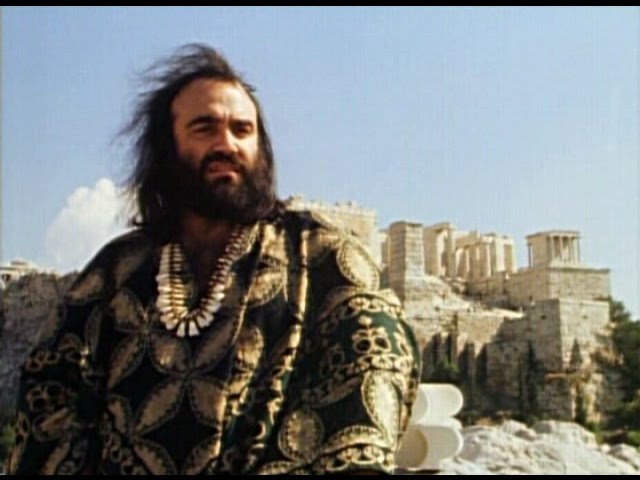
Before the kaftan and the European chart domination, this Greek giant fronted a prog-rock band with Vangelis — and the gentle 1973 ballad that made him a household name was never actually the UK No.1 most people think it was.
The voice came first, and it never quite belonged to any one country. By the time My Friend the Wind drifted across European radio in 1973, Demis Roussos had already lived three musical lives — choirboy in Alexandria, bass player and co-vocalist in the progressive-rock outfit Aphrodite’s Child alongside future Oscar winner Vangelis, and now a solo balladeer in a kaftan whose soaring, tremulous tenor sounded like nothing else on the dial. This song, more than almost any other, is where that voice found its widest audience.
Written by Alec R. Costandinos and Stélios Vlavianós, My Friend the Wind arrived as a single in 1973, pulled from Roussos’s second solo album Forever and Ever. The record had been assembled across an unusually scattered set of sessions — studios in Paris, Hamburg, and London, captured between March 1972 and January 1973 — and Roussos produced most of it himself. The song’s appeal was its simplicity: a slow, swelling melody, an arrangement that let the voice climb unobstructed, and a lyric of longing addressed to the wind itself. There was a Spanish-language version too, “Mi amigo el viento,” cut for the markets where Roussos was already a phenomenon.
A European No.1 — just not where the legend says
And a phenomenon he was. My Friend the Wind went to No.1 in the Netherlands and in Belgium’s Flanders region, and charted across the continent through 1973. This is the part of the story that the song’s own reputation tends to scramble. For decades, fans have repeated that My Friend the Wind was a UK No.1 — and the claim is half right in the most interesting way. The single itself was a continental smash but not a British chart-topper. What topped the UK chart was something stranger.
The breakthrough Roussos had in mainland Europe took years to cross the Channel. British audiences caught up only in 1976, when the BBC aired a documentary called The Roussos Phenomenon on June 10 of that year, examining how a Greek singer had quietly sold millions of records everywhere but the UK. Philips moved fast, bundling four of his best-known songs onto an EP titled Excerpts from “The Roussos Phenomenon.”
The first EP ever to top the UK chart
That EP — carrying Forever and Ever, Sing an Ode to Love, So Dreamy, and My Friend the Wind — spent a single week at No.1 on the UK chart dated July 17, 1976. It was the first extended-play record ever to reach the top of the British singles chart, and the only EP to do so in the entire decade. So when someone tells you My Friend the Wind was a UK No.1, the truth is gentler and odder: the song rode to the summit as one passenger on a four-track record, three years after it was first released, on the back of a TV documentary about why Britain had been so slow to notice.
Roussos kept selling — more than 60 million albums across a career that ran from the 1960s until shortly before his death in Athens on January 25, 2015. He remained, in the memorable phrase of his obituaries, an unlikely kaftan-wearing sex symbol, a man whose voice carried a kind of warmth that never went out of fashion in the places that loved him first. My Friend the Wind endures as one of the purest distillations of that gift — a small, swelling song about letting go, sung by a man who spent his whole life refusing to be pinned to any single border.
SONG INFORMATION
Artist: Demis Roussos
Song: “My Friend the Wind”
Album:Forever and Ever
B-side: “Lay It Down” (territory varies; “Someday Somewhere” on the Netherlands pressing)
Songwriter(s): Alec R. Costandinos, Stélios Vlavianós
Producer(s): Demis Roussos
Length: 3:54 (Netherlands single)
Chart Performance: No.1 Netherlands; No.1 Belgium (Flanders); No.15 Austria. Later reached UK No.1 in 1976 as part of the EP Excerpts from “The Roussos Phenomenon”