










Johnny Cash & June Carter Cash – Jackson
Johnny Cash Proposed to June Carter Onstage the Instant They Finished Singing About a Marriage Already Falling Apart
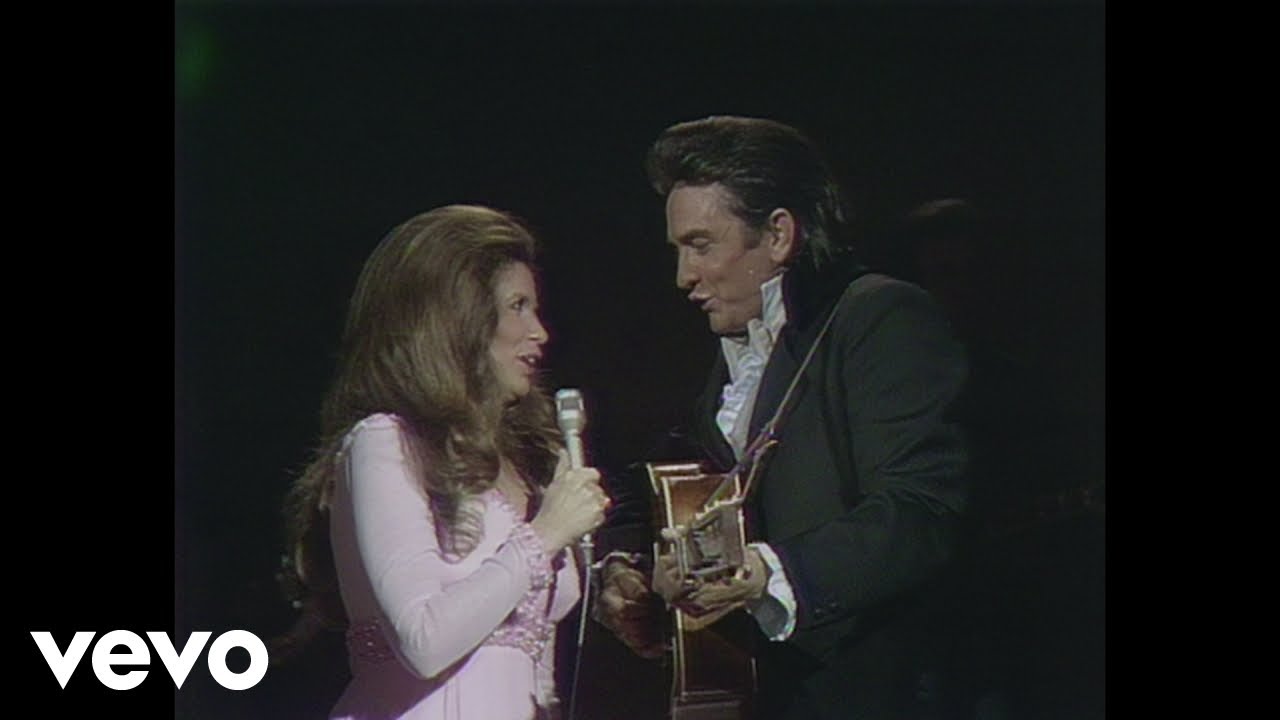
On February 22, 1968, in front of 7,000 people at the London Gardens in London, Ontario, Johnny Cash and June Carter finished a duet about a marriage that’s already cold, with a husband threatening to run wild in another town and a wife daring him to try it. The song was “Jackson”. Cash set his guitar down, turned to his singing partner, and asked her to marry him right there on the stage. She said yes. “He stopped the whole show,” she remembered decades later. It remains one of country music’s better-documented ironies: the most public proposal of Johnny Cash’s life happened in the afterglow of a song built entirely around a marriage that doesn’t work.
Keep watching: Johnny Cash – I Walk the Line (1972) · Sunday Morning Coming Down
The song wasn’t written with them in mind. Billy Edd Wheeler wrote it in 1963 after reading the script for Edward Albee’s Who’s Afraid of Virginia Woolf?, drawn to how viciously the play’s married couple went at each other. His editor on the song, Jerry Leiber of the songwriting team Leiber and Stoller, told him to scrap his original opening verses and start instead with what had been the song’s closing line: “We got married in a fever, hotter than a pepper sprout.” Wheeler had no particular city in mind when he picked the title — he later said he simply liked the sharp sound of the word against something softer like Nashville. Cash, performing the song live over the years, sometimes offered his own explanation anyway, telling audiences he was headed to Jackson to see his old Sun Records bandmate Carl Perkins, who genuinely did live in Jackson, Tennessee. The Kingston Trio and Flatt and Scruggs both recorded versions that same year, alongside Wheeler’s own cut on his album A New Bag of Songs. The official songwriting credit on the song’s original pressing lists a second co-writer named Gaby Rodgers, though no one named Gaby Rodgers wrote a line of it — it was Leiber’s then-wife’s name, used as a publishing pseudonym during an unrelated contract dispute that kept his own name off the paperwork.
Cash and Carter — not yet married, though they’d toured together since 1961 and were both freshly divorced — recorded their version at Columbia Studio in Nashville on January 11, 1967, with longtime Cash producer Don Law and Frank Jones at the board. Columbia released it as a single on February 6, 1967, backed with “Pack Up Your Sorrows”, and it climbed to No. 2 on the Billboard Hot Country Singles chart that spring. The track anchored Carryin’ On with Johnny Cash and June Carter, their first duet album together, released that August.
Five Weeks in 1968
What followed reads almost too cleanly to be true. Cash proposed after the London, Ontario show on February 22. One week later, on February 29, at the 10th Annual Grammy Awards, “Jackson” won Best Country & Western Performance, Duet, Trio or Group — the first Grammy either of them had ever won, and the first they’d win together. The next day, March 1, 1968, in Franklin, Kentucky, they married. A song about two people who can’t stand each other anymore had just bookended, almost to the day, the start of a marriage that would last thirty-five years, until both their deaths within months of each other in 2003.
The duet became one of the most reliable numbers on The Johnny Cash Show, the ABC variety series Cash hosted from June 1969 to March 1971, taped before a live audience at Nashville’s Ryman Auditorium. The show reached No. 17 in the Nielsen ratings in 1970, pulling performers as varied as Bob Dylan, Joni Mitchell, the Monkees, and Louis Armstrong into the same hour Cash hosted. Across its 58 episodes, Cash and Carter returned to “Jackson” again and again — it shows up in the surviving episode logs more than almost any other duet they performed together. The version now circulating as “Jackson (The Best Of The Johnny Cash TV Show)” comes from the episode that aired April 15, 1970, with guests Judy Collins and Bobby Goldsboro that week. By then the song wasn’t just a record they’d cut the year before their wedding — it was the number their audience expected, and, for anyone who knew the story, the one with the punchline already built in.
Beyond the Cash House
Cash and Carter weren’t alone on the charts with “Jackson” in 1967. Nancy Sinatra and Lee Hazlewood released a competing pop version the same year that reached No. 14 on the Billboard Hot 100 and did even better across continental Europe. The Cash and Carter recording earned a Silver certification from the BPI in the UK, and in 2024 Rolling Stone ranked it at No. 112 on its list of the 200 Greatest Country Songs of All Time. The song has had a long second life in covers — Australian band INXS recorded it for their 1985 Dekadance EP, and Trixie Mattel paired with Orville Peck for a 2021 version. In 2005, Joaquin Phoenix and Reese Witherspoon, playing Cash and Carter in Walk the Line, recorded their own version for the film’s soundtrack, introducing the song’s fight-and-flirt routine to an audience who’d never seen the Ryman stage. Nearly six decades on, “Jackson” still plays like a battle-of-the-sexes novelty about two people threatening to ruin each other’s name in a town that may not exist on any map. What the lyrics never had to explain is that the two people singing it would spend the next thirty-five years proving the song wrong.