



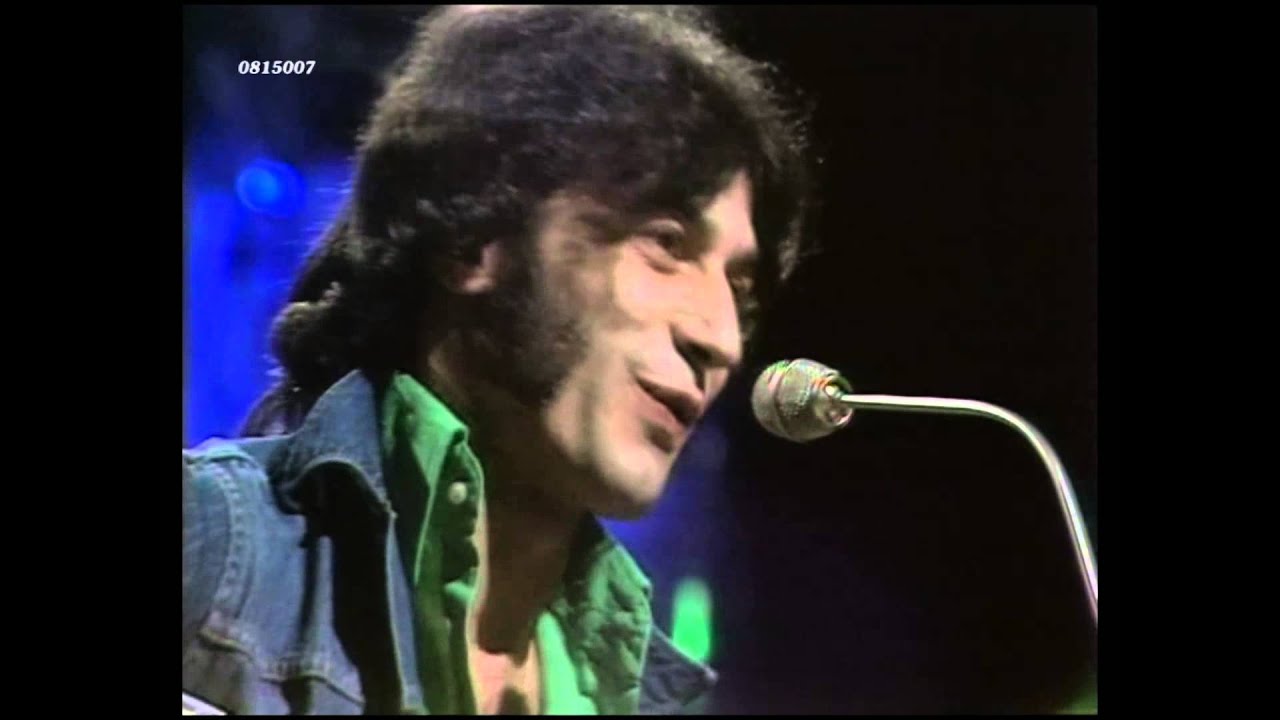


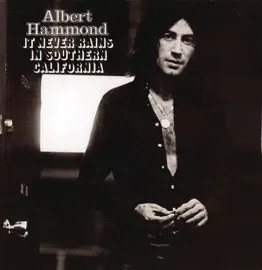
Albert Hammond – It Never Rains In Southern California
A 28-Year-Old British-Born Songwriter Moved From London to Los Angeles in 1971 to Record His First Solo Album. It Rained Almost Continuously During His First Months in California. The Song He Wrote About the Experience Hit #5 on the Hot 100, Sold a Million Copies, and Turned the Dishwasher From the Chelsea Drugstore Into One of the Most-Recorded Pop Songwriters of the Next Four Decades.
Albert Louis Hammond had spent most of the previous decade in London working as a contracted songwriter-for-hire for British publishers — a working musician with a steady stream of co-writing placements on other artists’ hit singles but no commercial recording career of his own. He had been born in London on May 18, 1944, to a family who had been evacuated from Gibraltar during the Second World War. The Hammonds had returned to Gibraltar after the war’s end, and Albert had grown up there fluent in both English and Spanish, hearing rock and roll, flamenco, and Spanish guitar around him in equal measure. He had left school at sixteen, formed a band called The Diamond Boys in Madrid in 1960, recorded a handful of unsuccessful Parlophone singles in his early twenties, and in 1966 met the British songwriter Mike Hazlewood in London. The partnership Hammond and Hazlewood formed across the second half of the 1960s produced some of the most-recorded British pop singles of the period: Little Arrows for Leapy Lee in 1968, Make Me an Island for the Irish singer Joe Dolan in 1969 (number one in fourteen countries), Gimme Dat Ding for the Pipkins in 1970, Good Morning Freedom for Blue Mink, Freedom Come, Freedom Go for the Fortunes in 1971. Hammond had, by this point, written enough hit songs for other artists to be financially comfortable — but the singing career he had pursued since his teenage years had never quite arrived. To pay his bills during the lean stretches between songwriting commissions, he had taken work washing dishes at the Chelsea Drugstore in west London.
The Atlantic crossing came in 1971. Hammond and Hazlewood had been signed to a new deal by Clive Davis, the President of CBS Records, who had heard the songwriting team’s catalogue and offered them a recording contract on the CBS subsidiary Mums Records — a New York-based label run by Columbia executives Steve Tyrell and Jerry Schoenbaum that had been set up specifically to develop singer-songwriters Davis believed could succeed in the American market. Hammond moved his family from London to Los Angeles in 1971 to begin work on his debut album for Mums. He had expected the Southern California of the postcards: sunshine, beach light, the perpetual yellow afternoon of the Beach Boys records that had been part of his musical vocabulary since adolescence. What he found, during the first months he spent setting up in Hollywood, was rain. Persistent rain. The unusual winter precipitation in Southern California — the brief but intense storm systems that arrive off the Pacific and saturate the Los Angeles basin for days at a time, then disappear — coincided exactly with Hammond’s arrival. He had moved from England to escape the weather, and the weather had followed him.
The song he and Hazlewood wrote about the experience took the climate as its hook and the autobiography as its content. The narrator of It Never Rains in Southern California, in the first-person delivery Hammond would sing on the recording, is a showbiz aspirant who has left his family and friends to pursue an entertainment career in Hollywood and has failed. The chorus title is a piece of received wisdom — the popular belief that Southern California enjoys uninterrupted sunshine — that the narrator inverts: it does rain in Southern California, and when it pours, it pours. The double meaning was, by Hammond’s own account in subsequent interviews, deliberate. The literal Pacific storm was a metaphor for the cascade of professional disappointments. The lyric does not specify the narrator’s living conditions, but the broader picture is unmistakable. The narrator has been on the road. He cannot tell his family the truth about how poorly things are going. He cannot tell them the dream is not happening. The song is, in its first-person narrative form, the most vulnerable autobiographical lyric Hammond ever wrote about his own working life.
The Wrecking Crew Session, the Michael Omartian Piano, and the Million Copies Sold
The recording took place in Los Angeles in early 1972 with Don Altfeld co-producing alongside Hammond. The instrumental backing was supplied by members of the Wrecking Crew — the loose Los Angeles session collective whose players had backed the Beach Boys, Phil Spector, the Mamas and the Papas, the Monkees, Sonny and Cher, and most of the major American pop records of the 1960s. The principal piano on the recording was performed by Michael Omartian, the young Detroit-born session keyboardist who would, across the next decade, produce records for Christopher Cross, Rod Stewart, and Donna Summer. Hammond’s vocal was placed at the front of the mix with a soft acoustic guitar bed underneath, the piano filling the harmonic space between his voice and the rhythm section, and a small string section arriving on the choruses to lift the dynamic. The arrangement is unhurried. The track runs three minutes and nineteen seconds in its single edit and three minutes and thirty-one seconds on the album. Mums released the single in October 1972. It entered the US Billboard Hot 100 within weeks and climbed steadily through the autumn and winter. By February 1973 it had reached number five on the Hot 100, where it stayed for two weeks. It reached number one on the Canadian RPM chart, the Top 10 in Australia (where it peaked at number six), and the Top 30 across most major European markets. Total US lifetime sales: over one million copies, certified Gold by the Recording Industry Association of America. The parent album, also titled It Never Rains in Southern California, was released in December 1972 and contained two other tracks that would become major songs in different contexts: The Air That I Breathe, which Hammond would later see become a worldwide hit for the Hollies in 1974, and the version of If You Gotta Break Another Heart that Cass Elliot would re-record in a slightly rewritten arrangement.
It Never Rains in Southern California was, then and now, Albert Hammond’s only American Top 10 single. He would never again reach the upper portion of the Hot 100 as a solo artist. His subsequent solo singles — The Free Electric Band (1973), Down by the River (1973), I’m a Train (1974, his only other US Top 40 entry at number thirty-one) — sold less well in the United States while continuing to chart strongly across the United Kingdom, Australia, and continental Europe. By the mid-1970s, Hammond had begun the second phase of the career that would eventually define him. The artists he and his collaborators — Mike Hazlewood, Hal David, Diane Warren, John Bettis, Carole Bayer Sager, Holly Knight, Roy Orbison — were writing songs for were becoming, across the next thirty years, the most commercially successful pop singers in the world.
The Songwriting Catalogue, the Hollies, and the Whitney Houston Olympics Moment
The list of singles Hammond has co-written for other artists since 1972 reads, in commercial terms, like a working summary of late-twentieth-century English-language pop. The Hollies took The Air That I Breathe — a song Hammond himself had recorded on his 1972 debut — to number two on the UK Singles Chart in 1974, after which the band’s promoters initially refused to play the song live and Hammond personally toured with the band to convince them to perform it. The single went on to be cited by Radiohead in the legal settlement that gave Hammond and Hazlewood co-writing credit on Creep in 1992. Leo Sayer made the Hammond-Carole Bayer Sager composition When I Need You a number-one single in the UK and US in 1977. Julio Iglesias and Willie Nelson took the Hammond-Hal David composition To All the Girls I’ve Loved Before to number five on the US Billboard Hot 100 in 1984. Whitney Houston performed the Hammond-John Bettis composition One Moment in Time at the closing ceremony of the 1988 Seoul Summer Olympics, where it became one of the most-watched live musical performances of the year. Starship took Nothing’s Gonna Stop Us Now — co-written by Hammond and Diane Warren — to number one in the United States, the United Kingdom, and twelve other countries in 1987. Ace of Base and Aswad both reached the UK Top 10 with the Hammond-Diane Warren composition Don’t Turn Around. Hammond has also produced records for Johnny Cash, Carmen McRae, Aretha Franklin, Tina Turner, Diana Ross, the Carpenters, and Westlife. He was inducted into the Songwriters Hall of Fame on June 19, 2008. He received the Ivor Novello Award for Outstanding Song Collection in May 2015. He was awarded the Spanish Ministry of Culture’s Lifetime Achievement Award in 2023. He has also held an Order of the British Empire since 2010.
The song that began the entire trajectory — that took a 28-year-old British-born songwriter who had been washing dishes at the Chelsea Drugstore in west London a few years earlier and turned him into a working Los Angeles recording artist with a Gold-certified American hit single — sits at the top of every Albert Hammond compilation released since 1973. The album it came from has remained in continuous catalogue distribution for over fifty years. Hammond himself has continued to record and tour into his ninth decade. He turned 82 on May 18, 2026. His son Albert Hammond Jr. has been the rhythm guitarist in the American rock band The Strokes since the band’s formation in 1998. The lyrical question Hammond posed in October 1972 — whether the showbiz dream he had crossed the Atlantic to chase would actually arrive, or whether the rain would just keep falling — has, in the half-century since, been answered as comprehensively as any career question in popular music. The dishwasher from the Chelsea Drugstore is now one of the most-recorded songwriters in the catalogue.
SONG INFORMATION

Enjoyed this one? New forgotten gems every day — tap Music Videos Club below to visit and follow us on Facebook:
Related videos
 Watch LaterAdded
05:29
Watch LaterAdded
05:29  Watch LaterAdded
02:58
Watch LaterAdded
02:58  Watch LaterAdded
04:13
Watch LaterAdded
04:13