The song that opens Houses of the Holy was never meant to have words at all.
Jimmy Page built it at home as an instrumental. It had no lyrics, no vocal line and no title beyond a working one — The Overture — and its job was to be the thing that led into The Rain Song. Page has recalled the moment it stopped being that: Robert Plant heard it and decided it was too good to be a doorway, which meant somebody had better write some words, quickly. The result opens Houses of the Holy, and it is called The Song Remains the Same, on the album where less of Led Zeppelin remained the same than on any record they ever made.
The words Plant put on it were about touring — the disorientation of playing to enormous crowds in places whose language you do not speak, and the idea he kept returning to that music works the same on everybody regardless. For a while the track carried the title The Campaign, which is what a tour feels like from inside it. The final title came last, and it reads now as a statement of faith rather than a description of the album it introduces.
Because almost nothing about Houses of the Holy was the same. It is the only Led Zeppelin album with no blues-based song on it anywhere — no twelve-bar, no Willie Dixon debt, none of the architecture the first four records were built on. In its place: reggae, doo-wop, funk, and John Paul Jones given room to put keyboards and string arrangements where the guitars used to be. It was recorded across 1972, largely at Stargroves in Berkshire using the Rolling Stones Mobile Studio, with Eddie Kramer engineering, plus sessions at Olympic in London and Electric Lady in New York. Atlantic released it on March 28, 1973.
Layers, and a voice that isn’t quite Plant’s
What makes the opening track sound the way it does is the number of twelve-string guitar parts stacked on top of each other. Page tracked them until the effect stopped resembling a guitar and started resembling a small orchestra tuning up in a hurry — bright, restless, and completely without the folky jangle that twelve-strings had meant to that point. Underneath it, Bonham and Jones simply hold, which is the only reason the thing does not fall over.
There is one more trick, and most listeners never notice it. Plant’s vocal was sped up slightly before the album was mastered. It sits marginally higher and marginally more urgent than he actually sang it, which is why the performance has a quality of straining upward that his live versions never quite reproduce.
Onstage, it went back to being an overture
They first played it live on the Japanese tour in 1972, before the album existed publicly. From late that year through 1975 it kept the job Page had originally designed for it: the band played it and went straight into The Rain Song with no gap, exactly as the record does. Page needed both necks of the Gibson doubleneck to manage it, twelve strings for one song and six for the other, and the pairing became one of the fixed points of a Zeppelin set.
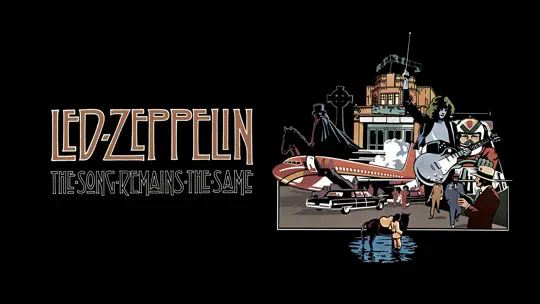
The title outgrew the song. When the band put out their concert film in 1976, they named it after this track, and then named the soundtrack album after the film. For a piece of music that started life as a link between two other things and was not supposed to contain a single word, that is a considerable promotion.
SONG INFORMATION
Artist: Led Zeppelin
Song: “The Song Remains the Same”
Album:Houses of the Holy
Released: March 28, 1973
Recorded: 1972
Studio: Stargroves, Berkshire; Olympic, London; Electric Lady, New York
Label: Atlantic
Songwriter(s): Jimmy Page, Robert Plant
Producer(s): Jimmy Page
Engineer: Eddie Kramer
Length: 5:24
Lineup: Robert Plant (vocals), Jimmy Page (guitars), John Paul Jones (bass), John Bonham (drums)
This unique rock concert film experience captures the essence of Led Zeppelin, one of the most exciting and durable rock bands of all time. Filmed during the group’s now-famous 1973 New York City concerts, this documentary mixes live performances of “Dazed and Confused,” “Stairway to Heaven,” “Whole Lotta Love” and other signature songs with fantasy sequences and personal backstage footage of the group. Surviving band members recently supervised the digital remastering and Dolby 5.1 remixing of the film’s picture and audio, so it now looks and sounds better than ever before!