






![Chaka Khan – Through the Fire (Official Music Video) [HD Remaster]](https://musicvideosclub.com/wp-content/uploads/2026/03/chaka-khan-through-the-fire-offi-360x203.jpg)




![Neil Young – Heart of Gold (Live) [Harvest 50th Anniversary Edition] (Official Music Video)](https://musicvideosclub.com/wp-content/uploads/2024/10/neil-young-heart-of-gold-live-ha-360x203.jpg)

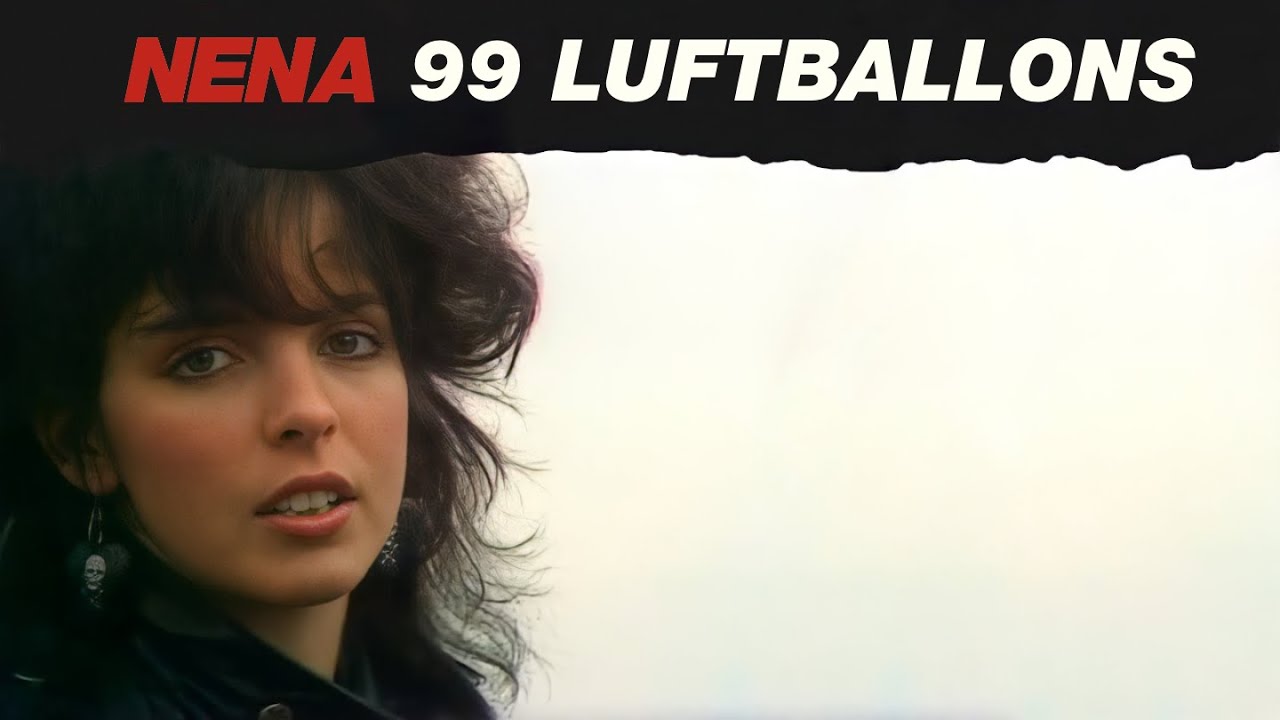
NENA – 99 Luftballons
The Label Had No American Plans. A DJ in Los Angeles Had Other Ideas.
Carlo Karges was watching balloons at a Rolling Stones concert at the Waldbühne in West Berlin in June 1982 when the idea arrived. Mick Jagger had released thousands of helium balloons into the evening air at the show’s end, and Karges watched them catch the wind and drift east toward the Wall — those shifting, clustering shapes that could, if you were standing on the wrong side of a radar screen, resemble almost anything. He wrote the lyric the same day. His keyboard player Uwe Fahrenkrog-Petersen wrote the music around it. The song they built from those two observations — ninety-nine balloons, mistaken for a UFO, triggering a war that destroys everything — was “99 Luftballons,” and when it was released in January 1983 nobody at CBS Records in New York had any intention of releasing it to an American market that they assumed would never embrace a German-language record. Then Rodney Bingenheimer at KROQ in Los Angeles got hold of a copy, put it on the air, and the phones did not stop ringing.
Released in January 1983 on CBS Schallplatten in Germany, “99 Luftballons” topped the charts in West Germany, the Netherlands, and Austria and had become a major hit across Europe and Japan before the American situation materialized. When the German-language version entered the Billboard Hot 100 it climbed to Number Two in March 1984 — held off the top only by Van Halen’s “Jump,” which was having one of the more dominant chart runs of the decade. It was the first German-language record to reach the American Top 10 since Lolita’s “Sailor (Your Home Is the Sea)” in 1961 — a twenty-three-year gap that underscored exactly how improbable the whole situation was. In the UK, where CBS released an English-language version titled “99 Red Balloons” with lyrics by Kevin McAlea, it went to Number One for three weeks beginning February 28, 1984. That version also topped the charts in Canada and Ireland. It did not chart in the United States, where the German original had beaten it there and made it redundant.
Karges had not set out to write a protest song. His own description of the lyric’s central concern was personal rather than political — a meditation on how paranoia shapes human behavior, how the fear of each other drives us toward cruelties we would not otherwise commit, how striking first only feels like safety until it doesn’t. Nena herself was consistent on this point: the song was about peace and about awareness of our actions, not about Cold War policy. The timing was not something any of them had engineered. The United States deployed Pershing II missiles in West Germany in January 1984 — the month “99 Luftballons” broke internationally — in direct response to Soviet SS-20 deployments, triggering protests across Western Europe at a moment when the song about a mistake that ends everything was already on heavy rotation. Context had arrived around the record uninvited, and it made the song feel both more urgent and more uncomfortable than its authors had intended.
The English version — which McAlea wrote on an envelope that he reportedly still has — was something the band accepted rather than embraced. Fahrenkrog-Petersen told interviewers in March 1984 that they had made a mistake and that the song lost something in translation. Nena agreed it was too blunt, too overtly political, stripping away the ambiguity that gave the original its particular unease. The German lyric ends with a single narrator walking through the ruins of the world, finding one balloon, and letting it go — thinking of someone they loved. McAlea’s English version ends with a more satirical, more explicitly anti-military resolution. Both endings work on their own terms. The band preferred the one they had written. American audiences, presented with both versions, reached for the one they couldn’t fully understand and played it regardless. The language turned out not to matter. The feeling was completely clear.
Recording had taken place at Spliff Studio in West Berlin in late 1982, with Reinhold Heil and Manfred Praeker producing the debut album sessions. The video, filmed at Harskamp — a Dutch military training camp — placed the band on a stage surrounded by fires and explosions provided by the Dutch Army, a visual concept that was both pragmatically convenient and accidentally perfect. For a song about military escalation, performing in front of actual military hardware communicated something that a more conventional studio setting could not have achieved without trying much harder. The original broadcast was on the Dutch music program TopPop on March 13, 1983. The song it introduced had, at that point, already topped the German chart. What nobody knew yet was how far it was going to travel.
Carlo Karges died in 2002 of liver failure at the age of fifty. He had continued playing with various bands after Nena split in 1987, but nothing in his subsequent career came close to the reach of the song he had written in an evening from the image of balloons drifting over a wall. The irony that a song born at a Wall — a physical structure built to contain the movement of people and ideas — went everywhere that people and ideas could reach is not a small one. The Russia-Ukraine war of 2022 brought the song back to global prominence for the third time, forty years after it was written, because the thing it described had not resolved itself as decisively as the Wall’s fall had seemed to promise. Nena has performed it live on all seven of her live albums dating from 1995 to 2018. She did not perform it in the United States until 2016 — thirty-three years after it first charted there. Some songs circle back around regardless.
SONG INFORMATION
Related videos
 Watch LaterAdded
 Watch LaterAdded
 Watch LaterAdded