





![Eagles – In The City (Official Video) [HD]](https://musicvideosclub.com/wp-content/uploads/2025/12/eagles-in-the-city-official-vide-360x203.jpg)



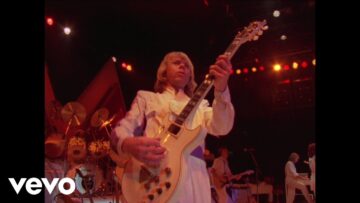



Boney M. – Rivers Of Babylon (ZDF Disco 12.06.1978)
Two Thousand, Five Hundred Years Before Frank Farian Got Involved
The lyric of “Rivers of Babylon” was already ancient when Brent Dowe of The Melodians adapted it for a reggae recording in 1970. Psalm 137 had been written in the sixth century BC — a lament composed by Jewish exiles sitting beside the rivers of Babylon after the conquest of Jerusalem in 586 BC, weeping as they remembered Zion, asking how they could sing the Lord’s song in a strange land. Twenty-six centuries later, Dowe heard in that specific grief an exact parallel to the Rastafarian experience — the descendants of African slaves, displaced and in exile, their Zion the homeland they had been taken from. He added a verse from Psalm 19 for the bridge, recorded it with The Melodians in Kingston in 1970, and watched the Jamaican government immediately ban it for its Rastafarian references — “King Alpha” and “O Far-I,” coded references to Haile Selassie that the authorities considered subversive. Producer Leslie Kong attacked the ban: the words had been sung by Jamaican Christians for generations. The ban was lifted. The song found its audience. When it appeared on the soundtrack to the reggae film The Harder They Come in 1972, it found a larger one. Six years later, Frank Farian’s German disco production machine found it too — and removed most of the theology that had given it its reason for existing in the first place.
Released on Hansa/Ariola in March 1978, Boney M’s “Rivers of Babylon” entered the UK Singles Chart and reached Number One on April 29, holding the position for five weeks before beginning its descent. Radio DJs then noticed the B-side — “Brown Girl in the Ring,” a West Indian playground song that Liz Mitchell had originally recorded in 1975 with a group called Malcolm’s Locks — and began giving it airplay. The A-side, already sliding, reversed direction and climbed back to Number Two on the strength of the B-side’s momentum. The double-sided single spent nineteen weeks in the UK Top 10 and six months in the Top 40, eventually selling over two million copies in Britain alone — making it the second single in UK chart history to achieve that figure, and one of only seven to have done so in the chart’s entire history. At the time of its run it was the second highest-selling UK single of all time. It currently sits seventh. Over 100 million records have since been attributed to the Boney M catalog. This was the record that built most of that number.
The transformation the song underwent between Kingston and Frankfurt was considerable. Farian stripped the Rastafarian language from the lyric: “King Alpha” became “the Lord,” and “O Far-I” — a devotional address to Haile Selassie — became the more prosaic “here tonight.” The early television performances caught Boney M singing “How can we sing King Alpha’s song,” but by the time the single was pressed and distributed, the Rastafarian references had been replaced by the original Biblical wording — a decision that restored the Psalm but erased the specific spiritual and political context Dowe had placed around it. The Melodians’ original was a Rasta anthem about exile and liberation. Boney M’s version was a disco record with Biblical lyrics. Both readings were present in the melody and the words. Only one was commercially intentional.
The first single pressings credited only Farian and his collaborator Hans-Jörg Mayer — known as Reyam — as songwriters. Dowe and McNaughton, the Melodians writers whose composition had been covered, were absent from the credits entirely. After negotiations with the pair, subsequent pressings added their names. Farian’s relationship to authorship and credit had been contentious from the beginning — his first significant hit as Boney M had used a Prince Buster composition without crediting Buster — and the Dowe and McNaughton situation followed the same pattern. Separately, arranger Peter Herbolzheimer accused Farian of lifting his arrangement for the song. The resulting court case ran for more than twenty years in Germany. The song that had begun as a Psalm and been transformed by a reggae group into a devotional anthem had, by the time the legal machinery was done with it, generated enough paperwork to fill its own archive.
The commercial architecture of Boney M was Farian’s creation in a more literal sense than most listeners understood. The group’s front man Bobby Farrell — the dancer whose physical presence on stage was as identifiable as any element of the act — did not sing. Farian provided the deep male vocals himself, with Farrell lip-syncing to them in every live performance and television appearance. Liz Mitchell, Marcia Barrett, and Maizie Williams — the three women in the group — sang their own parts. Mitchell’s lead vocal on “Rivers of Babylon” is the element that lifts the record above its production context: her Jamaican-born voice carries an authenticity with the material that the Frankfurt studio arrangement behind her was not designed to accommodate, and the tension between the two is audible throughout. It is, against the odds, a genuinely moving vocal performance inside a manufacturing exercise. Farian, who understood production better than almost anyone else working in European pop in 1978, had the instinct to leave it alone.
Bobby Farrell died on December 30, 2010, of heart failure in St. Petersburg, Russia, aged sixty-one — having performed with his band the evening before and complained of breathing problems afterward. He was found dead in his hotel room. Frank Farian died on January 23, 2024, aged eighty-two. Brent Dowe, who had written the lyric in Kingston in 1970 from words that had been written 2,600 years earlier, died in 2006. The song they had each contributed to — from different centuries, different continents, different intentions — is one of the top ten best-selling singles in the history of the British chart. The Psalm that started it is still in the Bible. Some things travel further than anyone who sets them in motion has any right to expect.
SONG INFORMATION
Related videos
 Watch LaterAdded
 Watch LaterAdded
08:39
Watch LaterAdded
08:39  Watch LaterAdded
03:54
Watch LaterAdded
03:54