






![Dead Or Alive – You Spin Me Round (Like a Record) [Live In Japan]](https://musicvideosclub.com/wp-content/uploads/2025/10/dead-or-alive-you-spin-me-round-360x203.jpg)

Carole King – Will You Love Me Tomorrow?
The Day the Album Came Out, She Was Already Singing It to the BBC
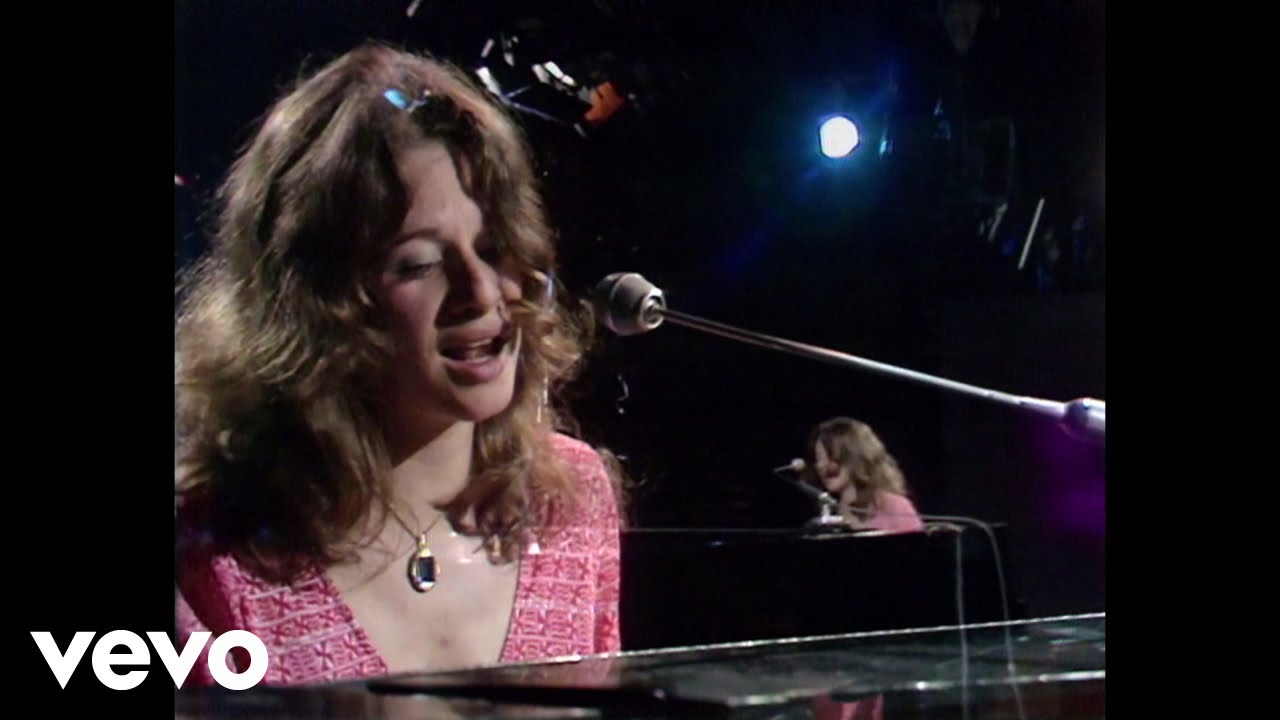
On February 10, 1971, Carole King’s Tapestry was released in the United States. On that same day, she walked into a BBC studio and performed it live for British television — just her, a small band, and a piano. The performance that would eventually be released as BBC In Concert, February 10, 1971 captured King at the precise instant the world was first hearing the album, before anyone fully understood what was about to happen. Her performance of “Will You Love Me Tomorrow” was the emotional centrepiece of the set — and unlike the lush, harmonically cushioned version on the record, this one arrived with almost nowhere to hide.
Tapestry went on to hold the Number One position on the Billboard 200 for fifteen weeks and spent nearly six years on the chart in total. It won four Grammy Awards including Album of the Year, sold well over 25 million copies worldwide, and remained the best-selling album by a solo female artist for more than twenty years until Whitney Houston’s The Bodyguard soundtrack overtook it. The BBC performance was produced by Stanley Dorfman for the BBC In Concert series and originally broadcast on October 2, 1971, by which point the album was already embedded in the cultural furniture of the decade. The footage was released to streaming and YouTube on February 10, 2021, exactly fifty years to the day after it was filmed.
Carole King wrote the melody for “Will You Love Me Tomorrow” in 1960, at the age of eighteen, while tending to her and Gerry Goffin’s young daughter. She recorded the tune on a cassette and left a message for Goffin to write lyrics around it. He came home from a bowling night, listened back, and wrote the words quickly — capturing, from a young woman’s perspective, the specific vulnerability of wondering whether a night of love was a lasting thing or a moment’s pleasure dressed up as something more. Don Kirschner, head of Aldon Music, heard the demo and immediately handed both writers a $10,000 advance — a staggering sum for two teenagers writing out of an office building across the street from the Brill Building. He knew what he was listening to.
The Shirelles nearly turned it down. Lead singer Shirley Owens heard the original demo and told the label it sounded too country for the group. She agreed to record it only after a string arrangement was added — and once those strings arrived, the song transformed into something that landed at Number One on the Billboard Hot 100 in early 1961, making it the first song by a Black girl group to top the chart. The Goffin-King partnership never looked back. John Lennon, watching from Liverpool in 1963, told journalists that his ambition for himself and Paul McCartney was to become “the Goffin and King of England.” King and Goffin were inducted into the Rock and Roll Hall of Fame in 1990.
By the time King recorded her own version for Tapestry, eleven years had passed, the marriage to Goffin had ended, and the question the lyric asks had taken on an entirely different weight. The Shirelles’ version is sung by a young woman on the edge of a decision. King’s version is sung by someone who already knows the answer. Joni Mitchell and James Taylor contributed background vocals on separate audio channels on the studio recording, but the emotional architecture of the track needed nothing external. The BBC performance strips it further still: just King at the piano, the Jo Mama rhythm section behind her — Charles Larkey on bass, Joel O’Brien on drums, Ralph Schuckett on a second piano — and no buffer between the song and the room.
The legacy of “Will You Love Me Tomorrow” sprawls in every direction. Roberta Flack took it to Number 76 on the Hot 100 in 1972. The Four Seasons reached Number 15 in 1968. Linda Ronstadt recorded it in 1970. Amy Winehouse sang it for the Bridget Jones: The Edge of Reason soundtrack in 2004, and the performance surfaced posthumously on Lioness: Hidden Treasures. The song is featured four times in the 2013 Broadway musical Beautiful: The Carole King Musical — more than any other in the show — because it keeps meaning different things depending on where in King’s life the narrative has arrived. That kind of depth does not happen by accident. It happens when a melody written at a kitchen table by a teenager turns out to contain more truth than even its author initially understood.
What makes the BBC performance enduring is not what King does differently — it is what she does less. No orchestration, no studio sheen, no Joni Mitchell floating in from the right channel. Just the song and the woman who wrote it, eleven years older, sitting at the piano in a BBC studio on the day her greatest album was born. Goffin once said of the lyric: “I put myself in the place of a girl.” King, singing it here, puts herself in the place of someone who no longer has to wonder. The performance is definitive not despite its simplicity, but because of it.
SONG INFORMATION
Related videos
 Watch LaterAdded
 Watch LaterAdded
03:07
Watch LaterAdded
03:07  Watch LaterAdded
04:23
Watch LaterAdded
04:23