







![Kelly Clarkson – Stronger (What Doesnt Kill You) [Official Video]](https://musicvideosclub.com/wp-content/uploads/2025/02/kelly-clarkson-stronger-what-doe-360x203.jpg)

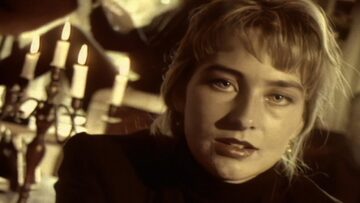
Mariah Carey – Without You
She Heard It in a Restaurant and Knew Immediately — Six Days After Harry Nilsson Died
Mariah Carey was deep in the recording sessions for Music Box when she heard it playing somewhere in the background of a restaurant and stopped. She had known the song since childhood — her mother had played Nilsson’s version around the house — but hearing it again in that unguarded moment, something clicked. She told interviewers she immediately understood it would be “a huge international hit.” What nobody could have predicted was the timing: when Columbia released her version of “Without You” in the United States on January 21, 1994, Harry Nilsson had been dead for exactly six days. The man whose recording she was remaking had suffered a fatal heart attack on January 15. RCA, recognising the moment, re-released Nilsson’s original on the very same day Carey’s UK version arrived in stores. Two versions of the same song, released simultaneously, one of them a tribute the world hadn’t planned for.
The single climbed to number three on the Billboard Hot 100, where it sat for six weeks — platinum certified by the RIAA, with 600,000 domestic copies sold and twenty-three weeks on the chart total. Those American numbers, respectable as they were, didn’t begin to tell the global story. In the United Kingdom, “Without You” debuted at number one — Carey’s first UK chart-topper after nine previous Top 40 hits — and stayed there for four weeks, finishing as the seventh best-selling single of the entire year. It topped the charts in Austria, Belgium, Germany, Iceland, Ireland, the Netherlands, Scotland, Sweden, and Switzerland, sitting atop the European Hot 100 Singles chart for two weeks. Simultaneously, Music Box held the UK Albums Chart’s number one position, giving Carey a chart double that underscored just how completely she dominated that early-1994 moment.
The song’s history before any of that is considerably darker, and considerably more remarkable. Pete Ham and Tom Evans wrote it for Badfinger’s 1970 album No Dice — Ham beginning with a melody he called “If It’s Love” that lacked a strong chorus, Evans completing the structure. Harry Nilsson heard the Badfinger recording while visiting a friend, immediately grasped what it was, and took it to number one on both sides of the Atlantic in 1972. Paul McCartney, who had signed Badfinger to Apple Records and watched the whole story unfold, eventually called it “the killer song of all time.” Ham hanged himself in 1975, crushed by financial and contractual pressures. Evans hanged himself in 1983, following a bitter dispute over the very royalties that “Without You” had generated — an argument with a bandmate about the song’s publishing that precipitated his final act. The two writers who created one of the most recorded ballads in pop history both died by their own hands in circumstances partly shaped by what that song had produced and what it had cost them.
Carey and producer Walter Afanasieff recorded “Without You” at Right Track Recording in New York City, with additional work at the Record Plant in Sausalito, California. Afanasieff’s arrangement leaned on orchestration — strings, keyboards, a gospel choir assembled from Carey’s own layered backing vocals — and gave the track the weight it required without burying the vocal underneath it. Rolling Stone’s Stephen Holden, reviewing the record, noted that Carey “dips into her lower register” and is carried by backing singers “magnified to sound like a mighty gospel chorus.” The Washington Post’s Mike Joyce put it more directly: “Unlike Nilsson, Carey has the pipes to pull off this anguished pop aria.” These were not small claims. They were accurate ones.
The official music video, directed by Scott Kalvert — who had recently helmed Marky Mark’s “Good Vibrations” and House of Pain’s “Jump Around” — was shot in black and white, placing Carey centre stage with minimal production design. The footage drew from her 1993 Here Is Mariah Carey TV special, taped at Proctor’s Theatre in Schenectady, New York, and the simplicity was entirely deliberate: nothing between the voice and the audience. No storyline, no locations, no actors. Just Carey at a microphone, in a black gown, delivering a performance that didn’t need anything around it to work. In an era when MTV was moving toward increasingly elaborate production — CGI, multiple locations, six-figure budgets — Kalvert and Carey made something that looked like it had been filmed in 1965 and felt completely current.
Music Box had already produced “Dreamlover” and “Hero” before “Without You” arrived as the third single — meaning Carey was asking radio programmers to follow two blockbusters with a cover version of a song that was itself a cover of a cover. The album went on to sell over 28 million copies worldwide, becoming the best-selling album of 1994 globally and still ranking among the ten best-selling studio albums of all time. Its success accelerated the commercial logic of the mid-Nineties power ballad, confirming that a voice of Carey’s range, applied to the right material at the right moment, could reach places that original compositions sometimes couldn’t.
There is a specific kind of longevity that belongs to songs built on genuine grief, and “Without You” has always carried that weight — through every version, every cover, every talent show performance that borrowed it for three minutes of emotional shorthand. What Mariah Carey understood, hearing it in that restaurant in 1993, was that the song’s power wasn’t historical. It was immediate. She was right about all of it. She was just also, without knowing it, recording a eulogy.
SONG INFORMATION
Related videos
 Watch LaterAdded
03:54
Watch LaterAdded
03:54  Watch LaterAdded
05:19
Watch LaterAdded
05:19  Watch LaterAdded