



![David Lee Roth – California Girls (Official Video) [HD]](https://musicvideosclub.com/wp-content/uploads/2026/10/david-lee-roth-california-girls-360x203.jpg)





Mr. Mister – Broken Wings
Before “Kyrie” Made Mr. Mister Look Like an ’80s Hit Machine, “Broken Wings” Turned a Quietly Tense Studio Ballad Into the Band’s First No. 1
“Broken Wings” – Single by Mr. Mister from the album Welcome to the Real World
Broken Wings became a No. 1 record by refusing to behave like the obvious hit of 1985. It did not charge out of the speakers, and it did not try to flatten radio with volume. Instead, Mr. Mister built the song around suspension: a pulsing low end, glassy keyboards, delayed guitar tones, and Richard Page singing as if the whole track were holding its breath. In a decade that often rewarded big gestures, Broken Wings found its power in restraint. That tension is why the song still feels less like a period piece than many of its mid-1980s contemporaries. It has the production fingerprints of its time, but its emotional machinery remains clear.
The song arrived as the lead single from Welcome to the Real World, the album that transformed Mr. Mister from a respected Los Angeles band into a major pop act. Richard Page, Steve George, Steve Farris, and Pat Mastelotto had the musicianship of session players and the instincts of a band trying to make complex material sound direct. Page and George had already worked together in Pages, and lyricist John Lang remained central to the writing. On Broken Wings, that history mattered. The song was written by Page, George, and Lang, and produced by Mr. Mister with Paul DeVilliers, giving it the feel of a carefully controlled studio construction rather than a simple band run-through.
A ballad built on pressure, not softness
What separates Broken Wings from many other slow-burning 1980s hits is how little comfort it offers at first. The introduction does not open into warmth; it circles. The bass pattern is shadowy, the keyboards feel distant, and the drum entrance gives the record more gravity than release. Page’s vocal carries the emotional load without overplaying it. He sounds wounded, but not theatrical. That makes the chorus feel earned when it arrives. The title image suggests damage and recovery, but the record is more complicated than simple reassurance. It is a plea, a negotiation, and a confession, all moving through a track that never quite relaxes.
The official 1985 video understood that atmosphere. Directed by Oley Sassone, it placed the band in a stark black-and-white visual world that matched the song’s polished melancholy. Rather than explain the lyric, the clip leaned into mood: desert motion, performance shots, dramatic close-ups, and a sense of distance that made Page’s vocal seem even more isolated. It was very much an MTV-era object, but it did not need a crowded storyline. The song already carried enough drama. The video simply gave that drama a face, a road, and a monochrome frame.
From studio precision to the stage
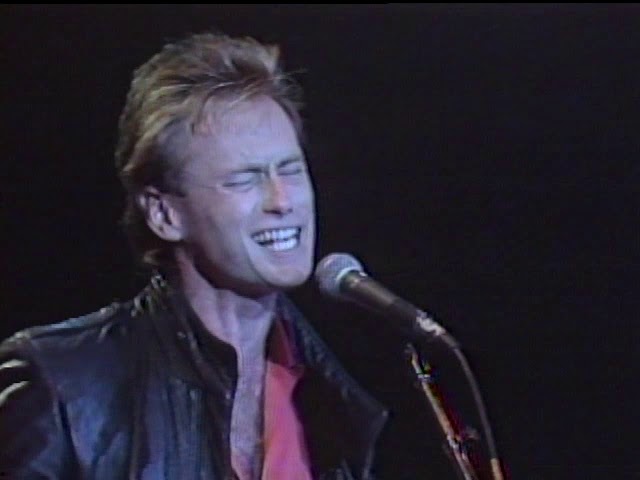
The live performance footage now associated with the page adds another useful angle because Broken Wings was never only a studio illusion. In concert, the song had to prove that its suspended atmosphere could survive without the perfect stillness of the record. That is where Mr. Mister’s musicianship becomes important. Steve George’s keyboards hold the architecture together, Steve Farris gives the guitar lines enough edge to keep the track from turning soft, Pat Mastelotto keeps the rhythm spacious but firm, and Page has to carry the vocal while anchoring the song from the bass. The live version does not replace the original single; it reveals how much performance discipline was underneath it.
Commercially, the song did exactly what a breakthrough single is supposed to do. Broken Wings reached No. 1 on the Billboard Hot 100 in December 1985 and climbed to No. 4 in the United Kingdom early in 1986. It also opened the door for Kyrie, giving Mr. Mister two consecutive U.S. No. 1 singles from Welcome to the Real World. But the reason Broken Wings still carries weight is not just the chart peak. It is the way the record captures a very specific kind of 1980s sophistication: expensive-sounding, emotionally serious, and built from musicians who knew how to make technical control feel like vulnerability. The song’s surface is smooth, but the feeling underneath is unsettled. That contradiction is the whole point.
SONG INFORMATION
Related videos
 Watch LaterAdded
03:30
Watch LaterAdded
03:30  Watch LaterAdded
06:49
Watch LaterAdded
06:49  Watch LaterAdded
04:05
Watch LaterAdded
04:05