


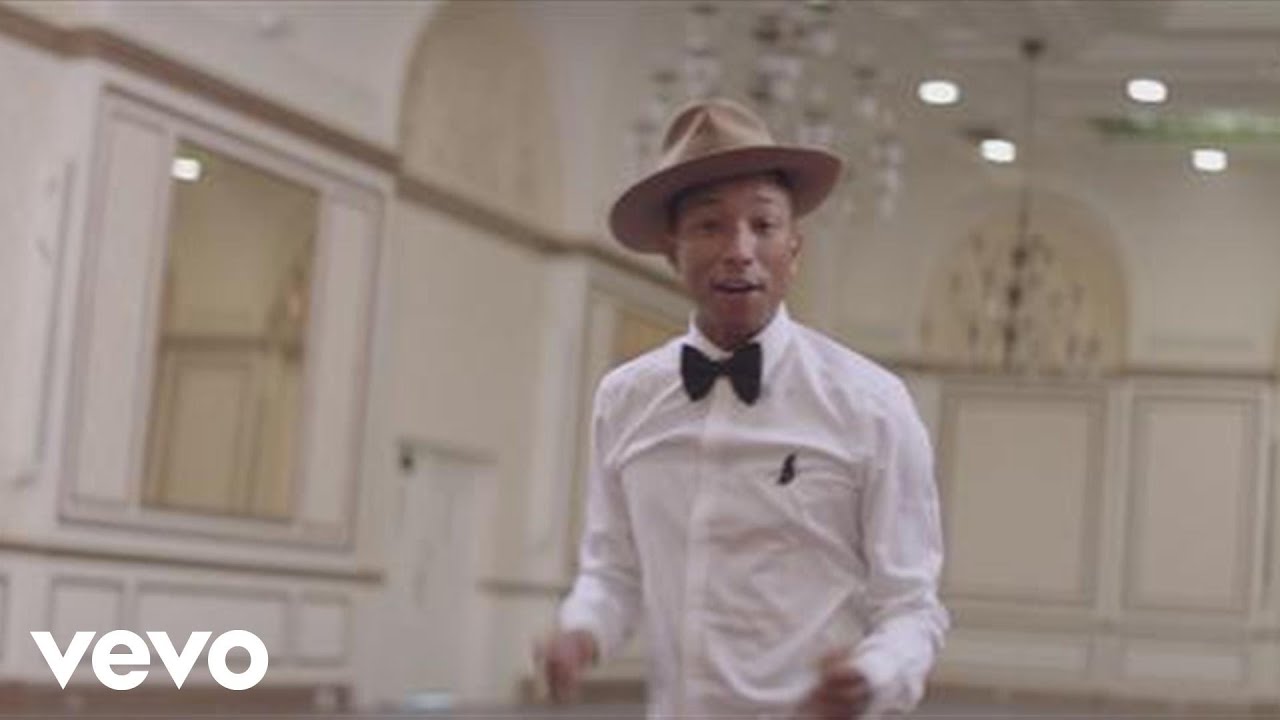

Pharrell Williams – Happy
The most inescapable feel-good song of the 2010s was written for another singer entirely — and Pharrell has said he likes that rejected version better than his own.
“Happy” almost wasn’t a Pharrell Williams song at all. He wrote it for Cee-Lo Green, who recorded his own version of it — and Williams has said he actually prefers Cee-Lo’s take to the one the world eventually heard. But Cee-Lo’s label decided the release would collide with the singer’s Christmas album and shelved it. So the song came back to Williams, who reportedly took something like ten attempts to get his own version right. The one everybody knows was, by his own account, not even his favorite.
Keep watching: explore more 2010s →
Williams built “Happy” for the soundtrack of the animated film Despicable Me 2, where it scores a scene in which the reformed villain Gru, newly in love, dances through the streets. He wrote and produced it, and played every instrument on the recording himself — the drums, the bass, the keys — singing lead and stacking his own falsetto on the backing vocals. Recorded in early 2013 at Circle House Studios in Miami, it’s a deliberately spare piece of soul revivalism, and its construction is almost aggressively simple. The word “happy” turns up in it dozens of times, well over half the song is given to the chorus, and there is no pre-chorus, no guitar solo, no bridge, and no outro to slow the momentum. It exists to lodge itself in your head and stay there.
It did not, at first. Released with the movie in the summer of 2013, the song barely registered on radio. What changed everything arrived that November.
Twenty-four hours of dancing
To relaunch the song, Williams and the French directing team We Are From LA made something nobody had made before: a full twenty-four-hour music video. Hosted at a site called 24hoursofhappy.com, it looped the four-minute track across an entire day, following more than three hundred people — ordinary Angelenos alongside cameos from Steve Carell, Jamie Foxx, Jimmy Kimmel, Magic Johnson, the members of Odd Future, and the Minions themselves — dancing through Los Angeles hour after hour. Visitors could drop into whatever hour matched the time they logged on, then share their favorite clips. Billed as the world’s first 24-hour music video, it went viral instantly, and the four-minute edit posted to YouTube did the rest. The song began a slow, relentless climb.
By early 2014 it was unavoidable. “Happy” reached No. 1 on the Billboard Hot 100 and held there for ten nonconsecutive weeks, topped the charts in more than nineteen countries, and finished as the best-selling song of 2014 in both the United States and the United Kingdom. The YouTube video eventually passed a billion views.
Everywhere, and honored almost everywhere
The awards mostly followed, with one famous exception. “Happy” was nominated for the Academy Award for Best Original Song, and Williams performed it at the 2014 ceremony — the night before his album Girl was released — but lost to “Let It Go” from Frozen. At the 2015 Grammys it took Best Pop Solo Performance and Best Music Video, part of a three-trophy night for Williams. The song long ago outgrew the cartoon it was written for; the United Nations adopted it as a centerpiece of its International Day of Happiness, and it remains a fixture at events that need a few minutes of uncomplicated joy. For a track its own creator handed off, got back, and rebuilt ten times over, that is a remarkable second life — proof that the simplest-sounding songs are often the hardest ones to actually make.