For a few seconds at Wembley in 1985, Freddie Mercury raised his hands and 72,000 strangers clapped back in perfect unison — a moment no one had rehearsed and no one has forgotten.
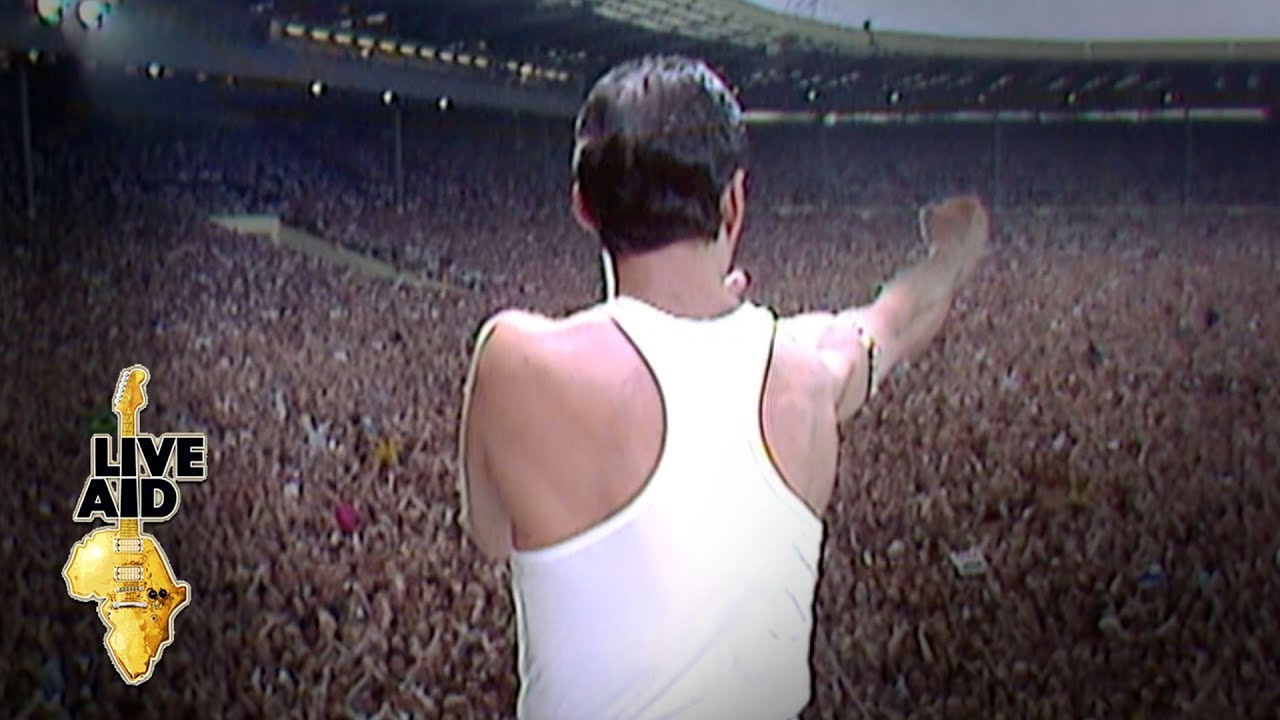
It happened in the space of a few bars. Halfway through Queen’s set at Live Aid on July 13, 1985, Freddie Mercury lifted both arms above his head and clapped, twice, over the beat of Radio Ga Ga — and 72,000 people at Wembley Stadium clapped straight back, in unison, as though they had all agreed on it beforehand. They hadn’t. Brian May later admitted he was baffled by it: this was a mixed festival crowd, not a Queen audience, most of them there for a dozen other acts, and yet every hand in the stadium went up on cue. “How did they know?” he wondered. “Nobody told them to do it.” That image — a sea of raised hands moving as one — became the single most replayed moment of the greatest rock performance ever staged.
The song they were clapping to had an unlikely origin. Roger Taylor, Queen’s drummer, wrote it after hearing his three-year-old son Felix react to a bad song on the radio in Los Angeles by muttering “radio ca ca.” Taylor locked himself in the studio with a Roland Jupiter 8 synthesizer and a drum machine and built the track almost entirely from electronics — a startling departure for a band built on Brian May’s guitars. John Deacon added the bass line; Mercury then reconstructed the song musically and lyrically, though he insisted it stay credited to Taylor alone, since he considered himself an arranger rather than a co-writer. Beneath the sleek synth-pop surface sat a genuinely wistful idea: a lament for radio itself, for the medium that had raised a generation, now being pushed aside by the rising dominance of television and the music video.
The song built for a stadium
Released as a single in January 1984, Radio Ga Ga reached number two in the United Kingdom, number sixteen on the Billboard Hot 100 in America, and number one in nineteen countries. It gave Taylor his first UK A-side, and it opened the album The Works. But its real life began on stage. From the moment of its release the band played it in every set, and its call-and-response structure — that two-clap gap Mercury could hand to a crowd — made it a natural centerpiece for the enormous stadium shows Queen were built to command. At Live Aid, with the whole world watching an estimated 1.9 billion people deep, the song found the biggest room it would ever have.
Queen almost weren’t there. Organizer Bob Geldof believed the band’s best days were behind them, and Mercury worried the appearance might read as a political statement. They were talked round, and they came prepared in a way few other acts were, rehearsing hard and stripping their set to nothing but peaks. The 21-minute run — a fragment of Bohemian Rhapsody, then Radio Ga Ga, Hammer to Fall, Crazy Little Thing Called Love, We Will Rock You, and We Are the Champions — was later voted the greatest live rock performance of all time, and in 2018 it was recreated shot for shot as the climax of the film Bohemian Rhapsody.
Behind the Iron Curtain
The performance you can also watch here comes from a different night entirely. A year after Live Aid, on July 27, 1986, Queen played the Népstadion in Budapest — one of the first concerts by a major Western rock band behind the Iron Curtain. Around 80,000 tickets sold, with thousands more listening outside the stadium walls, some having traveled from as far as Russia and Poland. The Hungarian government approved the entire operation, and the show was captured on 35mm film by seventeen of the country’s best cameramen, later released as the concert film Hungarian Rhapsody. It belonged to the Magic Tour, which would prove to be the last Queen ever undertook with Freddie Mercury, who died in November 1991. In Budapest, as at Wembley, the clap came back from the crowd — proof that the moment at Live Aid had never been a fluke, but something the song did wherever it was played.
Watch the video.
SONG INFORMATION
Artist: Queen
Song: “Radio Ga Ga”
Album:The Works
B-side: “I Go Crazy”
Released: January 23, 1984
Recorded: 1983, The Record Plant, Los Angeles
Label: EMI (UK); Capitol (US)
Songwriter(s): Roger Taylor
Producer(s): Queen, Reinhold Mack
Length: 5:48 (album version)
Chart Performance: No. 2 UK; No. 16 US Billboard Hot 100; No. 1 in 19 countries
Performance: Live Aid, Wembley Stadium, July 13, 1985; also Népstadion, Budapest, July 27, 1986