“Eleanor Rigby” is one of the most famous Beatles songs ever recorded — and not a single Beatle plays an instrument on it.
Ask which Beatle played what on “Eleanor Rigby,” and the answer is one of the great surprises in the band’s catalog: none of them. There is no guitar, no bass, no drums — Ringo Starr isn’t on the record at all. What carries the song instead is a string octet: four violins, two violas, and two cellos, playing a score written by the Beatles’ producer, George Martin. Paul McCartney sings the lead, with John Lennon and George Harrison adding harmonies on the chorus, and that is the entire Beatles presence on one of the most celebrated songs they ever released. It was, quite literally, the Beatles making a record without the Beatles’ instruments.
Released in August 1966, “Eleanor Rigby” arrived as a double A-side single paired with “Yellow Submarine,” and simultaneously as the second track on Revolver. Putting an album track out as a single broke the band’s own long-standing policy, a sign of how confident they were in it. The production was a deliberate provocation. McCartney asked Martin to write the strings with a hard, unsentimental edge, and Martin drew on the sharp, stabbing string writing of the film composer Bernard Herrmann, whose scores for Alfred Hitchcock gave movies like Psycho their nerves. The players were told to use little or no vibrato and were recorded close, so that every bow-scrape and attack lands with an almost unsettling immediacy. This wasn’t the Beatles decorated with pretty classical strings, as “Yesterday” had been the year before. Here the strings were the band.
Was Eleanor Rigby a real person?
The song’s origins are a tangle of coincidence that fans have argued over for decades. McCartney has said he took “Eleanor” from the actress Eleanor Bron, who had appeared in the 1965 film Help!, and “Rigby” from a shop sign — Rigby & Evens Ltd. — that he spotted in Bristol. The eerie part came later: there is a real gravestone bearing the name Eleanor Rigby in St. Peter’s churchyard in Woolton, Liverpool — the very churchyard where John Lennon and Paul McCartney first met at a village fete in 1957 — and a McKenzie grave stands nearby. McCartney has said the resemblance is coincidence, while conceding the names may have lodged in his memory without his knowing. An early draft, tellingly, named the priest “Father McCartney” before Paul changed it to McKenzie to avoid the personal echo. Whether memory or accident, the graveyard a few steps from where the Beatles began holds the names of the song’s two lonely strangers.
A pop song about no one at all
What made “Eleanor Rigby” genuinely radical wasn’t only the arrangement — it was the subject. In 1966, pop singles were about love, cars, and dancing. This was a stark character study about isolation and death: Eleanor Rigby, who keeps a face in a jar by the door and dies alone in a church, and Father McKenzie, who preaches sermons no one hears and buries her with no one there. The two never meet in life; their only connection is her funeral, and it changes nothing. “All the lonely people,” McCartney sings, “where do they all belong?” It was, as one critic put it, a shock to hear on the radio — a two-minute short story about the people pop music usually ignored. The song won McCartney a Grammy, and it has never lost its unsettling power. More than half a century later, it still sounds less like a pop record than a small, perfect piece of fiction set to strings.
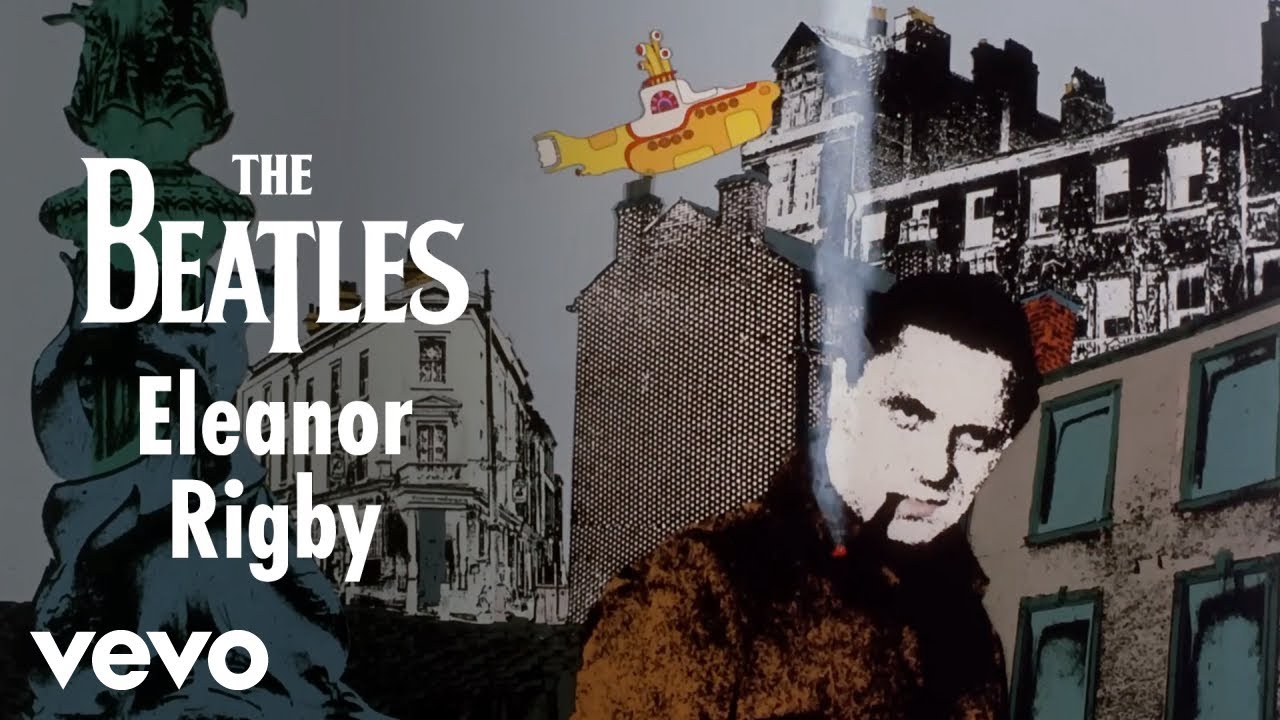
Watch the video — an official visual accompaniment to the Beatles’ “Eleanor Rigby.”
SONG INFORMATION
Artist: The Beatles
Song: “Eleanor Rigby”
Album:Revolver
Released: August 5, 1966 (double A-side with “Yellow Submarine”)
Recorded: April–June 1966
Studio: EMI Studios (Abbey Road), London
Label: Parlophone
Songwriter(s): Lennon–McCartney
Producer(s): George Martin
Length: 2:08
Arrangement: String octet (four violins, two violas, two cellos), scored by George Martin
Chart Performance: UK No. 1 (double A-side); US Billboard Hot 100 No. 11
Awards: Grammy Award, Best Contemporary Vocal Performance (1966); Rolling Stone 500 Greatest Songs
Vocals: Paul McCartney (lead); John Lennon and George Harrison (harmony)