





![Eric Clapton – I Shot The Sheriff [Crossroads 2010] (Official Live Video)](https://musicvideosclub.com/wp-content/uploads/2026/09/eric-clapton-i-shot-the-sheriff-360x203.jpg)
Suzi Quatro – Devil Gate Drive
A 23-year-old American bass player who had moved to England three years earlier on the personal invitation of a record producer named Mickie Most stood in a Birmingham TV studio in 1978 and played her biggest UK No. 1 — the song her parents back in Detroit could still not quite believe their daughter had written her name on.
The hardest thing to remember about Suzi Quatro in 1974 is how vanishingly rare she was. A 23-year-old American woman with a 1957 Fender Precision bass slung across a leather jumpsuit, fronting her own band, scoring number ones in Britain, Australia, Ireland, and Norway, getting onto the cover of every teen magazine in West Germany — none of that had a precedent. When Mickie Most, the record producer who founded RAK Records and had spent the 1960s building hits for Donovan, Herman’s Hermits, and the Animals, walked into a Detroit dressing room in 1971 to watch Quatro play with her sisters’ band the Pleasure Seekers, he saw all of it. He flew her to London within months. Two years later she was the second-bestselling solo female artist in the United Kingdom.
Devil Gate Drive was the song that locked it in. Written and produced by Nicky Chinn and Mike Chapman, the duo known across the industry as “ChinniChap,” it was the second consecutive UK number one for the writing team, following Mud’s Tiger Feet a few weeks earlier. Chinn and Chapman were running one of the most prolific hit-making operations in 1970s British pop — they would later write for Smokie, Racey, and (most consequentially) the Knack and Pat Benatar — and they understood Quatro’s appeal better than anyone else in the business. They built her songs around shouted choruses and big, simple, rhythm-section-driven arrangements that played to her instrument-first stage presence. Devil Gate Drive, released as a single on February 10, 1974, was perhaps the most exact statement of the formula they ever made.
The song itself describes a fictional teenage escape — the place every parent forbids and every kid therefore has to find. “It’s the place where you go when you’re a teenager,” Quatro explained later, “and your parents say, ‘Where are you going?’ ‘I’m going out.’ ‘Don’t you dare go to such-and-such.’ That’s Devil Gate Drive, and that’s where you go.” The arrangement is built around four shouted choruses, a piano figure pushed forward in the mix, and a guitar break held together by Quatro’s own bass line. It runs three minutes and thirty-eight seconds, and there is not one second of fat anywhere in it.
Two weeks at No. 1, and the song Suzi never quite topped
Recorded at Audio International Studios in London and released as the lead single from her second album Quatro, the song entered the UK Singles Chart in mid-February 1974 and reached number one within two weeks. It stayed there for two weeks of its own. It topped the chart in Australia, Ireland, and Norway; reached number two in West Germany; and put the parent album at number one across Australia, where Quatro had quickly become one of the biggest concert draws in the country. Her standing on the UK chart, though, was the most striking part of the run. Devil Gate Drive was her second UK number one in nine months, the second of her career — and the last she would have as a solo artist. She would not stand on a UK number one again for thirteen years and twenty-six days, when in 1987 the charity ensemble Ferry Aid took a cover of Let It Be to the top, with Quatro singing among them.
That long quiet at the top of the UK chart did not mean her career stalled. It did mean that the years after 1974 were quieter, slower, and increasingly anchored elsewhere — Quatro’s biggest US hit, the Chris Norman duet Stumblin’ In, would only arrive in 1979 (reaching number four on the Hot 100, the only American Top 40 placement of her career); her recurring role as Leather Tuscadero on Happy Days across three seasons of the sitcom (1977–1979) made her, finally, a household name in her own country. Devil Gate Drive was the song that had got her there, and the one that had also drawn the line.
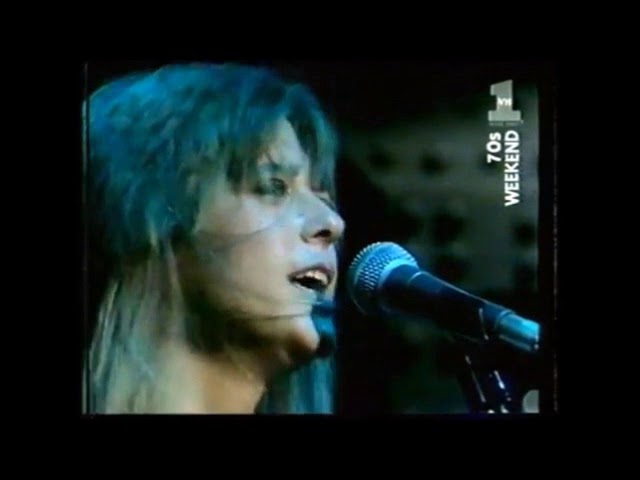
The performance featured here, captioned on its YouTube upload simply as “Live on Revolver. 70’s Weekend,” is from a British ITV music television series called Revolver — created and produced in 1978 by Mickie Most himself, hosted by Peter Cook playing the embittered manager of a fictional ballroom, and recorded in front of a live audience in Birmingham across eight episodes between May 20 and September 2, 1978. Most had built the show to platform his own RAK Records roster — Quatro, Smokie, Mud, Hot Chocolate — alongside the punk and new wave acts then crowding into the British pop conversation (Elvis Costello, Ian Dury, Dire Straits, Kate Bush). The Quatro performance is, in other words, of a piece with everything else about her story: Mickie Most discovering her, Mickie Most signing her, and Mickie Most building her her own television showcase four years after she had topped the UK chart with the song she still closes most of her concerts with. Watch the video.