




The Beatles – Sgt. Pepper’s Lonely Hearts Club Band
A roadie mumbled something nobody quite caught on a flight home from Kenya, and the Beatles built an entire imaginary band around it
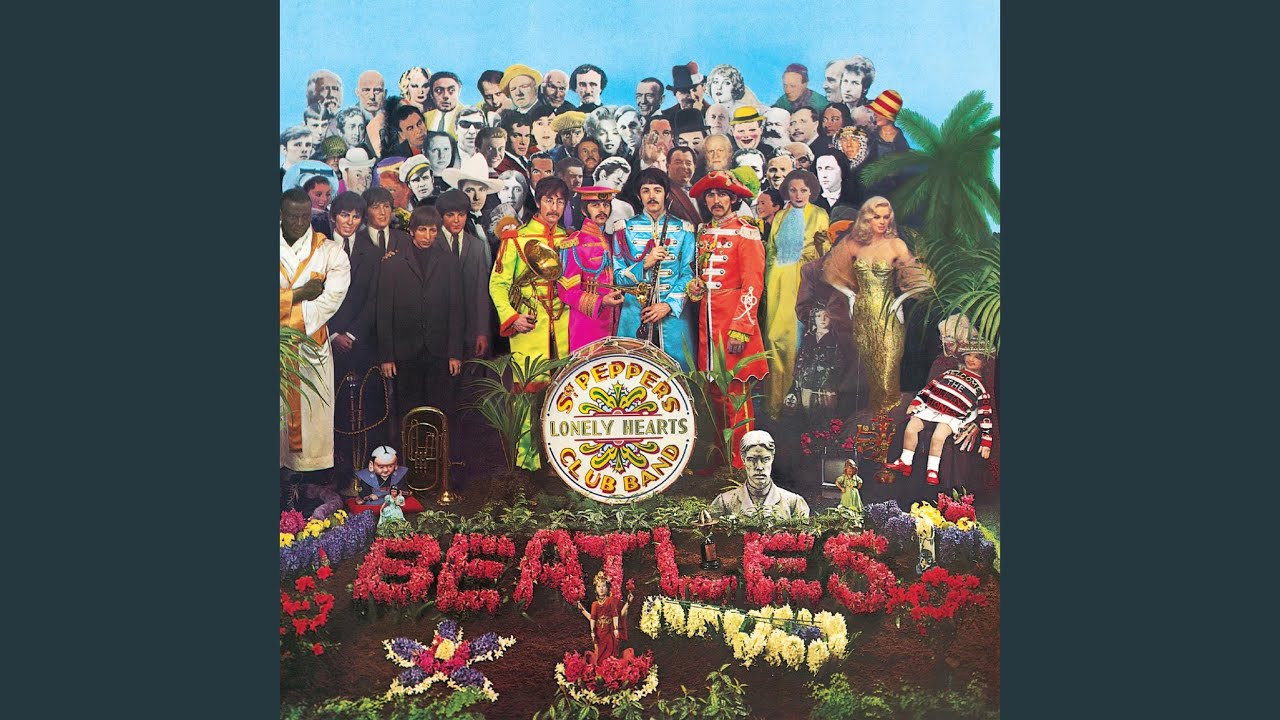
The idea arrived as a mishearing. Somewhere over Africa in November 1966, on the flight back to England from a holiday in Kenya, Mal Evans said something to Paul McCartney that McCartney did not entirely catch — a fragment about salt and pepper that his ear rearranged into a name. Sergeant Pepper. Not a person the Beatles knew, not a song title, just a sound with a uniform attached. Within minutes McCartney had the whole shape of it: an album performed not by the Beatles but by somebody else entirely, a fictional Edwardian band with a fictional bandleader, playing a fictional concert to an audience that would never exist. The band had stopped touring three months earlier and had no intention of standing on a stage again. So they invented one.
Keep watching: The Beatles — every article on the site · more from the 60s →
The song that carries the concept is under two minutes long and does almost nothing a rock record was supposed to do. It opens on noise. A crowd shuffles and murmurs, an orchestra saws through a tuning phrase, and then a guitar comes in hard enough to rearrange the room. McCartney sings a compère’s patter — welcome, we hope you enjoy the show, the band you’ve known for all these years — and hands the microphone to Billy Shears, which is how Ringo Starr’s vocal on the next track arrives without a gap. Two minutes to establish an entire fiction and then get out of the way. It is the most efficient piece of writing on the album.
Work began in Studio Two at EMI Studios on Abbey Road on February 1, 1967, with George Martin producing and Geoff Emerick engineering. The basic track and vocals took two days. Then the song sat for a month while the Beatles worked on everything else, and they returned to it on March 3 with four French horn players — James W. Buck, Neill Sanders, Tony Randall, and John Burden — and no score for them to read. Burden later described the session plainly: nobody knew what they wanted, so he wrote out phrases based on what McCartney was humming at him and Martin. All four Beatles were in the room. Only McCartney paid attention. Lennon, characteristically, had tape operator Richard Lush record the entire conversation between the horn players and McCartney, then took the tape home for reasons he never explained to anyone.
The audience that never existed
The crowd is the trick. Everything the listener hears at the front of the record — the murmur, the anticipation, the laughter and applause that punctuate the verses — was assembled from EMI’s sound-effects library and from tape Martin already had lying around. The orchestra tuning came from the February 10 session for A Day in the Life, where a full orchestra had genuinely been present and genuinely been tuning. The audience murmur came from Volume 28 of the EMI collection, recorded at the Royal Albert Hall and the Queen Elizabeth Hall. The applause and laughter came from Volume 6, taped by Martin himself at a 1961 performance of the comedy revue Beyond the Fringe at the Fortune Theatre in London.
So the audience cheering the Lonely Hearts Club Band is a theatre full of people in 1961 laughing at a satirical sketch show, spliced onto an orchestra warming up for a different song, in front of a band that had quit performing. Every element is real. None of it is what it appears to be. That is the whole record in miniature — a studio construction so complete that it convinced a generation it was hearing a concert.
Released on May 26, 1967, the album ran the song twice. The title track opens the record; the Reprise sits second from the end, faster and harder, closing the imaginary concert before A Day in the Life arrives to demolish the frame entirely. The bookend structure is what turned a collection of songs into something people called a concept album, though Martin was always careful to point out that the concept barely survives past track two. It did not need to. The idea of the thing was stronger than the execution of it, and the idea was what everyone took away.
What the name became
Eleven years later, on July 24, 1978, a film called Sgt. Pepper’s Lonely Hearts Club Band went into wide release across America, having opened in New York three days earlier. It was produced by Robert Stigwood, the Bee Gees’ manager, adapted loosely from a 1974 off-Broadway production directed by Tom O’Horgan, and built to make film stars of the Bee Gees and Peter Frampton on the back of Saturday Night Fever. Michael Schultz directed. George Martin served as musical director, which lends the whole thing an air of a man being asked to conduct the demolition of his own building. Critics destroyed it. The plot was incoherent, the acting was bad, and the handling of the songs struck most reviewers as something close to vandalism.
The soundtrack sold over a million copies anyway, and two of its recordings outlived the film that housed them: Earth, Wind & Fire’s Got to Get You Into My Life won a Grammy, and Aerosmith’s Come Together reached the American top twenty-five. The Beatles themselves kept their distance. The film has since acquired a small, affectionate cult, watched for its excess rather than despite it — a late-seventies artifact preserved in amber. The song it took its name from remains what it was in 1967: two minutes of invented applause, four horn players improvising off a hum, and a name a roadie never actually said.
SONG INFORMATION
Enjoyed this one? New forgotten gems every day — tap Music Videos Club below to visit and follow us on Facebook:
Related videos
 Watch LaterAdded
03:40
Watch LaterAdded
03:40  Watch LaterAdded
03:10
Watch LaterAdded
03:10  Watch LaterAdded
03:33
Watch LaterAdded
03:33