



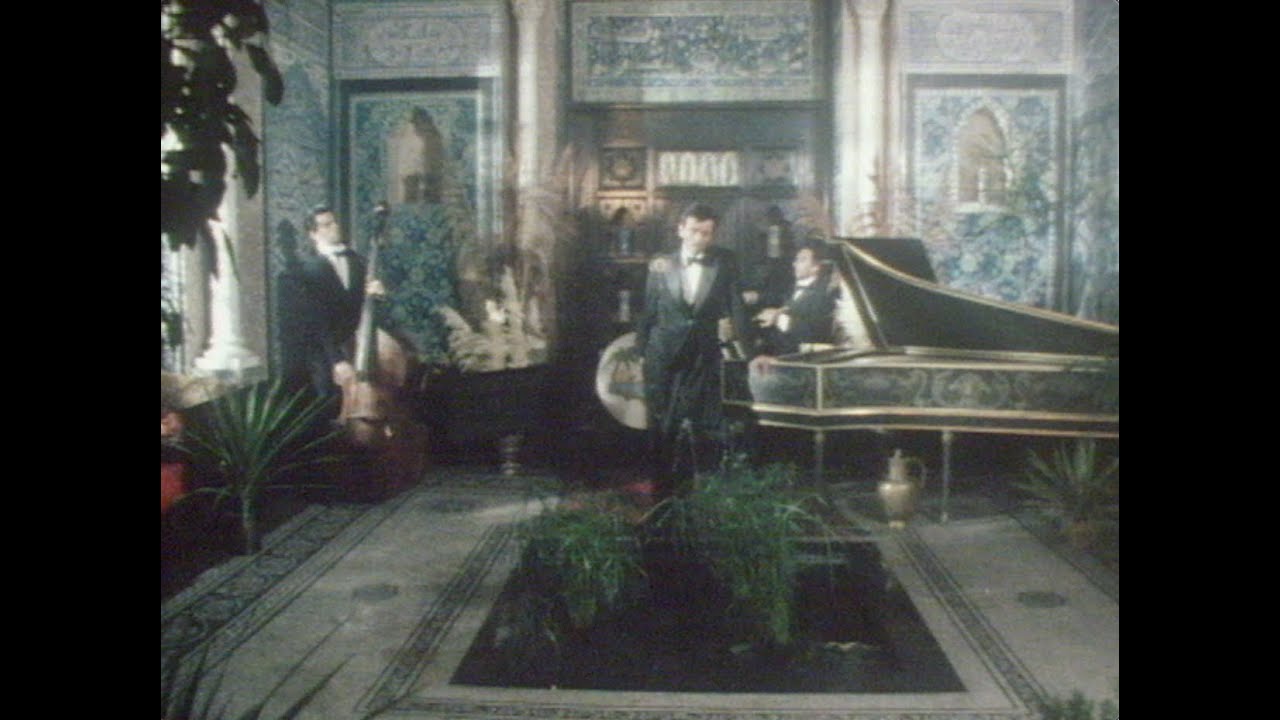




The Stranglers – Golden Brown
The Baroque Waltz Their Label Buried At Christmas
Released on 10 January 1982, The Stranglers’ “Golden Brown” emerged from the rubble of their commercial disappointment The Gospel According to the Meninblack, which flopped so badly that EMI paired them with legendary producer Tony Visconti for damage control. Dave Greenfield had been working on a song called “Second Coming” with drummer Jet Black when he created a harpsichord riff that didn’t fit. That unused fragment, featuring alternating bars of six-eight and seven-eight time creating a thirteen-beat phrase, became the foundation. The single peaked at number two on the UK Singles Chart in February 1982, held off the top only by The Jam’s “A Town Called Malice.” It became the band’s highest-charting single ever and EMI’s biggest-selling single for years, winning them the Ivor Novello Award for Best Song Musically and Lyrically.
The chart battle tells its own story. Both The Jam’s studio seven-inch and live twelve-inch versions counted toward their total sales, giving them the edge. Hugh Cornwell blamed bassist Jean-Jacques Burnel for telling the press the song was about heroin before it reached number one, causing radio stations to remove it from playlists. Cornwell later fumed he would have waited until after it topped the chart to reveal the truth. The song became a worldwide top ten hit, charting strongly in Australia and across Europe. In a 2012 BBC Radio 2 listener poll of favorite singles that peaked at number two, “Golden Brown” ranked fifth behind “Vienna,” “Fairytale of New York,” “Sit Down,” and “American Pie.” NME placed it at number 488 on their 500 Greatest Songs of All Time list in January 2014.
Cornwell’s lyrics worked on two levels, as he admitted in his 2001 book. The song addressed both heroin and a Mediterranean girlfriend with sun-kissed skin. The band had begun using heroin during the previous album’s recording, hoping to boost creativity. Black and Greenfield stopped after just days, but Cornwell and Burnel continued for roughly a year. Cornwell was briefly jailed on drug charges during this period. The double meaning allowed listeners to hear whatever they wanted, an aural Rorschach test as the band described it. Cornwell wrote the words after Greenfield played him the baroque-influenced riff during informal jamming sessions in 1981. What started as a ten-minute jam got condensed to fit the three-minute-twenty-two-second single format. The waltz rhythm in B-flat minor felt completely alien to everything The Stranglers had recorded before.
Recording took place during 1981 for the La Folie album sessions at unknown studios. Visconti mixed each song as if it could be a single, following EMI’s brief to salvage the band’s commercial fortunes. Greenfield performed the distinctive harpsichord-style riff on synthesizer, using his Hohner Cembalet, Hammond L-100 organ, and Minimoog. Burnel reportedly didn’t even play on the recording. Cornwell claimed in his songbook that Burnel couldn’t get his head around the unusual time signature and left them to work on it, with Greenfield playing the root notes on keyboard instead. The thirteen-beat structure made the song mathematically fascinating but practically impossible to dance to, as BBC newsreader Bill Turnbull discovered during his disastrous attempt on Strictly Come Dancing in 2005. When interviewing Burnel on BBC Breakfast in 2012, Turnbull admitted the alternating time signatures made it a nightmare.
“Golden Brown” became the second single from La Folie, released in November 1981. The album’s French title translated to madness, exploring different aspects of love across its tracks. The title song told the story of Issei Sagawa. Upon release, La Folie appeared destined to become the band’s lowest-charting album, but “Golden Brown” changed everything. The single’s success lifted the album to number eleven, spending eighteen weeks on the UK Albums Chart. The song also appeared on US pressings of their 1983 album Feline. For a band who’d built their reputation on aggressive punk singles like “No More Heroes,” “Peaches,” and “Something Better Change,” this gentle waltz marked a radical departure.
The covers tell the legacy story. British hip hop group Kaleef took their reworking to number twenty-two in 1996. Soul singer Omar reached number thirty-seven with his version in 1997. Jamelia heavily sampled it for “No More” in 2007. Cornwell recorded a mariachi version in 2012 backed by Mexican-British band Mariachi Mexteca. Actor Alexander Armstrong included it on his 2016 album Upon a Different Shore. In 2020, British YouTuber Laurence Mason’s saxophone cover in the style of Dave Brubeck’s “Take Five” went viral with over a million views, earning a commercial release as the Take Vibe EP that spent two weeks in the Official Vinyl Singles Chart top forty. The song appeared in Guy Ritchie’s film Snatch and featured prominently in Black Mirror and The Umbrella Academy. In 1995, Black, Burnel, and Greenfield performed a parody version about future Prime Minister Gordon Brown on Rory Bremner’s satirical Christmas special.
EMI spectacularly misjudged the song’s potential. After hearing it, executives told the band they were finished. Burnel recalled having to invoke a contractual clause to force its release. The label dumped it into the Christmas season hoping it would drown in what Burnel called the tsunami of Christmas rubbish. Instead, it developed legs of its own. Most surprisingly, conservative BBC Radio 2 DJ David Hamilton made it his Record of the Week, remarkable for a band once as notorious as the Sex Pistols. The Stranglers had never been conventional punks anyway. Formed in 1974, they’d cut their teeth on London’s pub circuit years before punk exploded. At ages ranging from late twenties to nearly forty when punk arrived in 1976, they exploited the movement as an opportunity rather than an ideology. As Cornwell later admitted, they weren’t really punks but provocateurs who saw a door opening. “Golden Brown” proved they’d been something more interesting all along.
SONG INFORMATION
Related videos
 Watch LaterAdded
03:52
Watch LaterAdded
03:52  Watch LaterAdded
 Watch LaterAdded
04:32
Watch LaterAdded
04:32