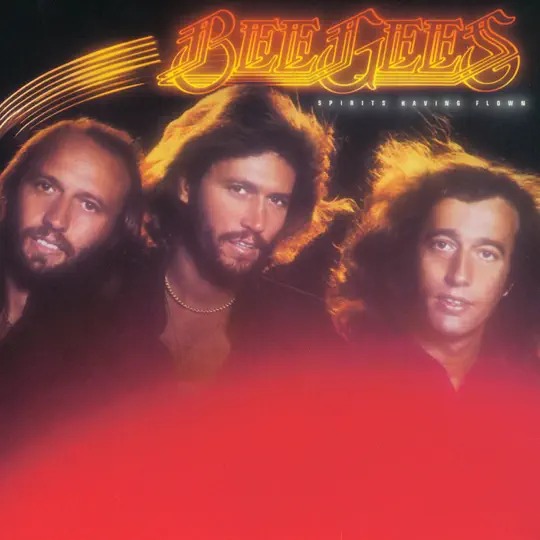
By early 1979, the Bee Gees weren’t just a band — they were a force of nature. “Tragedy”, released in February 1979, became their fifth consecutive number one on the Billboard Hot 100, knocking Gloria Gaynor’s “I Will Survive” off the top spot in the US. It hit number one in the UK, Canada, Italy, and New Zealand, and landed as the opening track on their fifteenth studio album, Spirits Having Flown. Three singles from that album reached number one in America. Nobody else was doing that.
The song was written on an afternoon off from one of the most catastrophic film sets of the era. Barry, Robin, and Maurice had taken a break from shooting the ill-fated Sgt. Pepper’s Lonely Hearts Club Band movie — a project that critics would savage — and in a single sitting wrote both “Tragedy” and “Too Much Heaven.” That same evening, they wrote “Shadow Dancing” for younger brother Andy, which also went to number one in the US. All three in one day. Just another afternoon for the Gibbs at their commercial peak.
The recording happened at Criteria Studios in Miami, with co-producers Albhy Galuten and Karl Richardson. Barry’s falsetto on “Tragedy” was pushed further than almost anything he’d recorded before — an open-wound wail that sounded less like disco and more like synth-metal arriving five years early. The horn section that punches through the mix was provided by Chicago, returning a favour after the Bee Gees had contributed to Chicago’s 1978 album Hot Streets.
Then there’s the explosion. Toward the climax of the track, a massive detonation-like boom shakes the speakers — and for years listeners argued about whether it was a synthesizer. It wasn’t. Barry cupped his hands around the microphone and made the sound with his mouth. Engineer Karl Richardson took multiple takes of that noise, ran them through a product generator alongside keyboardist Blue Weaver’s random bottom-end piano notes, and blended them into the thunderclap heard on the final record. The whole method was revealed when NBC filmed the studio sessions for a 90-minute special that aired in November 1979.
Spirits Having Flown reached number one in ten countries, but “Tragedy” arrived at a pivotal moment. Six months after its release, Disco Demolition Night at Comiskey Park in Chicago saw a crate of disco records literally blown up between games of a doubleheard. The Bee Gees, as disco’s most visible ambassadors, took the full force of the cultural backlash that followed — facing a near-total US radio blackout almost overnight.
The song has outlasted all of it. Steps took their cover to number one in the UK in January 1999, selling over a million copies and making it the best-selling Bee Gees cover in British chart history. The Foo Fighters — recording as the Dee Gees — covered it for their 2021 album Hail Satin. In 2024, it featured prominently in Beetlejuice Beetlejuice, introducing it to yet another generation.
Barry Gibb once said, “There’s fame and there’s ultra-fame and it can destroy.” “Tragedy” sits right at the centre of that ultra-fame — the sound of a band at the absolute top of the world, unknowingly writing one of their final chart-toppers before the storm arrived. It remains one of the most thrilling three minutes and fifty seconds in pop history.
SONG INFORMATION
Artist: Bee Gees
Song: “Tragedy”
Album:Spirits Having Flown
B-side: “Until”
Released: February 1979
Recorded: 1978
Studio: Criteria Studios, Miami, Florida
Label: RSO Records
Songwriters: Barry Gibb, Robin Gibb, Maurice Gibb
Producers: Barry Gibb, Robin Gibb, Maurice Gibb, Karl Richardson, Albhy Galuten
Chart Performance: No.1 UK (2 weeks), No.1 US (2 weeks), No.1 Canada, No.1 Italy, No.1 New Zealand




![Led Zeppelin – Rock And Roll (Live at Knebworth 1979) [Official Video]](https://musicvideosclub.com/wp-content/uploads/2025/07/led-zeppelin-rock-and-roll-live-360x203.jpg)