



Bob Dylan – Mr. Tambourine Man (Live at the Newport Folk Festival 1964)
The figure Bob Dylan was singing to was not a drug dealer and not a muse — it was a session guitarist who owned a Turkish frame drum so large that Dylan said it looked like a wagon wheel.
For sixty years, listeners have been certain they know what “Mr. Tambourine Man” is about. The song arrived in the middle of the 1960s, draped in imagery of magic swirling ships and jingle-jangle mornings and senses being stripped, and a generation decided it was a drug song — that the Tambourine Man was a dealer and the trip was chemical. Bob Dylan has spent decades saying otherwise, plainly and without much patience for the question. “Drugs never played a part in that song,” he wrote in the liner notes to his Biograph compilation. The real origin, by Dylan’s own account, was a person and an object. “Mr. Tambourine Man, I think, was inspired by Bruce Langhorne,” he explained. Langhorne was a session guitarist who played on a number of Dylan’s early recordings. “On one session, Tom Wilson had asked him to play tambourine. And he had this gigantic tambourine. It was, like, really big. It was as big as a wagon wheel. He was playing, and this vision of him playing this tambourine just stuck in my head.” The most mythologized song of the folk era was, at its root, a literal image: a man with an enormous Turkish frame drum, caught in Dylan’s memory.
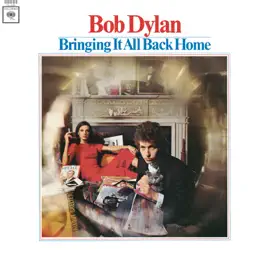
Dylan wrote the song across the early months of 1964, beginning in February and finishing it by April. He performed it in public for the first time at London’s Royal Festival Hall on May 17, 1964, and he tried to record it that June, during the sessions for Another Side of Bob Dylan. That early recording — a version on which the folk singer Ramblin’ Jack Elliott attempted a harmony vocal he had not had time to learn — was not deemed good enough, and it was left off the album. The song sat unrecorded in releasable form for the better part of a year. Dylan finally cut the definitive version on January 15, 1965, at Columbia’s Studio A in New York City, with producer Tom Wilson. After trying it with a drummer playing a heavy tambourine rhythm, Dylan and Wilson stripped the arrangement down: just Dylan’s voice, acoustic guitar, and harmonica, with Bruce Langhorne — the man who had inspired the song — adding the spare electric guitar countermelody that threads through the recording. It became the opening track of the acoustic side of Bringing It All Back Home, released on March 22, 1965.
The cover that arrived before the original
One of the strangest facts about “Mr. Tambourine Man” is that the version most of the world heard first was not Dylan’s. In August 1964, a Los Angeles folk-rock group then calling themselves the Jet Set — Jim McGuinn, Gene Clark, and David Crosby, soon to become the Byrds — obtained an acetate of Dylan’s unreleased demo through their manager, Jim Dickson. McGuinn, who would shortly rename himself Roger, heard something in the song that the demo did not yet contain. He overhauled it: he shifted the time signature from the 2/4 of Dylan’s demo to a standard 4/4, set it to a jangling twelve-string electric guitar and a rock rhythm section, and built the arrangement that would define an entire genre. The Byrds recorded their “Mr. Tambourine Man” on January 20, 1965 — five days after Dylan recorded his own definitive version, and before Dylan’s recording had been released. Their single came out on April 12, 1965, three weeks after Bringing It All Back Home. It went to No. 1 on the Billboard Hot 100 and to No. 1 on the UK Singles Chart, and it is generally credited as the record that launched folk rock — the fusion of folk-based lyrics with electric rock instrumentation that reshaped popular music for the rest of the decade. Dylan, remarkably, never had a No. 1 single in America under his own name; the song that came closest to giving him one did so in someone else’s hands.
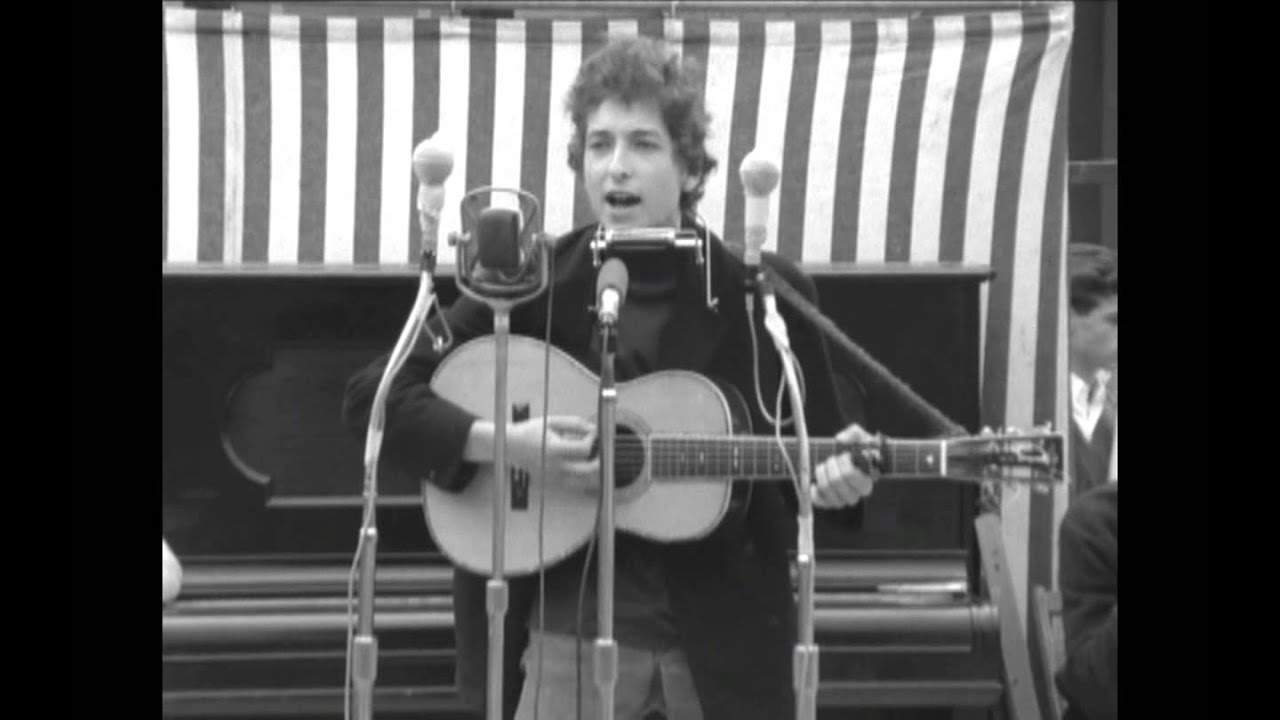
What the listener sees on this page predates all of it. Bob Dylan performed “Mr. Tambourine Man” at the Newport Folk Festival in 1964 — a full year before he recorded the studio version, and a full year before his far more famous return to the same festival in 1965, when he plugged in an electric band and was met with a hostile crowd. The 1964 performance belongs to an earlier, quieter chapter. Dylan had made his Newport debut in 1963 alongside Joan Baez; by 1964 he had become one of the festival’s biggest draws, and he took the stage for a solo acoustic set in his characteristic style — guitar, harmonica, raw voice, nothing else. He used part of that set to introduce songs that had not yet been recorded, including “Mr. Tambourine Man” and “Chimes of Freedom.” It was not an obvious choice. The Newport audience prized topical folk music, songs about the issues of the day, and “Mr. Tambourine Man” — a swirling, interior, image-driven piece with nothing political in it — pointed away from everything the festival’s core audience expected of him. Dylan was already, in 1964, moving somewhere his audience had not agreed to follow.
The song that opened the door
That movement is, in retrospect, what makes the 1964 performance worth preserving. “Mr. Tambourine Man” was the hinge. Dylan’s earlier work had made him the reluctant figurehead of the protest-song movement; songs like “Blowin’ in the Wind” and “The Times They Are a-Changin'” had become the soundtrack of the civil rights and anti-war movements. “Mr. Tambourine Man” was the public signal that he intended to write his way out of that role — toward interior, poetic, surreal songwriting that answered to no movement and no expectation. Within a year of the song’s release, the floodgates were open: in 1965 alone, more than a dozen other artists recorded “Mr. Tambourine Man,” among them Judy Collins, Odetta, Melanie, the Four Seasons, and a young Joni Mitchell.
The song has stayed central to Dylan’s catalog and to his concert life across six decades. He has recorded it live many times and returned to it on tour for the rest of his career. Bob Dylan was inducted into the Rock and Roll Hall of Fame in 1988, received the Presidential Medal of Freedom in 2012, and in 2016 was awarded the Nobel Prize in Literature — the first songwriter to receive it — for having “created new poetic expressions within the great American song tradition.” The 2024 film A Complete Unknown, with Timothée Chalamet as Dylan, brought the story of his early-1960s rise, and the Newport performances that bracketed it, to a new audience. The footage below catches him before almost any of that — a young songwriter at a folk festival in 1964, singing a song about a man with a giant tambourine, a year before the rest of the world would catch up to it.
SONG INFORMATION
Related videos
 Watch LaterAdded
03:04
Watch LaterAdded
03:04  Watch LaterAdded
04:06
Watch LaterAdded
04:06  Watch LaterAdded
03:03
Watch LaterAdded
03:03