A civil-servant strike nearly cancelled their Reykjavík show — the makeshift concert the students threw together instead gave rock one of its greatest war cries.
In June 1970, Led Zeppelin flew to Reykjavík as guests of the Icelandic government, and the day before the show every civil servant in the country walked off the job. The concert was set to be cancelled. Instead, students at the university cleared out a hall and built the band a venue overnight, and the response from the crowd was so electric that Robert Plant walked away thinking about Vikings, longships, and the land of ice and snow. Six days later, at the Bath Festival, Led Zeppelin opened their set with a brand-new song nobody had heard. It was Immigrant Song, and its opening war cry would announce the band for the next three years.
The song came out of an unlikely album. Most of Led Zeppelin III was written at Bron-Yr-Aur, a remote 18th-century cottage in the Welsh hills with no electricity or running water, where Page and Plant retreated after a punishing American tour and turned toward acoustic, folk-tinged material that startled fans expecting another Whole Lotta Love. Immigrant Song was the ferocious exception — two and a half minutes of pure aggression built on a staccato riff in F# minor from Page, John Paul Jones, and John Bonham, launched by Plant’s wordless banshee howl and a wash of echo-unit feedback. Plant’s lyric turned the Iceland trip into Norse myth: Vikings rowing west out of Scandinavia, the old gods, the promise that “the hammer of the gods will drive our ships to new lands.” That last image stuck so hard it became shorthand for the band’s whole sound, and later the title of the most famous Led Zeppelin biography ever written.
The single they didn’t want
Led Zeppelin hated singles. They built albums as complete experiences and resisted carving them into 45s, so Immigrant Song‘s release as a US-only single on November 5, 1970, happened over the band’s objections. It reached No. 16 on the Billboard Hot 100 anyway — one of the few genuine hit singles in a catalog that otherwise conquered radio through album cuts. The B-side was a gift to collectors: Hey, Hey, What Can I Do, a loose acoustic number recorded in the same sessions and left off the album, which stayed officially unavailable anywhere else until the band’s box set in 1990. Two details made the first pressings legend. The Japanese single accidentally shipped with the wrong B-side and is now a rare collectible. And etched into the run-out groove of the earliest US copies was a line from occultist Aleister Crowley, one of Page’s abiding fascinations: “Do what thou wilt shall be the whole of the Law.”
The war cry that opened the show
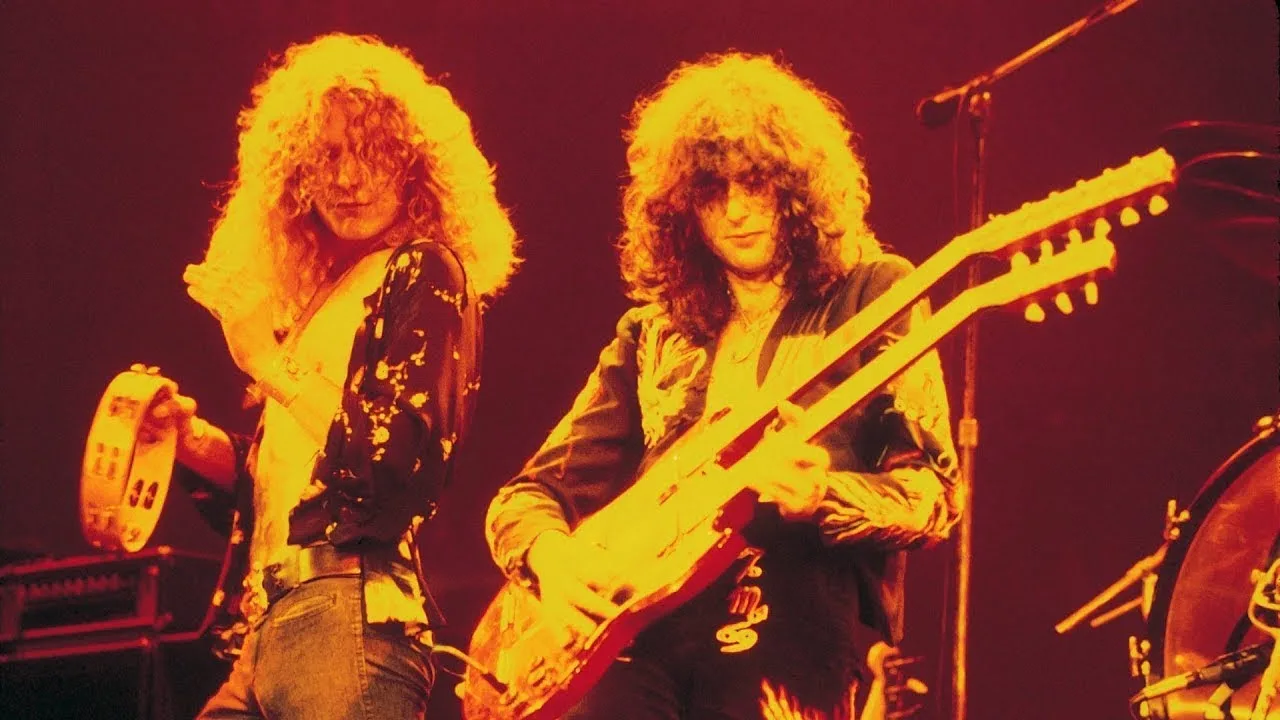
On stage the song became a ritual. From 1970 through 1972 it was the concert opener, the sound that told an arena the band had arrived, and on the 1972 American tour Page and company preceded it with a swelling wall of feedback known as the “LA Drone” to stretch the anticipation before Plant’s scream cut through. Live, Page extended it with a long guitar solo the studio version never had, and the definitive concert recordings survive on How the West Was Won, drawn from the band’s 1972 Los Angeles-area shows. By 1973 they had retired it, and it was never a regular part of the set again — which only sharpened its aura. The song has since opened School of Rock, been reborn as a Trent Reznor and Karen O howl over the credits of The Girl with the Dragon Tattoo, and inspired an entire lineage of Viking-obsessed metal bands from Iron Maiden to Amon Amarth. The performance on this page, from the band’s official archive, catches it in its natural habitat: 1972, the concert opener, Plant’s cry going up and the hammer coming down.
SONG INFORMATION
Artist: Led Zeppelin
Song: “Immigrant Song”
Album:Led Zeppelin III
B-side: “Hey, Hey, What Can I Do”
Released: November 5, 1970 (US single)
Recorded: May–August 1970
Label: Atlantic
Songwriter(s): Jimmy Page, Robert Plant
Producer(s): Jimmy Page
Length: 2:26
Key: F# minor
Chart Performance: No. 16 Billboard Hot 100 (1970)
Performance: Live, 1972
Lineup: Robert Plant (vocals), Jimmy Page (guitar), John Paul Jones (bass), John Bonham (drums)



![Eric Clapton – I Shot The Sheriff [Crossroads 2010] (Official Live Video)](https://musicvideosclub.com/wp-content/uploads/2026/09/eric-clapton-i-shot-the-sheriff-360x203.jpg)