Bonnie Tyler – Total Eclipse of the Heart (Turn Around)
- LUD:
It was originally written to be a vampire love song called “Vampires in Love” for a Nosferatu musical — and it became the biggest hit a Welsh singer has ever had, the only one to top the American chart.
The most famous power ballad of the 1980s began as a song about vampires. Jim Steinman, who wrote and produced Total Eclipse of the Heart, later explained that he had originally conceived it for a musical adaptation of Nosferatu — its working title was “Vampires in Love.” Listen again with that in mind and the lyric snaps into focus: the lines about living in the dark, about “turn around, bright eyes,” about being utterly consumed by another, were written as the longing of a creature of the night. What reached the top of the charts was, by its author’s own account, a vampire’s love song in disguise.
For Bonnie Tyler, it was the song that changed everything. A country-leaning singer from the Welsh town of Skewen, born Gaynor Hopkins, she had scored an earlier hit with “It’s a Heartache” but grown frustrated being steered toward country material. After seeing Meat Loaf perform “Bat Out of Hell,” she sought out the man behind it — Steinman — and asked to work with him. He initially passed, then met her in his New York apartment in 1982 and agreed. The result was Faster Than the Speed of Night, and its centerpiece was a ballad Steinman built as a showcase for Tyler’s extraordinary, sandpaper-and-velvet voice.
A love song that began as a vampire ballad
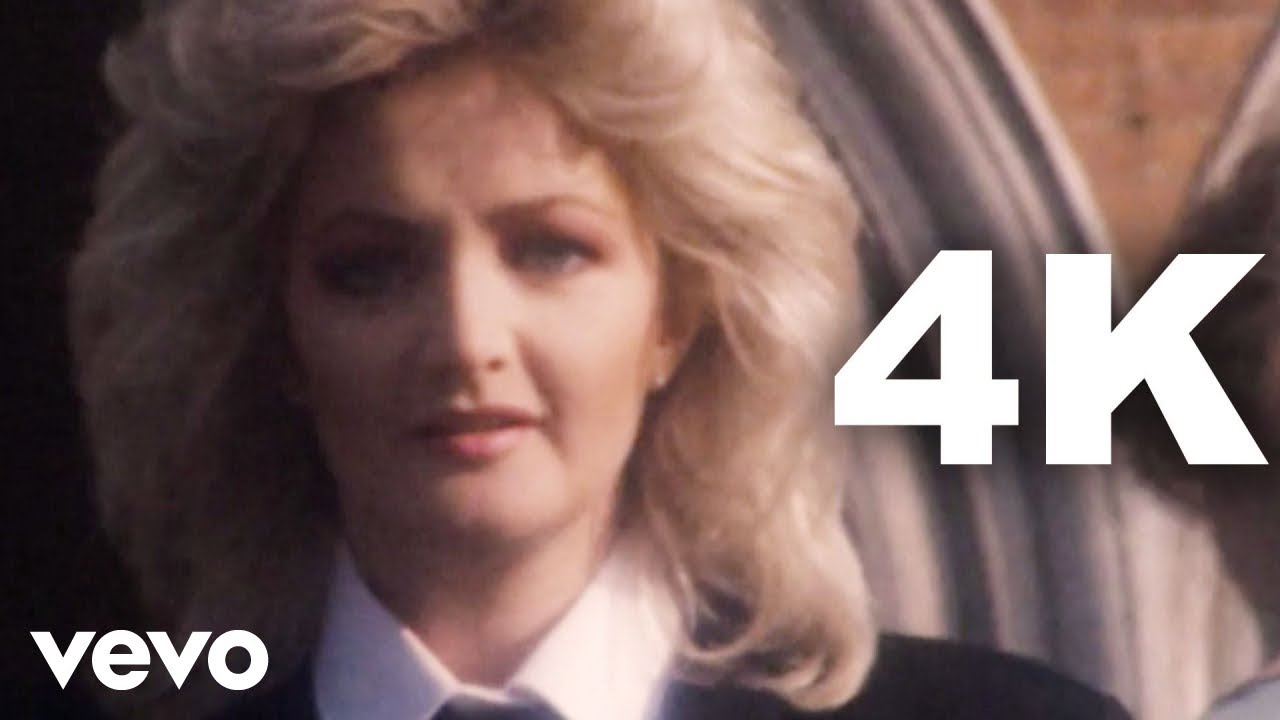
Recorded in 1982 at the Power Station in New York, the track was a Steinman production in full bloom: swooping piano, a slow build to an enormous chorus, and an all-star band that included E Street Band members Roy Bittan on piano and Max Weinberg on drums, guitarist Rick Derringer, and singer Rory Dodd delivering the famous “turn around” refrain. Steinman later said he wrote it “as a showpiece for her voice” and never imagined it would be a single. The full album version ran nearly seven minutes; it was trimmed for radio. The gothic video, directed by Russell Mulcahy — fresh from Duran Duran’s “Hungry Like the Wolf” — was filmed at the Holloway Sanatorium, a vast Victorian former asylum in Surrey, and cast Tyler amid choirboys, doves, and a fever-dream boarding school.
The performance below, from a 1983 appearance, captures Tyler delivering the song live in the year of its release, that remarkable voice front and center without the studio’s layers of production.
Number one twice over, and a billion streams later
The song conquered both sides of the Atlantic. It topped the UK chart in early 1983 and, after its American release, reached No. 1 on the Billboard Hot 100 on October 1, 1983, holding the top spot for four weeks. It made Tyler the only Welsh artist ever to score a U.S. No. 1, and it gave Steinman a remarkable moment: that autumn he held both the No. 1 and No. 2 positions on the American chart at once, with Air Supply’s “Making Love Out of Nothing at All” — another of his compositions — sitting just below. Worldwide sales eventually passed six million copies.
More than four decades on, the song refuses to fade. It has been a karaoke staple, a movie and television fixture, and the subject of a famous comedy “literal video” parody — and in January 2026 it crossed one billion plays on Spotify, a milestone Tyler called a thrill when the streaming service sent her an award disc. A vampire love song that its writer never expected to release as a single became the defining record of Bonnie Tyler’s career and one of the most enduring ballads of its era — proof that the strangest origins sometimes produce the most universal songs.
SONG INFORMATION
Artist: Bonnie Tyler
Song: “Total Eclipse of the Heart”
Album:Faster Than the Speed of Night
B-side: “Take Me Back” (UK); “Straight from the Heart” (US)
Released: February 11, 1983
Recorded: 1982
Studio: Power Station, New York City
Label: Columbia; CBS
Songwriter: Jim Steinman
Producer: Jim Steinman
Length: 6:58 (album); 4:30 (single edit)
Genre: Pop Rock, Power Ballad
Chart Performance: No. 1 Billboard Hot 100 (4 weeks); No. 1 UK; No. 1 Australia & Canada