





Mariah Carey – Always Be My Baby
The video shows her laughing poolside at her own mansion — she has since written that the house had listening devices, and she once had to sneak out for fries.
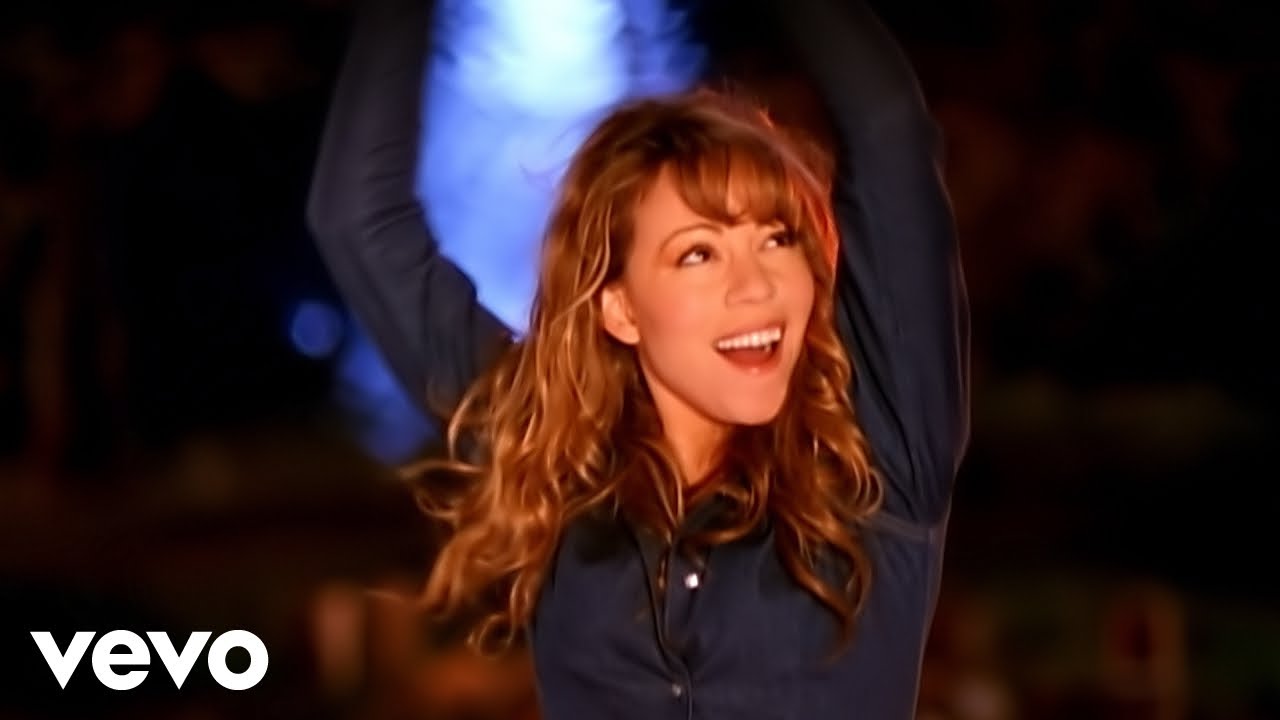
Two children slip out of their bungalow after dark, run through the woods past a campfire, and jump into a lake fully clothed. Mariah Carey watches from a lakeside tire swing in a denim jacket and bare feet, smiling, telling the story. The video for Always Be My Baby was filmed at the Fresh Air Fund camp in upstate New York — the charity Carey has sponsored for decades, and which named its camp after her. There is a real irony in that setting, though nobody watching in 1996 could have known it: while making the album this song came from, Carey was living under conditions she would later describe as constant surveillance, in a house with cameras and listening devices. The song’s video is about two kids sneaking out at night. So, in a sense, was her life.
Keep watching: Mariah Carey – Love Takes Time · explore more →
The song itself was built in a single unhurried session. Carey had spent late 1994 hunting for new collaborators to push her sound somewhere fresher, and landed on Jermaine Dupri, then rising fast off his work with Kris Kross and So So Def — he had remixed her Never Forget You in 1994, and she liked what she called his very distinct vibe. Dupri brought keyboardist Manuel Seal. The three of them sat down together, Dupri programmed the drums to the feel Carey described, Seal put his hands on the keys, and Carey started singing the melody she’d been hearing in her head, humming the phrase that became the title until the song assembled itself around it. What emerged was a midtempo pop-R&B record about a breakup with no grief in it at all — the narrator watches her lover walk out and calmly informs him that he’s coming back, that some part of him belongs to her permanently. Confidence, not heartbreak.
The single that broke the chart’s rules
Released on February 20, 1996, as the third American single from Daydream, it did something no record had ever done: it debuted at No. 2 on the Billboard Hot 100, the first single in history to enter that high without going straight to the top. Then it dug in. Nine nonconsecutive weeks at No. 2, two weeks at No. 1, and — the statistic that says the most about its saturation — according to ASCAP, it was the single most-played song on American radio across the whole of 1996. In Britain it reached No. 3, her twelfth UK Top 10. The remix architecture around it was equally ambitious: Dupri’s own Mr. Dupri Mix rebuilt the track over a sample of the S.O.S. Band’s Tell Me If You Still Care, adding Da Brat’s rap verses and Xscape’s harmonies, while Lil’ Vicious appeared on reggae-soul versions and David Morales and Satoshi Tomiie cut dance mixes with entirely new vocals. It was the beginning of a long partnership — Dupri would return a decade later to help engineer Carey’s comeback on The Emancipation of Mimi.
Behind the gates
What the record never lets on is how little freedom its author had while making it. Carey was married to Tommy Mottola, the head of her own label, and by her account in The Meaning of Mariah Carey, their upstate New York estate was a place of constant monitoring — cameras, listening devices, armed security, her movements tracked. During the Daydream sessions she once talked rapper Da Brat into sneaking off the property with her, without permission, to get french fries at a nearby Burger King. It reads like a funny story, and it is, but it is also the reason the Fresh Air Fund video lands the way it does now. On screen she sits on a swing watching two children run off into the dark toward a lake, delighted for them. A separate video, shot for Jermaine Dupri’s remix at the mansion itself, shows her poolside with Da Brat and Xscape, laughing. Listen to a song about refusing to let go while knowing what was on the other side of the camera, and the confidence in it starts to sound like something closer to a promise she was making to herself.
SONG INFORMATION
Enjoyed this one? New forgotten gems every day — tap Music Videos Club below to visit and follow us on Facebook:
Related videos
 Watch LaterAdded
04:11
Watch LaterAdded
04:11  Watch LaterAdded
03:43
Watch LaterAdded
03:43  Watch LaterAdded
04:53
Watch LaterAdded
04:53