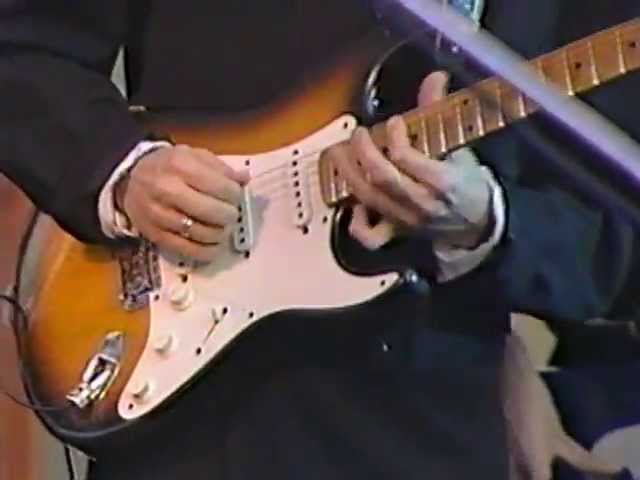
Eric Johnson spent his whole career chasing one impossible sound — Jimi Hendrix’s “house-burning-down” guitar tone — and on this track, with its baffling made-up title, he finally caught it.
Ask a room full of guitarists to name the most obsessive tone-chaser alive and a lot of them will say Eric Johnson — the Austin virtuoso so particular about his sound that he can reportedly hear the difference between battery brands in his effects pedals. High Landrons is one of his purest statements, and Johnson has been refreshingly plain about what he was reaching for: it is, in his words, “kind of an homage to Jimi Hendrix.” He loved that “house-burning-down guitar tone,” he said, and spent years trying to figure out how Hendrix got it. On this song, he got there.
The song comes from Ah Via Musicom, Johnson’s acclaimed 1990 album and the record that turned a musician’s musician into a genuine mainstream name. Released by Capitol on March 20, 1990, the album went platinum and spun off an astonishing four singles onto Billboard’s Mainstream Rock chart — High Landrons reaching No. 31, followed by Righteous, Trademark, and the towering Cliffs of Dover, which went to No. 5 and won the Grammy for Best Rock Instrumental Performance. For a largely instrumental guitar record to break through like that at the dawn of the 1990s was remarkable, and High Landrons was one of the tracks that did the breaking.
A guitar tone worth chasing
What makes High Landrons special is that it isn’t a pure instrumental — Johnson sings on it, one of only four vocal tracks on the album — but nobody comes to this song for the words. They come for the guitar: the singing sustain, the violin-like smoothness, and above all that searing, saturated lead tone that pays tribute to Hendrix without ever imitating him. Johnson achieves it with famous meticulousness, layering amplifiers and effects until the sound is exactly, obsessively right. The song’s flanger-drenched solo has become a rite of passage among serious players, endlessly studied and covered, pitched in the unusual key of A-flat minor that Johnson favors. It’s the kind of playing that made critics call his tone one of the greatest in rock.
The odd title has kept fans guessing for decades — “High Landrons” isn’t a phrase you’ll find in any dictionary, and Johnson has let it stand as a small mystery, the focus staying firmly on the sound rather than the name. That’s characteristic of the man: for Johnson, the music was always the message, and the song titles were almost afterthoughts hung on finished pieces of guitar architecture. The album was recorded over more than a year in Austin studios and mastered by the legendary Bernie Grundman, every second sweated over in Johnson’s relentless pursuit of perfection.
The original trio, live
The performance featured on this page is a special one, because it reunites the exact players who made the record. Johnson is joined by bassist Kyle Brock and drummer Tommy Taylor — the rhythm section that played on the original Ah Via Musicom and on High Landrons itself. Johnson has spoken movingly about the chemistry among the three of them, calling it a “certain magical chemistry” that can’t be manufactured no matter how skilled the players: “It’s like breathing. You can sit down and get the best players in the world and put it all together, and it won’t reach you on an emotional level.” Watching the trio dig into this song live, you hear exactly what he means — three musicians who have played together for decades, locked in and letting the music breathe.
More than thirty years after its release, High Landrons remains a favorite among the guitar faithful — a little overshadowed by the fame of Cliffs of Dover, but beloved by those who know Johnson’s catalog deeply. It captures everything that makes him one of the most respected guitarists of his generation: the impossible tone, the emotional restraint, the refusal to play a single note that isn’t exactly right. A tribute to Hendrix from a man who spent his life chasing a sound, it stands as proof that sometimes the chase is worth every year it takes.
SONG INFORMATION
Artist: Eric Johnson
Song: “High Landrons”
Album:Ah Via Musicom
Released: March 20, 1990
Recorded: 1988–1989, Austin, Texas
Label: Capitol
Songwriter: Eric Johnson
Producer: Eric Johnson
Chart Performance: No. 31 US Billboard Mainstream Rock
Performance: Live — Eric Johnson with Kyle Brock and Tommy Taylor
Lineup: Eric Johnson (guitar, vocals), Kyle Brock (bass), Tommy Taylor (drums)