



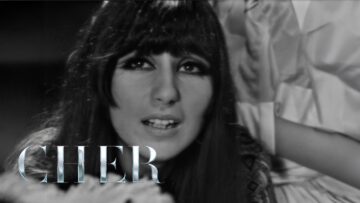




Cher – Believe
Nobody at Warner wanted the demo. Cher took it to No. 1 at 52 — after refusing, over her dead body, to remove the strange effect that changed pop forever.
Thirty-three years separate Cher’s first American No. 1 from her second. The first was “I Got You Babe” in 1965, sung with Sonny Bono when she was nineteen. The second arrived in March 1999, when “Believe” reached the top of the Billboard Hot 100 and stayed four weeks — making Cher, at 52, the oldest woman ever to top that chart, a record she holds to this day, and setting the longest gap between No. 1 hits in the chart’s history. No comeback in pop has ever covered more ground, and it was built on a demo nobody at her label wanted.
Keep watching: Cher – If I Could Turn Back Time · more Cher →
The song had been an orphan for months. A demo written by Brian Higgins, Matthew Gray, Stuart McLennen, and Timothy Powell circulated around Warner Bros. with a chorus everyone loved and verses nobody did — Cutting Crew’s Nick Van Eede has even recalled producing an original demo of it years earlier. When Warner UK chairman Rob Dickins went hunting for songs to relaunch Cher as a dance artist, he handed the stray to producers Mark Taylor and Brian Rawling at Dreamhouse Studios in Kingston upon Thames, whose writers Steve Torch and Paul Barry finished it. Cher did some finishing of her own: finding the song too self-pitying, she rewrote the second verse to make its heartbroken narrator fight back — a girl can be sad in one verse, she reasoned, but not in two. She never asked for a songwriting credit, a decision she has since said she regrets.
The Late-Night Accident That Rewrote Pop
The sound that made history was discovered almost by accident. Auto-Tune, released in 1997, was designed to be inaudible — software that quietly nudged flat or sharp notes into place. Working late on Cher’s vocal, Taylor pushed the correction speed to its extreme zero setting, and her voice shattered into that now-famous crystalline stutter on lines like “I can’t break through.” Playing it for Cher was, Taylor admitted, the most nerve-wracking part of the project. She loved it instantly. When the label heard the finished mix and wanted the robotic warble removed, Cher ended the conversation with four words: “over my dead body.” The producers, protecting their trick, spent months telling journalists the effect came from a vocoder pedal — but the truth escaped, the Auto-Tune manual itself eventually named the zero setting the “Cher effect,” and within two decades that once-shocking sound was simply what pop radio sounded like.
“Believe” was released on October 19, 1998, three days before the album of the same name — a record Cher dedicated to Sonny Bono, who had died that January, the man with whom she’d shared that first No. 1 a lifetime earlier. Britain fell first: the single entered the UK chart at No. 1 and stayed seven weeks, becoming the biggest-selling single of 1998 and the biggest-selling single by a female artist in UK history, at more than 1.8 million copies. America followed in March, and by year’s end Billboard ranked it the No. 1 song of 1999 outright. It topped the charts in more than twenty countries, sold over ten million copies worldwide, won the Grammy for Best Dance Recording, and earned its writers three Ivor Novello Awards.
Do You Believe in Life After Love?
The question the chorus asks was, of course, Cher’s own résumé. She had already survived more career deaths than most artists have careers: the folk-pop duo years, the television years, the disco detour, the film-star decade that won her an Oscar, the leather-and-battleship rock era of “If I Could Turn Back Time.” Each time the industry wrote her off, she returned as something new. “Believe” was the most improbable resurrection of all — a 52-year-old handed a rejected demo and a brand-new piece of software, emerging with the biggest hit of a career then in its fourth decade.
The record’s fingerprints are everywhere now. The vocal effect she refused to let anyone touch became the foundational sound of twenty-first-century pop, R&B, and hip-hop — every artist who has ever melted a vocal into digital glitter is working in the space “Believe” opened. Not bad for a song about a breakup, sung by a woman the business kept trying to retire, who knew exactly what she was hearing the first time her own voice broke into pieces and came back together.
SONG INFORMATION
Related videos
 Watch LaterAdded
04:29
Watch LaterAdded
04:29  Watch LaterAdded
04:05
Watch LaterAdded
04:05  Watch LaterAdded
02:57
Watch LaterAdded
02:57