







Cher – If I Could Turn Back Time
Diane Warren had to grab Cher’s leg in the studio and refuse to let go until Cher agreed to record the song. The result was the comeback single that put a 43-year-old Oscar winner back at the top of pop radio.
Cher did not want to record the song. Diane Warren had written “If I Could Turn Back Time” specifically for her — a plain-spoken regret built around a rising melodic line that detonates on the title phrase — and Warren brought it to a Los Angeles studio session in early 1989 expecting the kind of reception Cher had given her earlier ballad “I Found Someone.” Cher hated it. Warren, by then in her early thirties and three years into the run of hits that would make her the most-recorded female songwriter in American pop music, got down on her knees, took hold of Cher’s leg in the studio lounge, and refused to release it until Cher agreed to at least try the song. Warren has now told the story to Billboard, to People, to the documentary Diane Warren: Relentless in 2025 — and the punchline is always the same. Cher sang the opening line in the vocal booth and turned around with a look that, in Warren’s recounting, said only one thing: “You were right.”
The track was cut at Criterion Studios in Hollywood with producer Guy Roche running the desk alongside Warren, engineer Frank Wolf mixing, and Steve Lukather of Toto cutting the lead guitar. Lukather built the song’s signature gesture — the palm-muted chord progression that opens the record and returns under each verse — in a single afternoon, working off a chart Roche had handed him with Warren’s piano demo as the reference. John Pierce played bass, Mark T. Williams played drums, Alan Pasqua and Roche split keyboards. The backing-vocal stack was unusually deep for a Cher pop record: Desmond Child, Maria Vidal, Robin Beck, Michael Anthony, Jimmy Demers, and Jean McClain layered the chorus harmonies, with Child — already the songwriter behind Bon Jovi’s “Livin’ on a Prayer” and Aerosmith’s “Dude (Looks Like a Lady)” — contributing both vocals and uncredited arrangement input. Cher’s vocal was tracked through a vintage Neumann U47 tube microphone, the same model used on most of her late-1980s rock-pivot records.
The day the Navy expected a jumpsuit
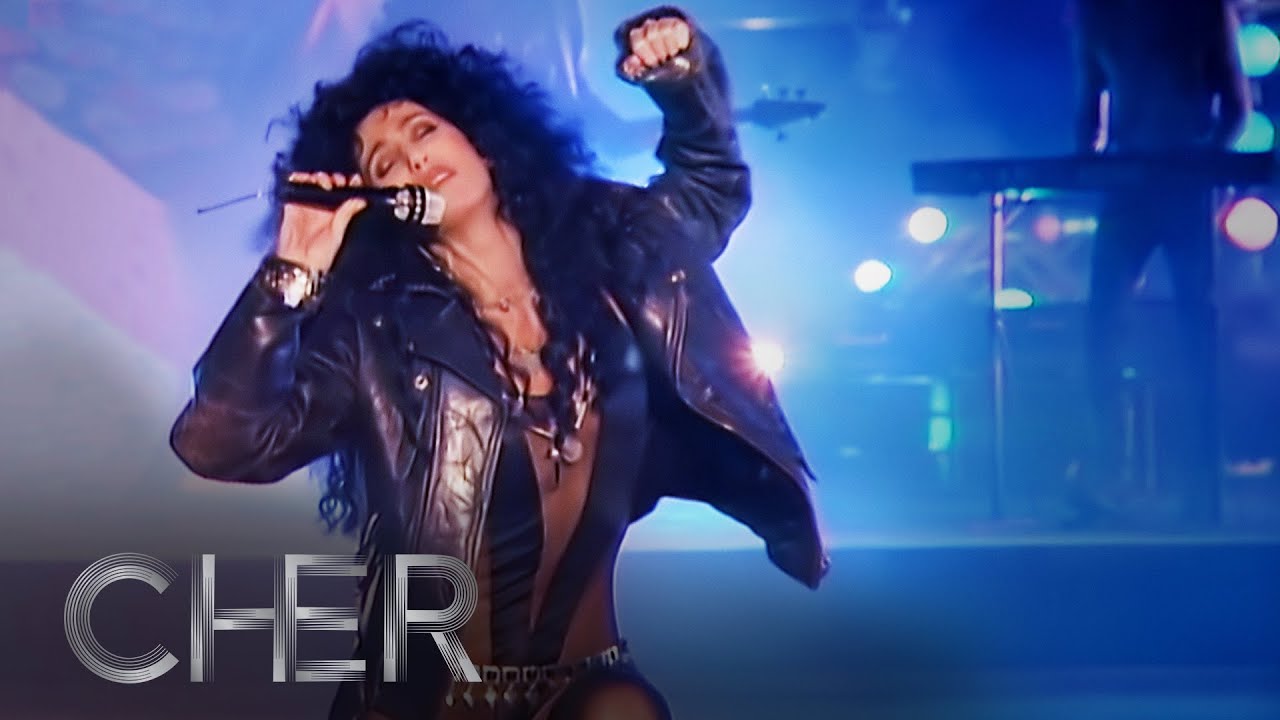
Geffen released the single in June 1989 as the lead single from Heart of Stone, Cher’s nineteenth studio album, ahead of the album itself in July. The accompanying music video was shot in late June 1989 on board the battleship USS Missouri at the former Long Beach Naval Shipyard at Pier D, directed by Marty Callner — the rock-video specialist whose résumé already included Aerosmith, Whitesnake, and Heart videos. The Navy had granted access on the assumption that the video would function as a recruiting promotion. The storyboards Geffen had submitted showed Cher in costume; what the Navy did not anticipate was the costume Bob Mackie had built specifically for the shoot. Cher arrived on deck the night of the shoot wearing a fishnet bodystocking under a black V-strap one-piece, a leather jacket, garters, and over-the-knee boots — a “seatbelt outfit,” in Mackie’s later description, that exposed a butterfly tattoo on her right hip and left most of her backside bare. The sailors’ reactions captured in the final cut were genuine. Lieutenant Commander Steve Honda of the Navy’s Hollywood Liaison office asked Callner to suspend the shoot until Cher changed clothes; Callner refused. The shoot continued.
MTV initially banned the video outright, then restricted it to airplay after 9 p.m. The restriction worked as restrictions on pop videos almost always work — by making the video an event for any teenager with access to a VCR and a late-night television. Family-values groups protested. World War II veterans wrote to the Department of the Navy describing the shoot as a desecration of a national historic site, since the Missouri was the ship on which the formal Japanese surrender ending the war had been signed on September 2, 1945. The Secretary of the Navy reportedly considered firing the captain of the Missouri before deciding to take no disciplinary action. The video’s notoriety carried the single straight up the Billboard Hot 100. “If I Could Turn Back Time” peaked at No. 3 in the United States on the chart dated September 9, 1989, blocked from the top spot by Richard Marx’s “Right Here Waiting” and Gloria Estefan’s “Don’t Wanna Lose You.” It went to No. 1 in Australia (Cher’s first Australian No. 1) and in Norway, No. 6 in the United Kingdom, and reached the top ten in Belgium, Canada, Ireland, the Netherlands, and New Zealand. It topped Billboard’s Adult Contemporary chart for two consecutive weeks — Cher’s second consecutive Adult Contemporary No. 1 after “After All,” her duet with Peter Cetera from the soundtrack to Chances Are.
From battleship to Rock Hall
Cher’s twelve-year-old son Elijah Blue Allman appears in the video as one of the band’s guitarists, wearing dark glasses and a Jimi Hendrix T-shirt — a detail rarely noted in the contemporary coverage but visible in every full-length print of the clip. The single sold past 500,000 units in the United States within months of release and was certified Gold by the RIAA; in the United Kingdom it crossed the threshold for Platinum certification, in Australia for double Platinum. Heart of Stone peaked at No. 10 on the Billboard 200 and would eventually sell over four million copies worldwide, supported by Cher’s 1990 Heart of Stone Tour. The song became the song Cher could not retire — it remained in the live setlist across her Love Hurts, Do You Believe?, Living Proof, Dressed to Kill, Classic Cher, and Here We Go Again tours, the last of which ran from 2018 to 2020.
The video kept reappearing too. In 2010, Cher presented the Video of the Year award at the MTV Video Music Awards wearing the original Mackie outfit, twenty-one years after the Missouri shoot; the winner that night was Lady Gaga for “Bad Romance,” who accepted the award in a dress made of raw beef designed by Franc Fernandez. In 2021, Rolling Stone named the “If I Could Turn Back Time” video to its list of the Sexiest Music Videos of All Time. In 2024, Cher — long publicly skeptical about the Rock and Roll Hall of Fame’s inconsistent treatment of women artists — was finally inducted into the Hall at age 78, introduced by Zendaya. Her performance set ran two songs: “If I Could Turn Back Time” and “Believe.” The Diane Warren song that Cher had once refused to record had become the bookend the Hall used to summarize her entire pop career, second only to the auto-tuned dance record that had defined the second half of it.
Warren’s song outlasted the controversy that launched it. The fishnet bodystocking is now a Mackie museum piece. The USS Missouri is a museum ship moored at Pearl Harbor. The five-second TikTok clip of Diane Warren describing how she physically restrained Cher into recording the song has accumulated millions of views across half a dozen years of repostings. And the record itself — Lukather’s guitar figure, Warren’s regret-built hook, Cher’s contralto coming in at full force on the title phrase — is still the song that runs when American pop radio needs three minutes and fifty-nine seconds of straightforward late-1980s power. The reluctant recording became the comeback. The comeback became the late-career signature. And the late-career signature became the Hall of Fame induction.