



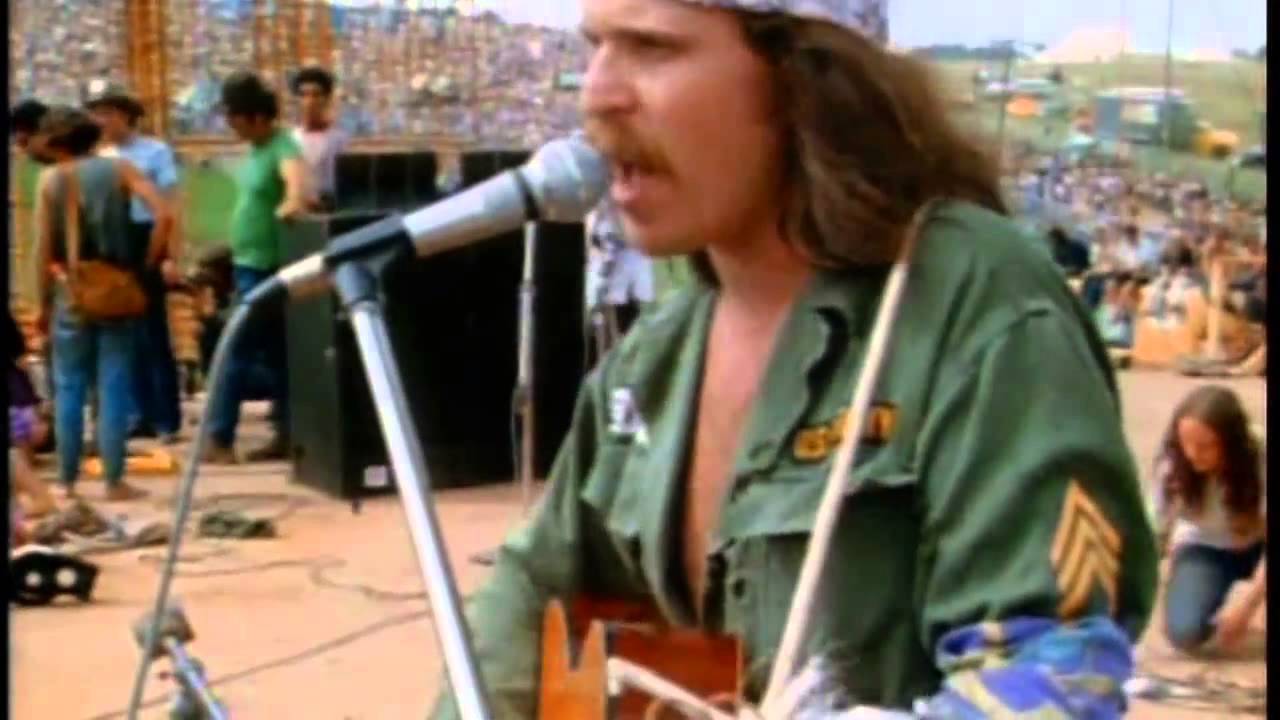



Country Joe McDonald – Feel Like I’m Fixing to Die Rag (Woodstock 69)
He Wrote It In 30 Minutes To Fill A Magazine. Then He Sang It To 400,000 People Who Had No Idea What Was Coming.
There are songs that protest a war. And then there is “I-Feel-Like-I’m-Fixin’-to-Die Rag” — a song that made the war’s absurdity so undeniable, so darkly hilarious, and so bone-chillingly true that even the soldiers fighting it recognised it immediately. Country Joe and the Fish was fronted by United States Navy veteran Joe McDonald , a man who had actually served — who knew from the inside what he was singing about — and who wrote one of the most devastating anti-war songs in American history using the cheerful musical vocabulary of a 1920s ragtime hoedown. The juxtaposition was entirely deliberate. So was the fury beneath it. Joseph Allen McDonald died on March 6, 2026, at the age of 84, of Parkinson’s disease, in Berkeley, California — leaving behind a song that had long since outgrown him, and a Woodstock moment that will never be forgotten.
Joe wrote the song in the summer of 1965, living in a flat in the Bay Area with his first wife Kathe. The circumstances were almost comically mundane. McDonald was the publisher of a left-wing underground newspaper called Rag Baby, and he decided to record an EP “talking issue” — a promotional record to fill a gap when there weren’t enough articles for one particular edition. The song was written to pad out the running time. He started working on it after being asked to contribute to an anti-Vietnam War play, and after writing another song first, he sat back in his chair, strummed some chords, and wrote “1-2-3, what are we fighting for?” The melody and lyrics just seemed to flow out of him — the whole thing took about 30 minutes. The song that would define an era was essentially dashed off as filler for a self-published zine. McDonald was 23 years old.
Musically, “I-Feel-Like-I’m-Fixin’-to-Die Rag” takes the form of an upbeat ragtime song from the 1920s, yet its lyrics are dark and sardonic, filled with black humour and pointed commentary about the folly of the Vietnam War. McDonald blames American involvement in Vietnam on several groups: the government, zealous military commanders, greedy arms manufacturers and capitalists — even parents who encourage or allow their sons to enlist. The genius of the song is precisely that cheerfulness — the military-march bounce, the singalong chorus structure, the carnival-barker energy — all deployed in the service of a lyric about young men coming home in boxes. It was the musical equivalent of laughing at a funeral, except the funeral was still happening, and the people attending it were being drafted.
The first recording appeared on that 1965 EP, Rag Baby Talking Issue No. 1, as an acoustic folk sketch. The fully electric version — the one the world knows — came two years later when the song became the title track of I-Feel-Like-I’m-Fixin’-to-Die, the band’s second album, released in late 1967. Recorded in San Francisco at the height of the Summer of Love, the production gave the song its now-iconic bounce — fuzz guitar, rolling piano, and a rhythm section that made you want to clap along to lyrics about dying. Despite receiving little airplay on radio or television due to its dark tone, the song was widely known by young Americans, particularly those in the anti-war and counterculture movements. A Vietnam veteran named Richard Hughes later recalled that US Army psychological operations helicopters — broadcasting propaganda over enemy positions — had sometimes switched to playing the song while flying back over American lines. The Army’s own psych-ops equipment was broadcasting Country Joe McDonald’s anti-war rag across the jungle at 40,000 watts.
Then came Woodstock. Country Joe McDonald wasn’t supposed to perform at Woodstock as a solo act. On Saturday, August 16th, the festival’s schedule was in complete disarray — rain delays and logistical nightmares meant that the Incredible String Band refused to play in the drizzling rain, and someone needed to fill the gap. They just asked him to go out there solo with a guitar, to do a few songs and fill in some time while the stage was being prepared for Santana. He was a placeholder. A warm body with an acoustic guitar and nothing to lose. He was saving the Fuck Cheer and “Fixin’-to-Die Rag” for the full Country Joe and the Fish electric set scheduled for later that night. He played his filler songs. The crowd was polite, distracted, enormous. Then he consulted his manager standing nearby about whether to go further. The road manager replied: “Nobody’s listening to you, so what difference does it make?” He walked back to the microphone. Gimme an F.
Leading a crowd of 400,000 people to spell out and shout the F-word was deeply shocking to mainstream America. Filmmaker Michael Wadleigh captured the sing-along moment in the Woodstock movie by adding the lyrics as subtitles, complete with a follow-along bouncing ball — the same technique used in family sing-alongs, now deployed for the most gleefully profane mass participation event in rock history. McDonald didn’t know the crowd was singing along until Wadleigh brought him to Los Angeles and showed him the film. From the stage, he couldn’t hear them. He only saw, afterwards, that they were mouthing every word. The performance led side two of the official Woodstock triple album. It launched him as a solo artist. It permanently attached his name and face to the anti-Vietnam War movement in a way no radio play ever could have.
McDonald wrote and recorded somewhere around 40 albums across a career that spanned more than half a century, lending his voice to cause after cause — from opposing war to advocating for military veterans, nurses, animals, and the ecosystem. He was, as one writer put it, a master of the piquant ballad, a pioneer of the psychedelic, and an avatar of music-as-activism. None of it, in the public memory, ever quite escaped the shadow of one song — the ragtime hoedown that took 30 minutes to write, got banned from American radio, was broadcast by the US Army’s own helicopters over the jungles of Vietnam, and was sung back to its author by half a million people who didn’t know they knew the words until they heard themselves singing them.
McDonald said of that Woodstock moment: “I’m happy and proud that I could represent the Vietnam War and Vietnam veterans in that moment. It was very powerful, and we’re all lucky that Michael Wadleigh was there to capture it.” He spent the rest of his life being defined by 90 seconds of cheerleading and three minutes of ragtime. It was, by any measure, enough. Country Joe McDonald was 84 years old. The song is still singing.
SONG INFORMATION
Related videos
 Watch LaterAdded
05:45
Watch LaterAdded
05:45  Watch LaterAdded
 Watch LaterAdded
04:11
Watch LaterAdded
04:11