




David Bowie – Starman
Bowie’s record label complained that the Ziggy Stardust album had no single — so he dashed off a song built around a stolen octave leap from “Over the Rainbow,” and three minutes on Top of the Pops turned him into a star overnight.
The song that made David Bowie famous almost didn’t exist. When he handed RCA the finished The Rise and Fall of Ziggy Stardust and the Spiders from Mars, an executive named Dennis Katz sent it back with a complaint: there was no obvious single. So in early 1972 Bowie sat down and wrote one to order — Starman — and bumped a Chuck Berry cover off the album to make room. That last-minute commission became the record that launched Ziggy Stardust into the world, and the performance of it that followed changed British pop forever.
Keep watching: David Bowie – “Heroes” · more David Bowie →
Bowie recorded Starman on February 4, 1972 at Trident Studios in London with the Spiders from Mars — guitarist Mick Ronson, bassist Trevor Bolder, and drummer Mick Woodmansey — during the very last of the Ziggy sessions. Its shimmering hook was no accident. The great octave leap on the word “Star-man” is lifted, note for note, from Judy Garland’s “some-where” in “Over the Rainbow,” a deliberate nod that casts Bowie’s alien messiah as a figure from just beyond the rainbow. The lyric imagines Ziggy Stardust beaming a message of hope to Earth’s teenagers through their radios — a starman waiting in the sky, afraid he’ll blow our minds. It was, as one writer put it, a “space-age novelty hit” in the lineage of Bowie’s earlier “Space Oddity,” but with something bigger behind it: a whole character, a whole world.
Three minutes that invented the future
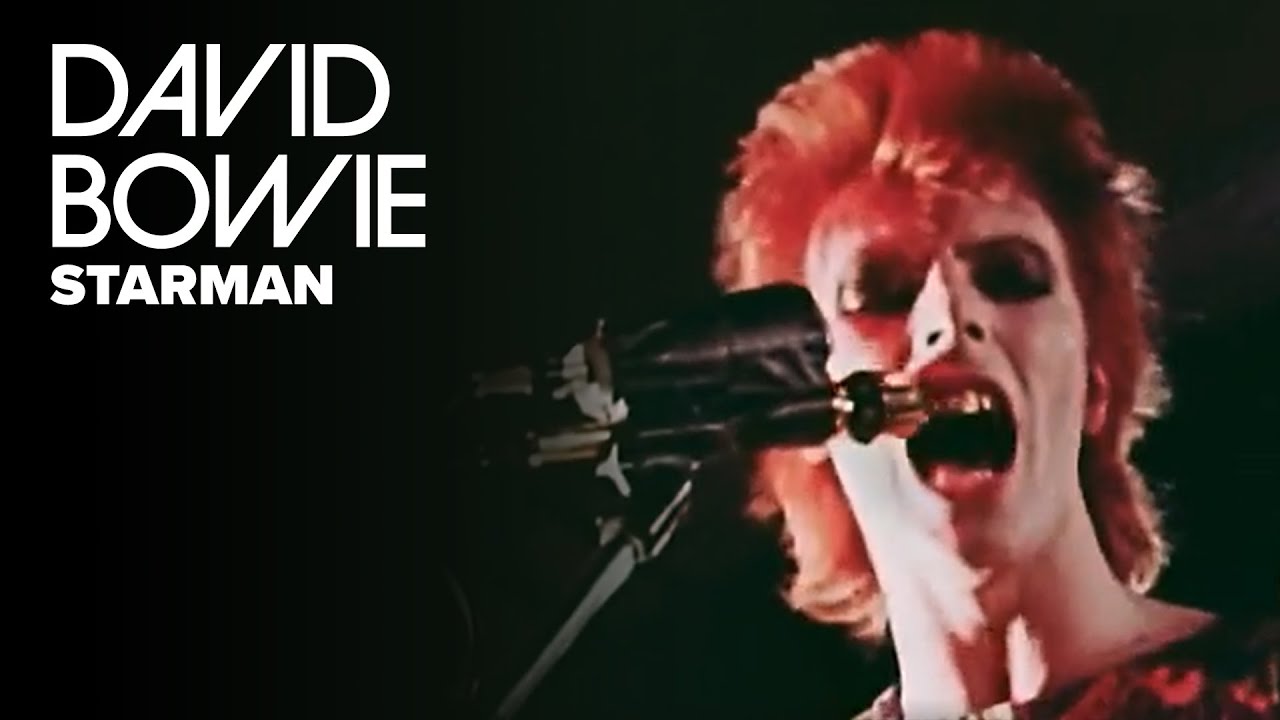
The song was climbing modestly when Bowie made the appearance that turned everything around. On July 5, 1972, at the BBC’s Television Centre in White City, he and the Spiders taped a performance of Starman for Top of the Pops, broadcast the following night, Thursday, July 6. What the nation saw was unlike anything on British television: Bowie, hair dyed shocking red, wrapped in a rainbow jumpsuit, draping a limp arm around Mick Ronson’s shoulder as they leaned into the microphone together, then pointing straight down the camera lens on the line “I had to phone someone, so I picked on you.” It was androgynous, alien, and utterly magnetic. He even tweaked a lyric to “some get-it-on rock ‘n’ roll” as a sly wink to his friend and rival Marc Bolan.
The impact is almost impossible to overstate. The broadcast has been called “the day that invented the 80s,” because a startling number of the children watching went on to reshape music themselves. Among those glued to the screen that night were Boy George, Adam Ant, Morrissey and Johnny Marr, Siouxsie Sioux, Ian McCulloch, the Clash’s Mick Jones, Duran Duran’s John Taylor and Nick Rhodes, and Gary Kemp of Spandau Ballet — later the writer of another song in this archive, True. Bono said seeing it was like watching “a creature falling from the sky.” Within two weeks Starman shot to No. 10 on the UK chart, and the album behind it climbed to No. 5 and stayed on the chart, on and off, for two years.
Mick Rock and the moving image of Ziggy
The primary video on this page is a different kind of document. Assembled from footage shot across the Ziggy Stardust tour of 1972 and 1973 by Mick Rock — the photographer and filmmaker so central to Bowie’s rise that he became known as “the man who shot the seventies” — it sets the studio recording of Starman against images of Ziggy in full flight. Rock, who died in 2021, was there for the pivotal moments of this era, including the notorious night at Oxford Town Hall in June 1972 when he photographed Bowie miming fellatio on Ronson’s guitar, an image that ran in the music press and stoked the myth. His Starman film is a moving companion to those still photographs: the closest thing to standing in the room as Ziggy conquered Britain.
More than fifty years on, Starman remains the pivot on which Bowie’s whole career turns — the moment the struggling artist who had spent years and four failed singles trying to break through finally did, in a single televised instant. It reached only No. 65 in America at the time, a slower burn across the Atlantic, but at home it was a detonation. A song written grudgingly to satisfy a record label became the doorway through which an entire generation walked into a stranger, freer world. Below the main film, you can watch the performance that started it all: the legendary Top of the Pops broadcast of July 6, 1972.
The performance that changed everything: David Bowie and the Spiders from Mars performing Starman on Top of the Pops, broadcast July 6, 1972.
SONG INFORMATION
Related videos
 Watch LaterAdded
03:30
Watch LaterAdded
03:30  Watch LaterAdded
06:49
Watch LaterAdded
06:49  Watch LaterAdded
04:48
Watch LaterAdded
04:48