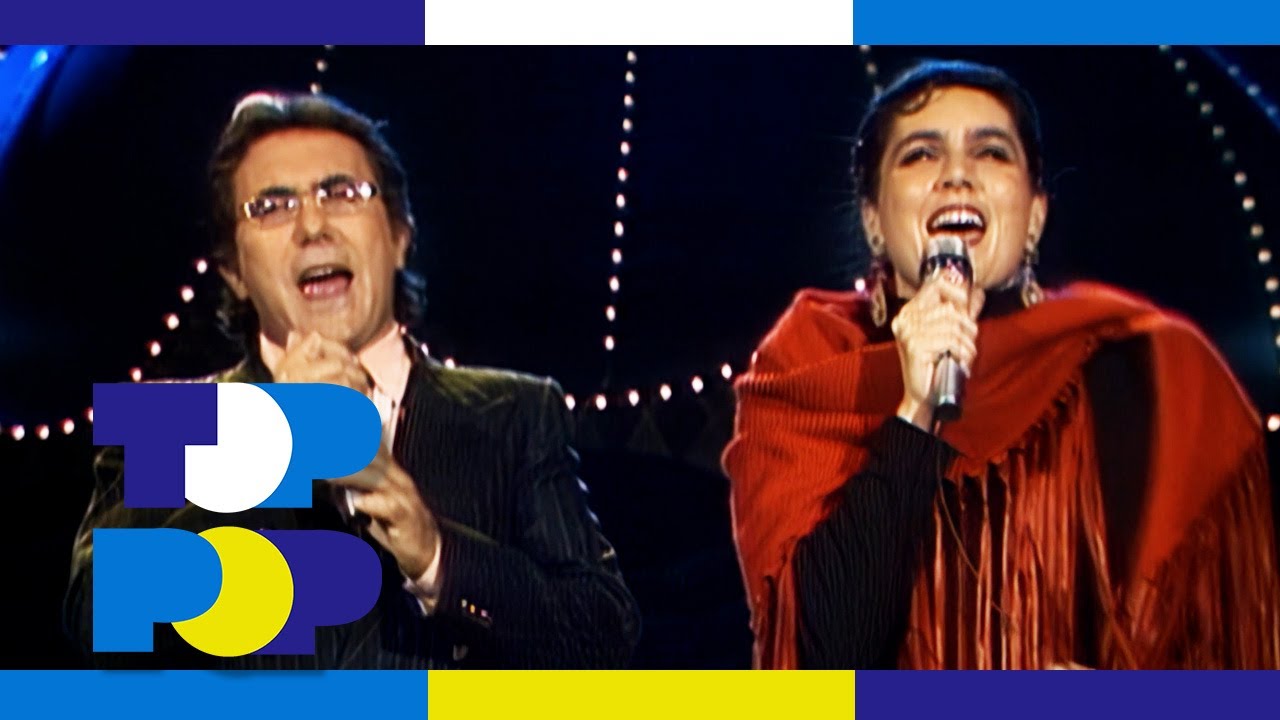
It sounds like one more sweeping Italian love ballad — but Al Bano and Romina Power wrote it as a hymn to freedom, and one of its authors was a famous pop star hiding behind a fake name.
On first listen, Libertà! is exactly what you’d expect from Al Bano and Romina Power — a grand, tearful ballad, the Italian tenor and his American wife trading verses over a melody built to fill an arena. But the song has more going on beneath the surface than a simple love story. It was written as a hymn to freedom, its chorus addressing liberty itself, and it hides a genuine surprise in its credits. It remains one of the most enduring songs in the catalog of one of Europe’s biggest-ever pop acts.
By 1987, Al Bano and Romina Power were a phenomenon across continental Europe. He was Albano Carrisi, a baker’s son from Puglia blessed with an operatic tenor; she was Romina Power, daughter of the Hollywood matinee idol Tyrone Power. They had met on a film set in 1967, married, and turned their partnership into a musical empire, winning the Sanremo Festival in 1984 with Ci Sarà and eventually selling around 150 million records across Italy, Germany, Spain, Eastern Europe, and Latin America. Libertà! became the title track of their 1987 album and one of the signature songs of their entire career.
A song with a secret set of authors
The writing credits hold a real surprise. The lyrics came largely from the veteran Italian songwriter Vito Pallavicini, with Romina Power herself among the credited authors. But listed alongside them is a name that looks like a puzzle: “Springbock.” It was a pseudonym — and the man behind it was Howard Carpendale, the South African-born singer who was one of the biggest stars in German-language pop, quietly co-writing a song for his Italian labelmates without attaching his famous name to it. That hidden collaboration helps explain the song’s grand, hymn-like sweep: it was a genuinely pan-European effort disguised as a purely Italian record.
It’s worth clearing up a common mix-up, too. Many assume Libertà! was the duo’s entry at the 1987 Sanremo Festival. It wasn’t — that year they competed with Nostalgia canaglia, which finished third. Libertà! arrived instead as the centerpiece of the album that shared its name, and it went on to outlast almost everything around it, becoming far better known than the Sanremo song that officially represented them that season.
Love song, freedom song
What gives Libertà! its weight is the double meaning threaded through the lyric. It opens with evening falling on the shoulders of a man walking away, a woman searching among houses and churches for someone who is no longer there. Then comes the chorus, addressed not to a lover but to freedom itself: Libertà, how many you have made weep; without you, how much loneliness. It takes the language of a breakup ballad — longing, absence, the ache for someone gone — and turns it toward something larger, phrasing a plea for liberty as if freedom were a beloved worth any sacrifice to win back. That is why the song has always felt bigger than a romance, and why audiences across many countries and languages took it to heart as their own.
The 1987 album carried one more piece of intrigue. A track called I cigni di Balaka would later put Al Bano at the center of a lawsuit: in 1992 he publicly accused Michael Jackson of copying its melody in his hit Will You Be There, a plagiarism dispute that made international headlines and kept the record in the news years after release. But it is Libertà! that has proven the most durable — still performed by Al Bano to this day, translated into dozens of languages, and sung back to him by crowds who know every word. It’s a testament to a song that, for all its love-ballad surface, was reaching for something higher all along.




![David Lee Roth – California Girls (Official Video) [HD]](https://musicvideosclub.com/wp-content/uploads/2026/10/david-lee-roth-california-girls-360x203.jpg)