



![David Lee Roth – California Girls (Official Video) [HD]](https://musicvideosclub.com/wp-content/uploads/2026/10/david-lee-roth-california-girls-360x203.jpg)


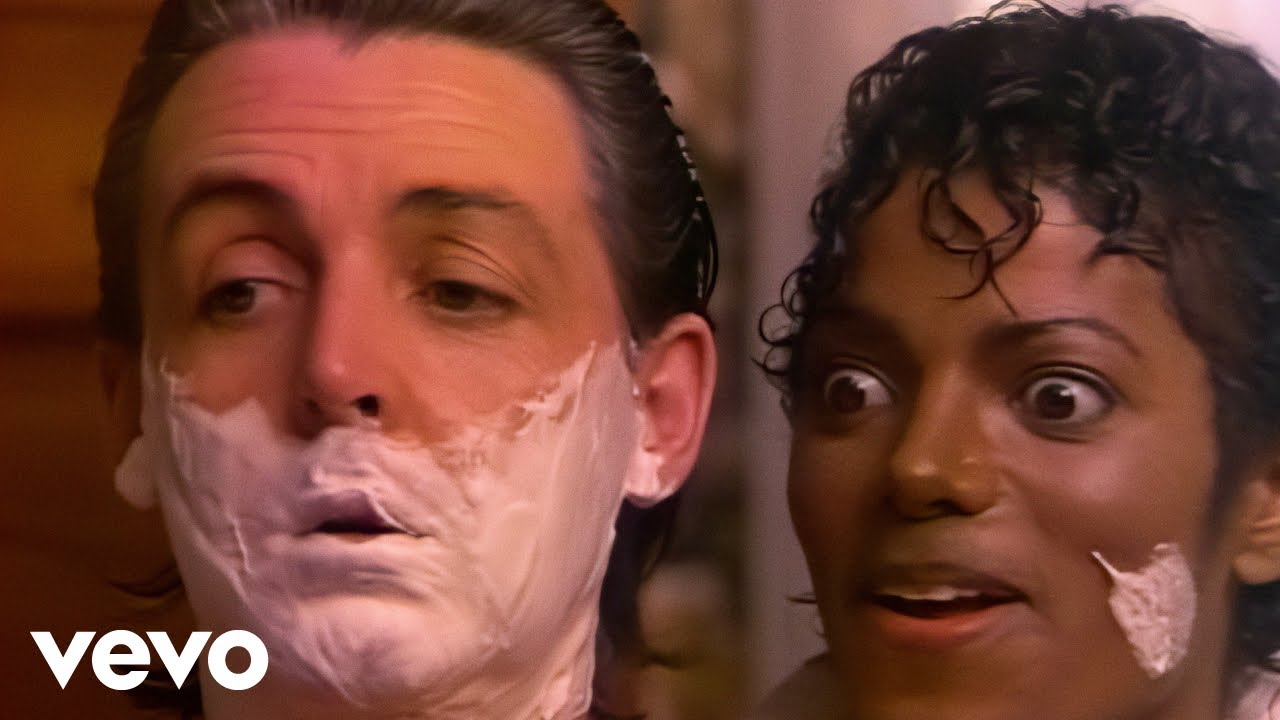
Paul McCartney & Michael Jackson – Say Say Say
Paul McCartney showed him two things while they made this record. Michael Jackson went out and bought both of them.
Dinner at the McCartneys’ house in London, 1981. Michael Jackson had been staying with Paul and Linda for weeks while the two of them worked, and at some point during the meal McCartney went and fetched a booklet. It listed every song whose publishing he owned. This is the way to make big money, he told Jackson, and explained the arithmetic: a record cut, a radio play, a live performance, and money arrives every time. Jackson listened carefully. He was twenty-two.
Keep watching: Paul McCartney – Pipes of Peace · Michael Jackson – Billie Jean
Jackson had made the first move. He rang McCartney at Christmas 1980, out of the blue, and proposed they write together — he had already recorded Wings’ “Girlfriend” for Off the Wall and knew the material. He flew to London and moved into the house. Recording started at AIR Studios in May 1981, running alongside the Tug of War sessions, and the pair came away with three songs. The one everyone heard first was not this one: The Girl Is Mine was cut afterwards and released ahead of it, on Thriller, in October 1982. This track was finished in February 1983 and held back for McCartney’s own album.
George Martin produced it, which put him behind the desk for another McCartney No. 1 twenty years after the first. McCartney played several of the instruments himself, with David Williams on guitar, Nathan Watts on bass, Bill Wolfer on keyboards, Ricky Lawson on drums, and a harmonica part from Chris Hammer Smith that gives the record its one piece of grit. Columbia and Parlophone released it on October 3, 1983, backed with “Ode to a Koala Bear.” It reached No. 1 on the Billboard Hot 100 in December and held for six weeks, went to No. 2 in Britain, and topped the chart in Canada, Italy, Norway, Sweden and Finland. It also handed Jackson his seventh top-ten single inside a single year, a record the Beatles and Elvis Presley had previously shared.
Four days in a town of a few hundred people
Bob Giraldi directed the film. He had made Beat It that spring and would go on to shoot Lionel Richie’s Hello, and he brought an advertising man’s instinct for narrative to a form that mostly didn’t have one yet. Shooting ran four days from October 4, 1983 in Los Alamos, a small town in Santa Barbara County, at a cost of around $500,000. McCartney and Jackson play Mac and Jack, two hucksters working a nineteenth-century circuit selling a strength tonic that plainly does nothing, then handing the takings to an orphanage. The pool hall and hotel sequences were shot at the Union Hotel on the second day and the vaudeville material on the third. Linda McCartney appears, La Toya Jackson appears, and Giraldi put himself in the frame too. The clip is routinely credited with bringing spoken dialogue and a plot into music video, and Giraldi’s recollection is that McCartney was badly unnerved at the prospect of dancing beside Jackson, which is not an unreasonable thing to be unnerved by. McCartney’s channel posted a 4K restoration of the film on September 4, 2026.
Everything he was shown, he bought
While the shoot ran, the McCartneys were staying at a property called Sycamore Valley Ranch, near Los Olivos. Jackson came over to visit them there and said he liked it enough to want it. He bought it in 1988 and renamed it Neverland.
The other thing he was shown at that dinner table took longer and cost more. In 1985 Jackson paid $47.5 million for ATV Music Publishing, which owned Northern Songs, which owned nearly everything Lennon and McCartney had written together. McCartney had been circling the same catalog and was outbid by the man he had taught the value of it. The two of them never recorded together again, and McCartney has spoken about it since with a restraint that reads as considerable effort.
So the record stands as the last thing they made while the friendship was still whole, and it is a good one — Jackson’s falsetto and McCartney’s ad-libs circling each other, no seams showing, neither man carrying the other. On film they play a pair of con men selling something that doesn’t work. Off camera, the only transaction that mattered was the one where the older man explained exactly how the business worked, to somebody who was listening more closely than he realized.
SONG INFORMATION
Enjoyed this one? New forgotten gems every day — tap Music Videos Club below to visit and follow us on Facebook:
Related videos
 Watch LaterAdded
03:59
Watch LaterAdded
03:59  Watch LaterAdded
04:41
Watch LaterAdded
04:41  Watch LaterAdded
04:50
Watch LaterAdded
04:50