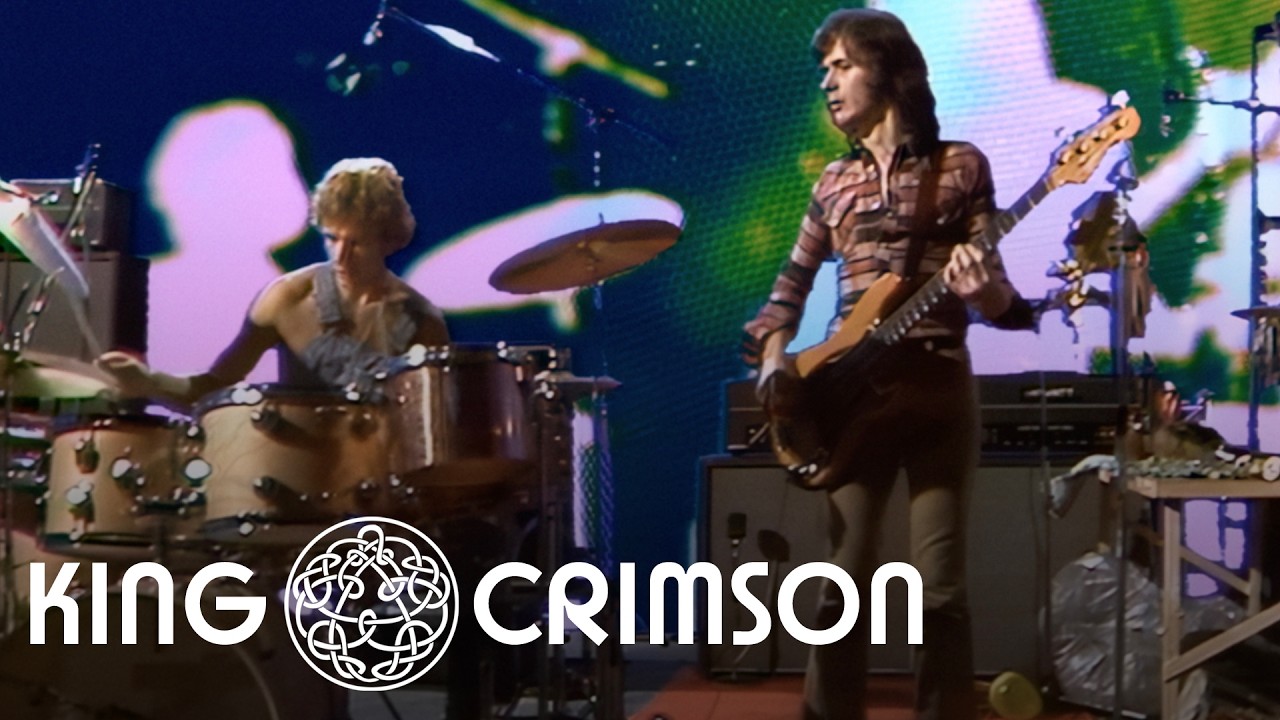
The first time this band ever played together was on German television, in front of people expecting a pop show.
The show finished with Jamie Muir emptying a sack of leaves across the studio floor. That is Robert Fripp’s own account of October 17, 1972 at Bremen, and it is a reasonable summary of what the room had just watched. What almost nobody present understood was that this was the first formal performance the five of them had ever given. Not an early tour date — the first. They walked into a German television studio, played material that would not be released for another five months, and left the floor covered in leaves.
Fripp had spent 1972 taking the band apart and building a different one. He had ended the previous lineup after Islands, saying they were musically incompatible with where he wanted to go, and then assembled four musicians who had no obvious reason to be in the same group. John Wetton came from Family. David Cross played violin, which no rock band was using as a lead instrument. Jamie Muir came out of London’s improvised-music scene and brought a percussion rig containing a thumb piano, a glockenspiel and a quantity of things that were not instruments at all.
The fourth was the one that made the papers. Bill Bruford quit Yes in July 1972 — front-page news in Melody Maker — walking away from the biggest progressive rock band in Britain immediately before the Close to the Edge tour, on the grounds that he had learned what he was going to learn there. He took a substantial cut in money and status to do it.
The first lesson
What he got in return was Jamie Muir stopping a session to tell him that what he was playing was “crap.” Bruford has described that as one of the most important moments of his early career, which is a striking thing for a man of his standing to say about being insulted by a percussionist. Muir was not being cruel. He was pointing out that a drummer who had spent four years serving arrangements had arrived somewhere that did not want arrangements served.
The results are on this recording. The piece opens with almost three minutes of small sounds — Muir’s thumb piano, glockenspiel, objects being struck — before Cross’s violin establishes anything resembling a theme, and it is another stretch after that before Fripp’s guitar figure arrives and the whole thing detonates. Nothing about the structure is conventional and nothing about it is accidental. The band had been drawing on Eastern European modernist composition and free improvisation, and had decided that a rock audience could follow both if you simply played it at them.
What happened to the man who named it
They recorded the album at Command Studios in London between mid-January and early February 1973, and Island released it on March 23. It reached No.20 in Britain and No.61 in America, which for a record this uncompromising was a considerable result. The title came from Muir — somebody asked him to describe what the band sounded like and that was his answer.
A week after it came out, he left. He gave up music entirely and entered a Buddhist monastery in Scotland, and the group carried on as a quartet through Starless and Bible Black and Red before Fripp shut the whole thing down in the summer of 1974. Muir’s playing survives on one studio album and a handful of recordings like this one, made before the band had played a note in public. The performance stayed unreleased until 1999, when it came out through King Crimson’s own collectors’ club — twenty-seven years after five men walked into a television studio in Bremen and played something nobody had ever heard.
SONG INFORMATION
Artist: King Crimson
Song: “Larks’ Tongues in Aspic, Part I”
Album:Larks’ Tongues in Aspic
Released: March 23, 1973
Recorded: January–February 1973
Studio: Command Studios, London
Label: Island
Songwriter(s): David Cross, Robert Fripp, John Wetton, Bill Bruford, Jamie Muir
Chart Performance: Album No.20 UK, No.61 US
Performance: Beat-Club, Radio Bremen, West Germany, October 17, 1972 — the lineup’s first formal performance
Lineup: Robert Fripp (guitar, mellotron), John Wetton (bass, vocals), David Cross (violin, mellotron), Bill Bruford (drums), Jamie Muir (percussion)