



Ray Charles – What’d I Say
Ray Charles had twelve minutes left to fill and nothing left to play.
The contract said four hours. Somewhere in Pennsylvania in December 1958, with about twelve minutes still to go, Ray Charles had played every song he knew. He turned to the band and told them he was going to start something and had no idea where it was headed, so they should follow him. He told the Raelettes to repeat whatever he sang. Then he put his hands on a Wurlitzer electric piano and made up What’d I Say in front of a room full of people who had come out to dance.
Keep watching: More Ray Charles on Music Videos Club
The Wurlitzer was there by accident of temperament. Charles had been hauling one around since 1956 because he did not trust the pianos waiting for him at venues — the tuning, the action, the general condition of an instrument nobody had loved in years. Other musicians thought carrying an electric keyboard was ridiculous and told him so. It is the sound that opens the record, and in 1959 almost nobody listening had heard anything like it.
The room’s reaction settled the question. Charles said afterward that he never tried material out on audiences before recording it, and that this was the single exception. People came up to the stage wanting to know what the song was called so they could go and buy it. There was nothing to buy. He went and made one.
The song nobody in the room thought was the good one
Atlantic had just taken delivery of an eight-track recorder, and engineer Tom Dowd was still learning what it did. On February 18, 1959, Charles brought the orchestra and the Raelettes into the label’s small studio on 56th Street in New York and they cut it live, no overdubs, three or four takes. Dowd’s recollection is that it did not feel like anything special. It was the second of two songs that day, and Charles, the producers, and the band all preferred the first one, Tell the Truth.
The finished tape ran long past what a single could hold, so Dowd trimmed some of the shouted asides and split it across two sides of a 45, Part I and Part II, with a false ending in the middle where everything stops and the room begs Charles to keep going. Having heard it back, Dowd’s view had changed entirely; he said later there was no question it was a hit. Atlantic held it through the spring and released it in June.
Radio was less sure. A great many stations, Black and white alike, refused to play it on the grounds that the call-and-response between Charles and the Raelettes was too suggestive for the air. Charles never pretended otherwise; asked about it, he agreed with them and left it there. Billboard’s first review was lukewarm. Then the distributors started calling. The record entered the chart on July 13, 1959, went to No. 6 on the Hot 100 and No. 1 on the R&B chart, and became Charles’s first gold record and the best-selling thing Atlantic had.
Eight years later, on a Sunday night
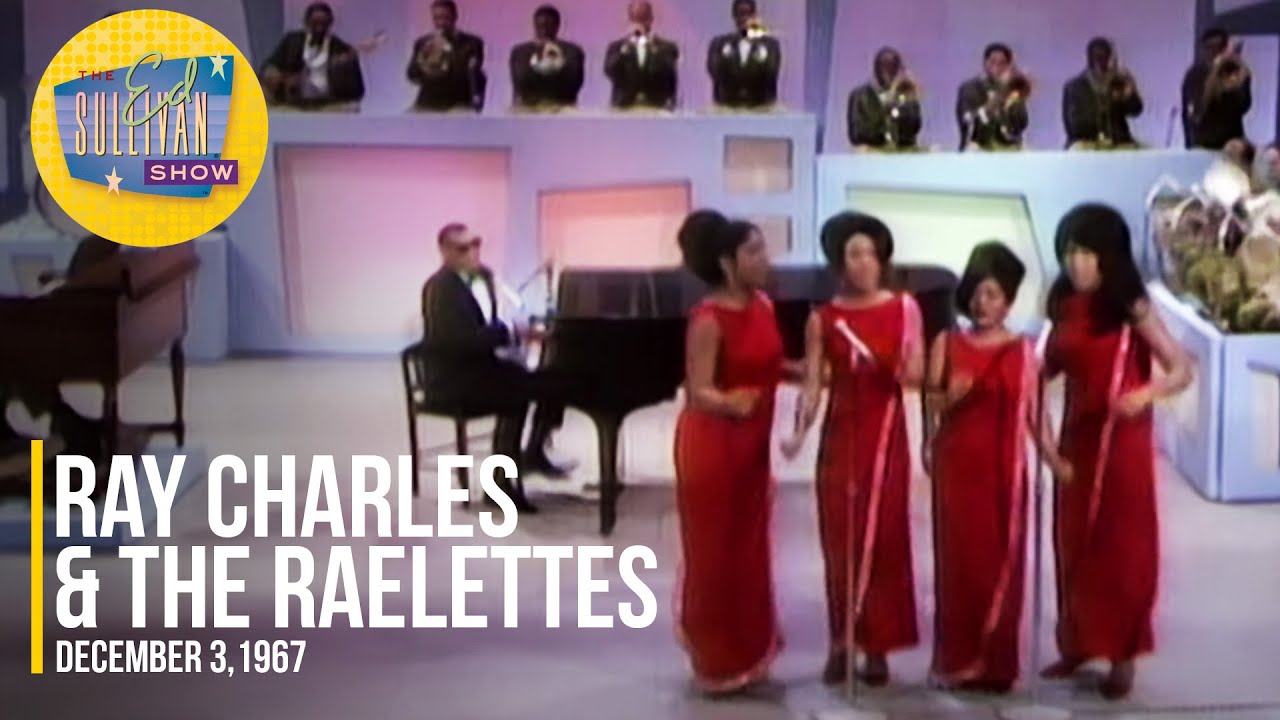
What plays on this page is not that record. It is CBS, December 3, 1967, and it was Ray Charles’s first appearance on The Ed Sullivan Show — he made only one more, a year later. He had left Atlantic for ABC by then, and the man at the organ is Billy Preston, who was in his band at that point and who is not on the 1959 recording at all.
Preston’s contribution to the intro is the reason this performance is worth watching separately from the record. He is doing something the studio version does not do, and Charles gives him the room to do it. Two years after this broadcast Preston was in a London studio playing on Beatles sessions, and the line from a Sullivan soundstage in 1967 to the roof of Apple Corps in 1969 is shorter than it looks.
The Raelettes are doing on camera exactly what got the record banned, in front of a Sunday-night family audience, and by 1967 nobody minded at all. That is roughly what happened to the whole song. It was gospel structure carrying secular words, which had made people uncomfortable when Charles started doing it in 1954 and which by the mid-sixties was simply what popular music sounded like. He built it out of twelve minutes he needed to fill.
SONG INFORMATION
Related videos
 Watch LaterAdded
02:02
Watch LaterAdded
02:02  Watch LaterAdded
02:27
Watch LaterAdded
02:27  Watch LaterAdded
04:17
Watch LaterAdded
04:17