





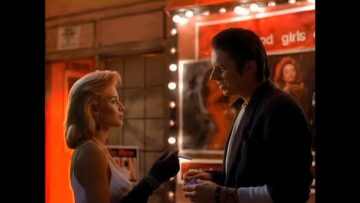
Rod Stewart – You’re In My Heart (from One Night Only!)
He Took a 1977 love song into the Royal Albert Hall in 2004 and sang it like time had only sharpened the ache.
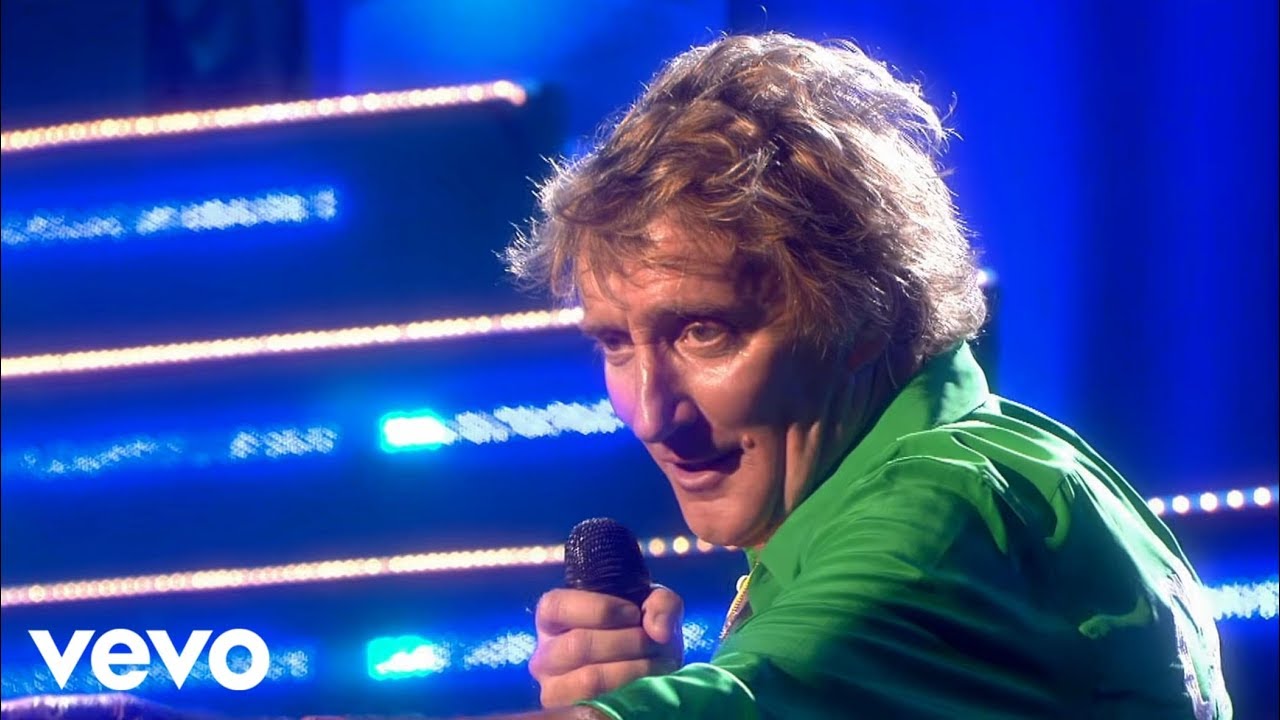
By the time Rod Stewart reached “You’re in My Heart” at the Royal Albert Hall, the song was no longer just a soft-focus hit from the late seventies. In that room on October 13, 2004, it landed as a piece of personal history carried into a new phase of his career: older, looser, more reflective, and framed by an audience that knew every turn of the melody before he sang a word. That is what makes the One Night Only performance matter. It is not simply a famous singer revisiting a favorite. It is Stewart using one of his most openly sentimental songs to connect the swagger of his classic run with the more expansive, showman-like version of himself he had become by the early 2000s.
That context changes the way the performance plays. “You’re in My Heart (The Final Acclaim)” first appeared in 1977 on Foot Loose & Fancy Free, written by Stewart and produced by Tom Dowd at a moment when he was balancing hard-edged rock, radio balladry, and tabloid-sized charisma better than almost anyone in mainstream pop. On paper, it is a love song with unusual tenderness for an artist more often associated with raspy bravado. In practice, it became one of the records that defined how he could soften his voice without losing his identity. It climbed to No. 4 in the United States and No. 3 in the U.K., which helps explain why the Royal Albert Hall crowd treats the opening lines less like a nostalgia cue than a shared possession.
The song that aged with him
What Stewart understood, and what this performance proves, is that “You’re in My Heart” grows more persuasive with age. In 1977, its appeal came partly from contrast. Here was a singer known for mischief and bravado delivering a romantic song with real warmth, and doing it without sanding off the roughness in his voice. By 2004, that roughness had become part of the meaning. The vocal on One Night Only is not trying to recreate the studio single note for note. It leans into grain, breath, and phrasing. Stewart lets the lines settle instead of hurrying them, which gives the performance a reflective weight the original hinted at but did not fully need. A younger man sings it as devotion. An older performer sings it with memory inside it.
The setting helps. Royal Albert Hall always asks artists to think in scale, and Stewart meets that challenge by refusing to overplay the song. Rather than forcing it into a grandstanding showpiece, he lets the arrangement do the lifting. The band keeps the performance broad and elegant, giving the chorus room to bloom while preserving the directness that made the record a crossover success in the first place. That balance is essential to Stewart’s best live work. He has always been a crowd-pleaser, but his stronger performances do not confuse sentiment with excess. This one works because he trusts the song’s shape, then adds the lived-in authority of a singer who no longer has to prove he can sell a ballad to a rock audience.
Royal Albert Hall as a frame, not a backdrop
The 2004 show also arrived at a revealing point in Stewart’s career. His Great American Songbook albums had widened his audience and reintroduced him as an interpreter of standards, but One Night Only made the case that the older catalog still carried its own emotional force. In that sense, “You’re in My Heart” becomes more than a familiar title in the set. It becomes evidence that Stewart’s original songs could stand comfortably alongside the standards he had recently embraced. The venue, the occasion, and the benefit setting for The Prince’s Trust all sharpen that impression. Instead of treating the performance as a museum piece, Stewart folds it into a larger self-portrait: rock star, balladeer, veteran entertainer, and writer of songs sturdy enough to survive changes in fashion, voice, and audience expectation.
That is why this footage still holds up. It preserves a version of Rod Stewart that is impossible to reduce to one era. The man who first recorded “You’re in My Heart” in 1977 was still present, but so was the performer who had learned how to turn recollection into dramatic tension without making it look effortful. The Royal Albert Hall performance does not depend on novelty, reinvention, or spectacle. Its strength is simpler and harder to fake. Stewart walks a well-known song back into the spotlight and shows that its emotional center is still intact. In the process, One Night Only turns a major seventies hit into something rarer: a live performance that deepens the song instead of merely replaying it.
SONG INFORMATION
Related videos
 Watch LaterAdded
 Watch LaterAdded
02:13
Watch LaterAdded
02:13  Watch LaterAdded
04:19
Watch LaterAdded
04:19