









The Police – Every Breath You Take
It plays at weddings every weekend, somewhere in the world, right now — and it is a song about a man who cannot stop watching a woman who left him.
Somewhere in the world this weekend, a couple will take their first dance to Every Breath You Take. They will have chosen the most played song in radio history — certified exactly that by BMI in 2019 — and they will have chosen a song about surveillance, possession, and a man who cannot stop watching a woman who has left him. Sting has spent four decades pointing out how sinister the lyric is, and four decades of listeners have kept hearing a love song anyway. That misunderstanding is part of why it never goes away: the melody promises devotion while the words describe a cage, and most people only ever hear the melody.
Keep watching: The Police – Roxanne · When the World Is Running Down · explore more →
The darkness was autobiographical. Sting wrote it in 1982, retreating to the Caribbean as his marriage to actress Frances Tomelty collapsed and his relationship with Trudie Styler — Tomelty’s close friend and the couple’s next-door neighbor — became a public scandal. He woke in the middle of the night with the title line in his head, sat at the piano, and finished the song in half an hour. The demo, cut at Utopia Studios in London, was just Sting singing over a Hammond organ, and it might have stayed a moody sketch if the band recording it had not been at war with itself.
Three men who could not stand each other
By the time the Police reconvened at George Martin’s AIR Studios on Montserrat to make Synchronicity, the band was held together by contract and spite. Producer Hugh Padgham has said Sting and Stewart Copeland flatly hated each other — the fights were verbal and physical, and the sessions came close to being abandoned before a crisis meeting with manager Miles Copeland kept the album alive. The track itself was assembled under that strain: six weeks spent on just the snare and bass, the drum part built from separate overdubs with a snare and gong drum struck together for the backbeat, and Padgham suggesting the stark single-note piano in the middle eight. The transforming moment belonged to Andy Summers. Handed a track with no guitar and told by Sting only to make it his own, Summers played his circling, Bartók-inspired arpeggio figure in one take — the part every guitarist on earth has since had to learn. Copeland’s verdict on the finished record is one of rock’s great backhanded reviews: “Sting’s best song with the worst arrangement.” He may be the only person who hears it that way. Released in May 1983, it reached No. 1 on the Billboard Hot 100 on July 9 and stayed for eight weeks — the band’s only American No. 1 — while topping the UK chart for four weeks, finishing as Billboard’s No. 1 song of 1983, and taking two Grammys, including Song of the Year.
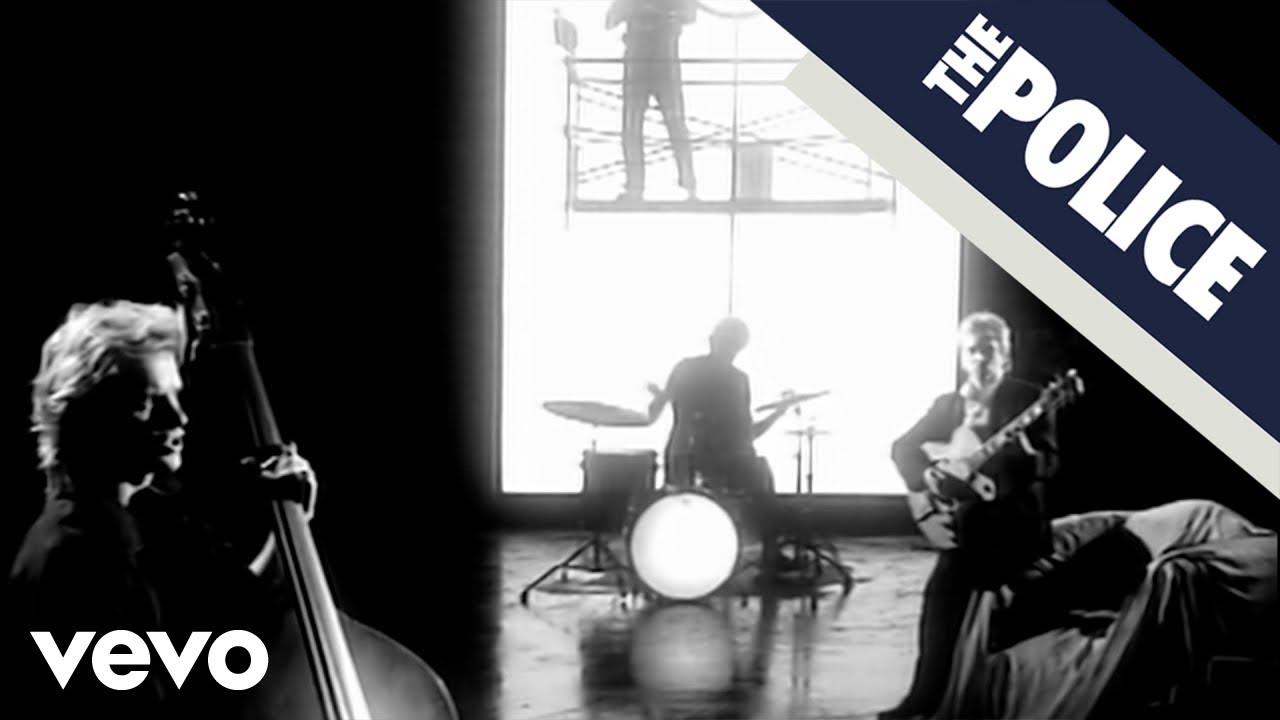
The video did as much as the record. Directed by Godley & Creme and modeled on Gjon Mili’s 1944 jazz short Jammin’ the Blues, it placed the band in a darkened ballroom in high-contrast black and white, Sting on double bass, a pianist and string section behind them, and a lone window washer working the glass — co-director Kevin Godley’s quiet nod to the song’s real subject, somebody watching. Cinematographer Daniel Pearl won the inaugural MTV Video Music Award for Best Cinematography, MTV and Rolling Stone later ranked it among the greatest videos ever made, and in 2022 it crossed one billion views on YouTube.
The forty-year argument
The song outlived the band — the Police were on hiatus within a year and gone by 1986 — and then it started generating arguments almost as durable as itself. When Puff Daddy built his 1997 Notorious B.I.G. tribute I’ll Be Missing You on the record, what he actually sampled was Summers’ guitar; neither Sting nor Copeland appears on it, yet the publishing money flowed to Sting, the sole credited writer of a song estimated to produce as much as a third of his publishing income. Summers, who said in 2023 the track was “going in the trash until I played on it,” and Copeland finally sued Sting in August 2025 over credits and royalties, and in January 2026 Sting agreed to pay his former bandmates over half a million pounds, acknowledging years of underpaid royalties. Forty-three years after three men who could not stand each other cut it in a room on Montserrat, the most played song in radio history is still teaching its oldest lesson: everybody hears what they want to hear — in the lyric, and in the credits.
SONG INFORMATION
Related videos
 Watch LaterAdded
04:05
Watch LaterAdded
04:05 ![David Lee Roth – California Girls (Official Video) [HD]](https://musicvideosclub.com/wp-content/uploads/2026/10/david-lee-roth-california-girls-360x203.jpg) Watch LaterAdded
04:37
Watch LaterAdded
04:37  Watch LaterAdded
05:29
Watch LaterAdded
05:29