






Petula Clark – Downtown
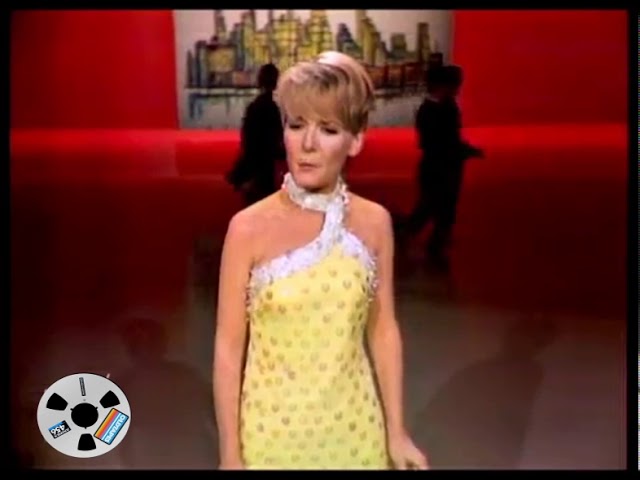
More than two years after **“Downtown”** changed her career, Petula Clark walked onto American network television and sang it not like a current hit, but like a standard she already knew would outlast its moment.
What makes the January 26, 1967 performance of “Downtown” on The Dean Martin Show so revealing is not that Petula Clark still sounded polished, or that the song still landed, or even that television remained one of the great engines of pop fame in the mid-sixties. It is that the performance catches her in the more difficult phase that follows a breakthrough: the point when a singer has to prove a signature hit can live beyond the chart week, the radio cycle, and the first wave of excitement. By early 1967, “Downtown” was no longer the new British record puzzling and then conquering American radio. It was already part of Clark’s identity, which meant the challenge had changed. She was no longer introducing it. She was carrying it.
That matters because “Downtown” had not arrived in 1964 as a routine transatlantic success. Written and produced by Tony Hatch, the song gave Clark the kind of American breakthrough British female singers rarely managed in the rock era. It reached No. 1 on the Billboard Hot 100 in January 1965 and No. 2 in the UK, and its success did more than expand her audience. It repositioned her entirely. Clark had already built a substantial career in Britain and Europe, but “Downtown” turned her into a fully international pop figure at a moment when the British Invasion story was still largely told through male groups and male songwriters. The record did not break through by force. It slipped in through elegance, melodic precision, and emotional reassurance, then proved strong enough to dominate.
By 1967, the song belonged to her in a different way
That is the frame that makes the Dean Martin footage worth revisiting. On paper, the setting could encourage people to treat the performance as a period curio: another brightly lit network showcase, another major singer delivering a familiar favorite for a mass American audience. But Clark’s performance refuses to sit still as nostalgia. She sings “Downtown” with the ease of somebody who understands that the song no longer needs to prove its craftsmanship. What it needs now is presence. The tone is confident without becoming casual. Her phrasing is crisp, the warmth in the vocal remains intact, and the performance has that particular kind of television discipline that the best singers of the era mastered: intimate enough for the camera, controlled enough for the room, and direct enough to reach viewers who may have thought they already knew the song by heart.
That control is part of what made Clark such a distinctive television performer in the first place. Unlike artists whose stage power depended on visible struggle or theatrical excess, she often looked almost improbably composed. The poise could make people underestimate the difficulty of what she was doing. “Downtown” is not a huge belting showstopper masquerading as pop. Its strength lies in line, lift, and emotional management. The lyric offers escape, but not frenzy; comfort, but not softness without structure. To sell it properly, a singer has to balance sophistication and invitation at once. In the 1967 performance, Clark does exactly that. She does not lean on the song’s fame. She refreshes it by inhabiting it with the assurance of someone who knows the architecture is solid enough to support a lighter touch.
The television performance as proof of longevity
The other thing the Dean Martin appearance captures is the distance between the first impact of “Downtown” and the way the song had settled into American culture just two years later. When a record arrives with unusual force, there is always a question hiding behind its success: is this a hit, or is this repertoire? By 1967, Clark was already answering that question in real time. She had followed “Downtown” with a run of significant hits, and that larger body of work helped free the song from the burden of being a one-off phenomenon. On television, that meant she could present it not as a career-defining rescue line but as one part of a broader catalog. The effect is subtle but crucial. A song lasts differently once it is no longer carrying all the narrative weight by itself.
Seen from that angle, the Dean Martin performance becomes more than a pleasant document of a famous singer revisiting her best-known recording. It shows the moment when “Downtown” had already crossed from chart event into durable songbook material, and when Petula Clark had learned how to present it accordingly. The camera catches neither reinvention nor strain. What it catches is command. That may sound less dramatic than a comeback, a controversy, or a reinvention, but in pop history it is often the rarer achievement. Plenty of songs peak high. Fewer survive their own success with grace. Clark’s performance on The Dean Martin Show shows exactly how that happens: not by overselling the past, but by standing inside it calmly enough to make it feel current all over again.