



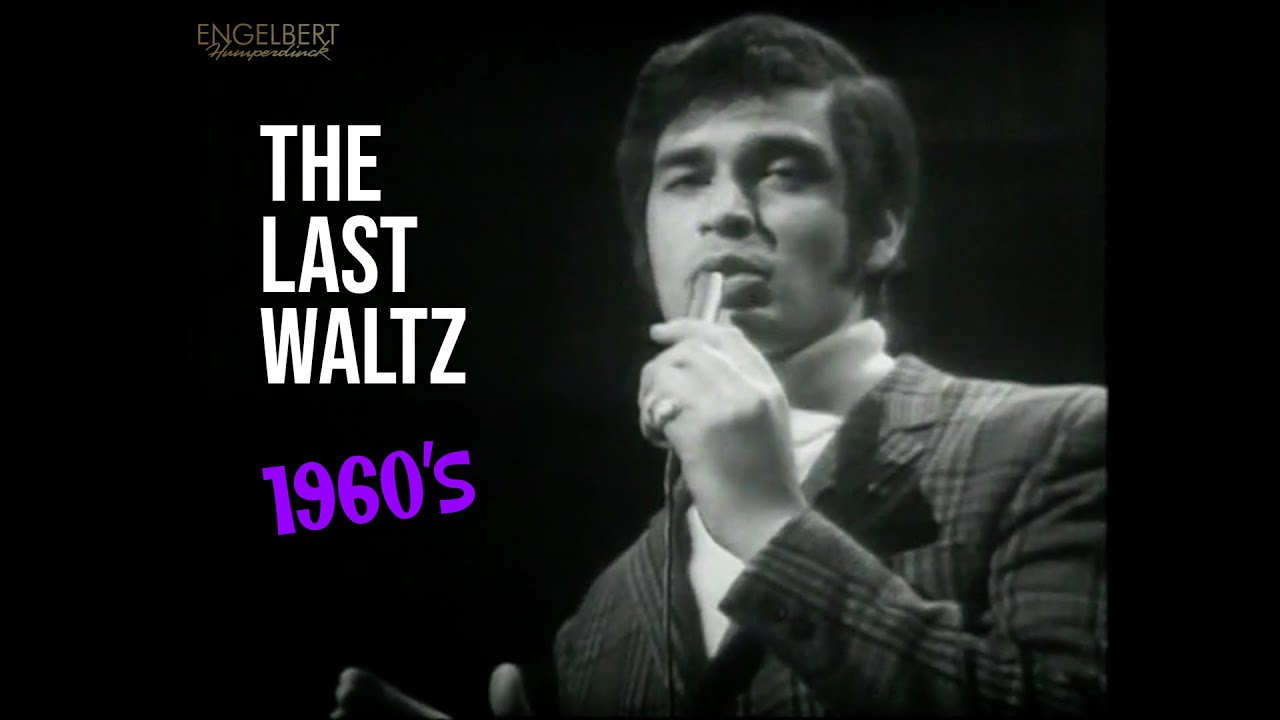





Engelbert Humperdinck – The Last Waltz
He Had Already Blocked the Beatles Once That Year. The Second Time, He Did It with a Waltz.
By the time Arnold George Dorsey walked into the studio to cut The Last Waltz in the summer of 1967, the man no longer existed in any commercially relevant sense. He had been replaced — at his manager’s insistence — with a stage name borrowed from a nineteenth-century German composer of fairy-tale operas. Engelbert Humperdinck was the new identity, the new product, the new chart-topping voice of the Decca roster, and earlier that same spring he had done the seemingly impossible: he had kept The Beatles off the number one spot in Britain. Release Me sat at the summit of the UK Singles Chart for six consecutive weeks beginning in March 1967, holding back Strawberry Fields Forever / Penny Lane — the double A-side now widely considered one of the greatest singles ever pressed. By summer, Decca knew exactly what they had. They needed another ballad, and they needed it fast.
The song that arrived to do the job was written by two men who would later define an entire decade of British pop balladry. Les Reed and Barry Mason had already given Tom Jones his career-launching It’s Not Unusual in 1965 — Reed as composer, working with Gordon Mills, the same manager who looked after Humperdinck. They would go on to write Delilah for Jones the following year. The Last Waltz was their second number one of 1967 and their template-defining work: a slow, orchestrated, devastatingly singable piece of melodrama, built around a lyric whose entire architecture rested on a single double-meaning. The “last waltz” of the title is the dance that ends the night when the narrator first meets the woman. Years later, the same waltz becomes the dance where they part. The song is a love story and a breakup compressed into the same three-minute frame, and the listener does not realise the trick is being played until the second verse turns the first one inside out.
The Decca Studios Sessions
Producer Peter Sullivan, who had overseen Humperdinck’s earlier work, brought the singer back to Decca Studios in West Hampstead with a small army of arrangers — Les Reed himself orchestrating alongside Charles Blackwell and Johnny Harris, with engineer Bill Price at the desk. The arrangement they built was extravagant by 1967 standards: full orchestra in waltz time, prominent strings, a discreet rhythm section, and a vocal mixed forward enough to carry every nuance of Humperdinck’s baritone delivery. He was not a rock singer trying to sound classical. He was a working-men’s-club singer from Leicester who had found, in his second decade of trying, the exact register and material his voice was built for. The song does not strain him anywhere. It sits in the middle of what he could do, and it lets him stay there for the entire performance.
Decca released the single in August 1967. By the chart dated September 6, it was at number one. It stayed there for five consecutive weeks, holding off Scott McKenzie’s San Francisco, The Bee Gees’ Massachusetts, and a parade of other late-summer contenders, before yielding the top spot in early October. It sold more than 1.17 million copies in the United Kingdom alone, qualifying for one of the relatively rare million-selling certifications of the era. In Australia it spent nine non-consecutive weeks at number one. In Belgium it went to number one. In the United States, where Humperdinck was distributed via Parrot Records, it climbed to number 25 on the Billboard Hot 100 and into the top ten of the Easy Listening chart — a respectable showing in a market that found his style harder to place than the British and Commonwealth audiences who had embraced him without hesitation.
The Year Humperdinck Owned
What the bare numbers do not quite capture is the strangeness of the chart picture in 1967. The year-end rankings of best-selling UK singles placed The Last Waltz at number one for the entire year, with Release Me at number two. A single artist had taken the top two slots of the most culturally consequential year in British pop history — the year of Sgt. Pepper, of Are You Experienced, of The Velvet Underground & Nico, of the Summer of Love itself. He was 31 years old, born in Madras to a British Army NCO, raised in Leicester, and had spent the early 1960s as a moderately successful club singer named Gerry Dorsey before nearly dying of tuberculosis in 1965. His old roommate from a Bayswater flat, Gordon Mills, was now managing both him and Tom Jones, and had decided the way to break Dorsey on a second attempt was to give him a name nobody could forget after they had heard it once.
The song’s success internationalised quickly. Mireille Mathieu’s French version, La Dernière Valse, topped the French chart for three weeks and crossed back over to reach number 26 in the UK. Petula Clark’s competing French rendition followed in early 1968 and peaked at number two in France. Peter Alexander’s German version, Der letzte Walzer, hit number one in Germany in November 1967. Across all language versions, the song would eventually account for sales in excess of eight million copies — a footprint very few mid-1960s ballads ever achieved. Decades later, the song became indelibly associated with two English football clubs, Peterborough United and Gillingham, played at home matches as a fan tradition that long outlasted the original chart context. Humperdinck himself returned to the title repeatedly across his career: in 2024, at 88, he announced his international farewell road trip and named it, with no apparent irony, The Last Waltz Farewell Tour. The song he cut over a few sessions in 1967 had become the frame around the rest of his working life.
SONG INFORMATION
Related videos
 Watch LaterAdded
04:05
Watch LaterAdded
04:05  Watch LaterAdded
02:57
Watch LaterAdded
02:57  Watch LaterAdded
03:04
Watch LaterAdded
03:04