





Carrie Underwood – Before He Cheats
They Wrote It For Gretchen Wilson. A Sweet Farm Girl From Oklahoma Heard It Once On A Plane And Said “I’m Cutting That Song.”
The girl who had never been on a plane before American Idol, who worried about her pets while she was in Hollywood, who was genuinely concerned that Simon Cowell might say something mean — that girl heard “Before He Cheats” for the first time in the back of a tour aircraft somewhere between two cities and knew, without hesitation, that she was recording it. One listen. No deliberation. “There was no discussion of putting it on hold or just letting us know they would sit with it. It was just one listen and knowing she would record it,” songwriter Josh Kear later recalled. The song became an enormous crossover success, topping the Billboard Hot Country Songs chart for five consecutive weeks and reaching number eight on the Billboard Hot 100. It is, twenty years on, one of the most recognisable country songs of its generation — and it was never meant for Carrie Underwood at all.
On the Billboard Hot 100, “Before He Cheats” achieved a longevity of 64 consecutive weeks on the chart, making it the eighth longest-charting single in the history of the Hot 100. The song held the record for the longest ascent to the top ten of the Billboard Hot 100, taking 38 weeks to climb to the top tier in 2006–07 — eventually surpassed only by Glass Animals’ “Heat Waves,” which took 42 weeks in 2021. It became the first ever country song to sell over two million digitally and was once the best-selling country song of all time. It has since been certified 11× Platinum by the RIAA. At the 50th Grammy Awards, Underwood took home Best Female Country Vocal Performance while Kear and Tompkins collected Best Country Song — an unusually clean sweep for a record that had begun its life as filler for someone else’s album.
Chris Tompkins had been thinking of edgy material for Gretchen Wilson’s second record when he sat down one morning and began typing lyrics — not even picking up a guitar or a pen — and produced the first verse. Kear, in fact, had no idea who Carrie Underwood was in the summer of 2005. When the pair wrote the lyrics, they were trying to be funny. Josh had come over to Tompkins’ new house, Tompkins played him what he’d typed earlier, and without even talking about it, Kear just sang the chorus line: “Maybe next time he’ll think before he cheats.” They started talking about it from there, thinking of quirky stuff to match that first verse, and the song essentially wrote itself. It took about two hours — far faster than their usual process of multiple sessions spread across days. They were writing a Gretchen Wilson song. They were writing for someone with, as Kear later put it diplomatically, “a more believable bite.” A 22-year-old from Checotah, Oklahoma who had won a TV singing contest was not their target market. The song had other ideas.
When the question of recording it arose, Underwood was nervous. “It was kind of like, ‘Oh, is this too aggressive?’ Because I was, like, a sweet farm girl on American Idol,” she told People. “I remember at that time, I get this song. I thought, ‘People are going to hate me for singing this song. They’re gonna be like, we can’t let our children listen to this.’ Finally I was just like, ‘You know what? I like this song. I would turn this song up on the radio, so I’m just gonna go for it.'” The decision was more consequential than anyone understood at the time. Underwood was not simply recording an edgy song — she was redefining what kind of artist she intended to be, permanently separating herself from the beaming, wholesome Idol winner image that would otherwise have defined her entire career. She picked up the baseball bat and never looked back.
The recording itself was produced by Mark Bright, whose instinct was to keep the production deliberately country — no pop softening, no crossover smoothing, just a straight Nashville record with a big guitar sound and Underwood’s voice front and centre. Backstage at the Grammys, Kear told Billboard that the song’s broad appeal surprised even him: “It’s like a movie. You’ve got just enough sex and just enough violence to appeal to both sexes. The fact that they just left it as a straightforward country record and it worked was a surprise, and pleasantly so.” The key of F-sharp minor, the shuffle beat, and Underwood’s controlled ferocity on the chorus all combined to create something that was simultaneously completely country and completely impossible to ignore on any radio station it touched.
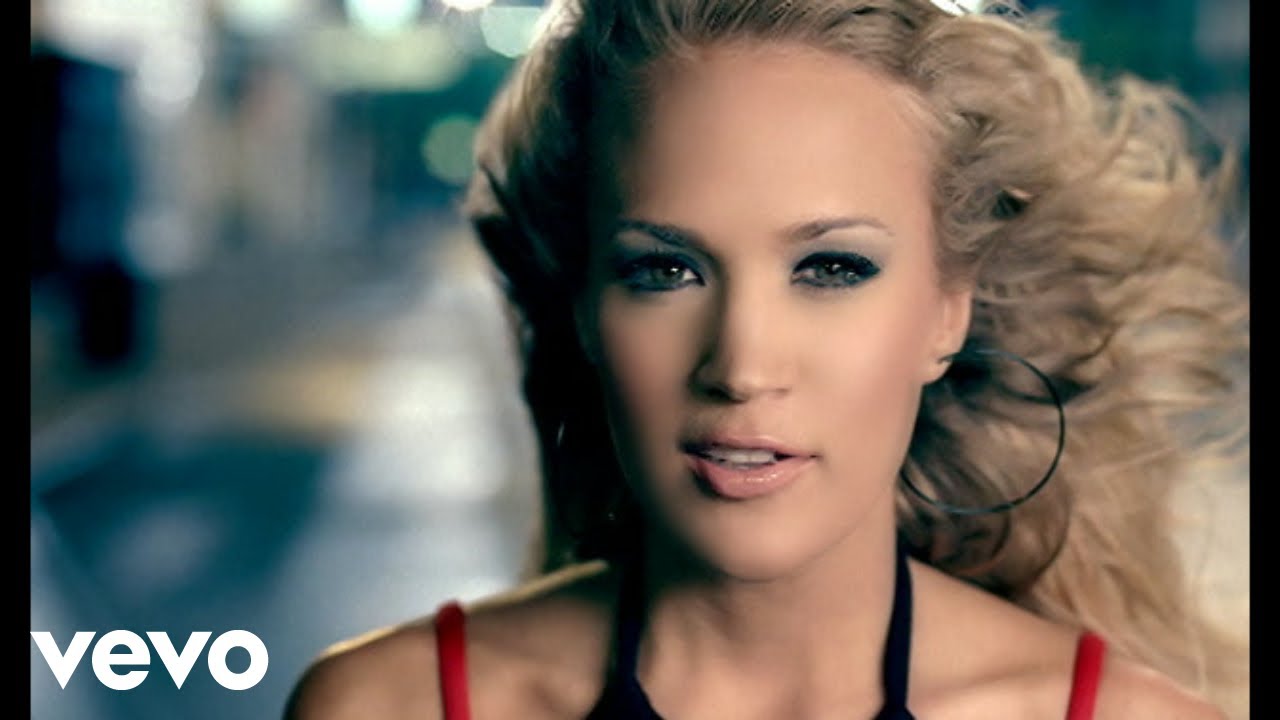
The music video, filmed in downtown Nashville’s Printer’s Alley, carries its own small piece of unplanned history. Not everyone on set was supposed to be there — a real-life drunk stumbled in front of Underwood during filming, and he made the final edit. The accidental extra blundering into the frame of a meticulously choreographed revenge fantasy gave the video an irreplaceable jolt of reality. The final scene, featuring exploding glass and light bulbs, was filmed on Fourth Avenue just north of Church Street in Nashville and pays homage to Brian De Palma’s Carrie. The video made GAC music video history by debuting at number one, swept the 2007 CMT Music Awards with three wins — Video of the Year, Female Video of the Year, and Director of the Year — making Underwood the first female to win Video of the Year, and was later voted the greatest diva music video of all time by VH1 viewers.
The song’s wider legacy reshaped not just Underwood’s career but the template for a certain kind of country hit. Thanks to this song, Underwood carved out a niche for songs that take down badly behaved boyfriends — a seam she would mine with increasing confidence across Blown Away, Storyteller, and beyond, building a body of work in which good men were occasionally rewarded but bad ones reliably paid a price. She performed it at the 2008 Grammy Awards with the cast of Stomp acting as backup dancers and percussionists on a set designed to look like cars being beaten up — a theatrical coup that remains one of the most memorable Grammy performances of that decade. “Before He Cheats” was named 2007 Single of the Year by the Country Music Association Awards, cementing its status as not just a hit but a cultural moment.
Underwood has since reflected simply: “Yeah, 20 years later, we still see people perform it, and it’s a lot of fun.” She is right that it is fun — but it is also something more durable than that. It is the song that proved a sweet farm girl from Oklahoma could swing a Louisville Slugger harder than anyone expected, that one listen on a plane is sometimes all the certainty you need, and that the most dangerous thing in country music is a woman who has made up her mind. Chris Tompkins started writing it for someone else. Carrie Underwood turned it into the defining song of her career, and then kept building from there. The truck never stood a chance.
SONG INFORMATION
Related videos
 Watch LaterAdded
04:26
Watch LaterAdded
04:26  Watch LaterAdded
02:50
Watch LaterAdded
02:50  Watch LaterAdded