


Donna Summer – I Feel Love
Brian Eno Burst Into the Room and Said He Had Heard the Sound of the Future — He Was Holding a Donna Summer Single
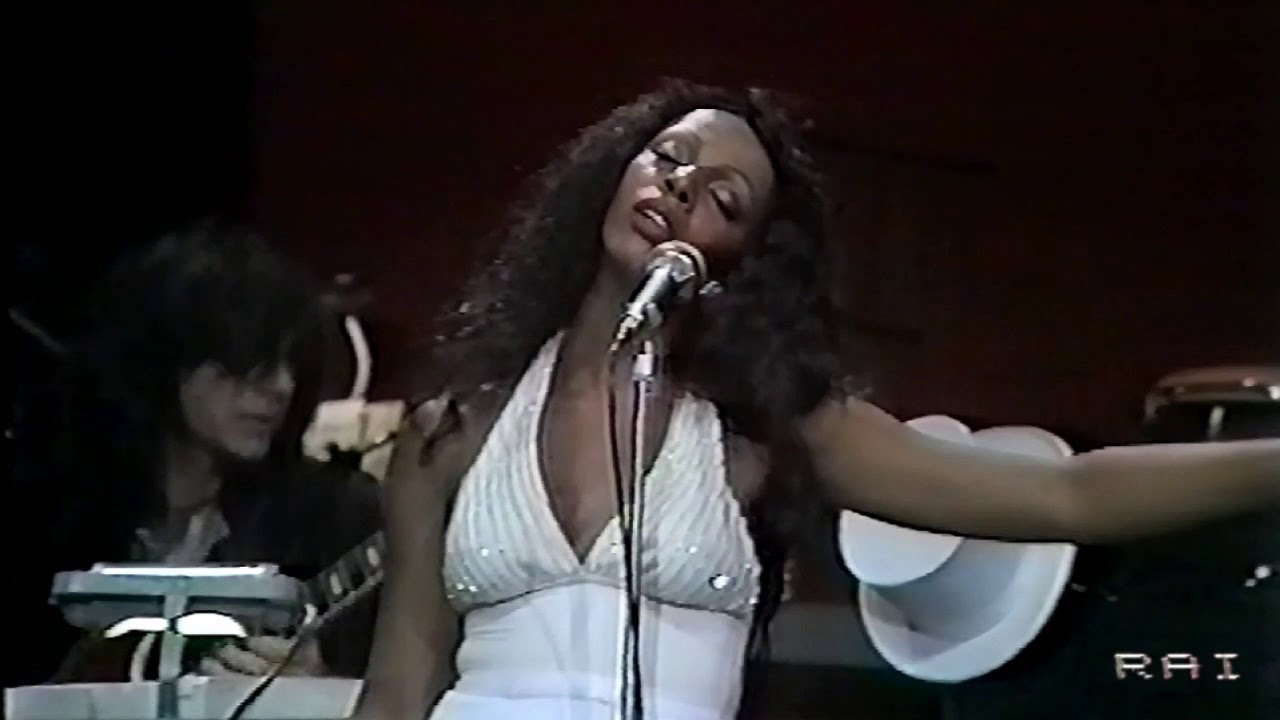
The story has been told enough times that it has passed into mythology, but it happened exactly as David Bowie described it. Bowie was in Berlin in 1977, deep into the sessions for the album that would become Heroes, when Brian Eno came running in with a record under his arm and the expression of a man who had just seen something he couldn’t explain. He put “I Feel Love” on the turntable, let it play, and told Bowie: “This is it, look no further. This single is going to change the sound of club music for the next fifteen years.” He was, as Bowie later confirmed with characteristic understatement, more or less right. By the time Donna Summer brought that record to life on the stage of the Greek Theatre in Los Angeles in 1978, it had already been rewriting music’s future for a year — and the live performance captured there made clear that no studio version, however perfect, could fully contain what happened when Summer stood in front of an audience and let it run.
The 1978 Los Angeles show caught Summer at the precise peak of her commercial and creative dominance. “I Feel Love” had been released in July 1977 on Casablanca Records, initially as the B-side to “Can’t We Just Sit Down (And Talk It Over)” — a placement so obviously misguided that the label reversed the sides within weeks. It reached number one in the United Kingdom, Australia, Austria, Belgium, and the Netherlands, and peaked at number six on the Billboard Hot 100. DJ Nicky Siano, then the reigning tastemaker at New York’s The Gallery, was handed an acetate of the unreleased single at a packed party by Casablanca’s own promotion team. He put on headphones, dropped the needle, and said he heard something that wasn’t a new record — it was a new style of production entirely. He played it immediately. The floor erupted. None of that surprise is audible in the studio recording. All of it is visible in the Los Angeles footage.
The song had been constructed in Giorgio Moroder’s Musicland Studios in the basement of the Arabella High-Rise building in Munich’s Bogenhausen district — a room that had already produced Donna Summer’s breakthrough “Love to Love You Baby” and was about to rewrite the rules of how electronic music could be made. The concept for I Remember Yesterday was Bellotte’s: each track would evoke a different musical decade, from forties swing through sixties girl groups to seventies funk, with the final song imagining the future. For that track, Moroder borrowed a Moog synthesizer from classical composer Eberhard Schoener — and because the Moog was so temperamental, the loan came with Schoener’s own engineer, Robby Wedel, as part of the deal. Moroder was frank about the arrangement: “I needed him because even if I’d owned one, I wouldn’t have been able to get any sound out of it.” Everything on the recording was synthesized — everything, that is, except the kick drum. The Moog couldn’t generate a thump powerful enough to move a dancefloor, so drummer Keith Forsey sat in the studio for seven minutes with just a bass drum pedal and laid down the pulse that the rest of the track breathes around.
Summer recorded the vocal in a single take. The lyric — simple, almost abstract, cycling through variations of bliss and sensation — was written to inhabit the space Moroder’s sequence had opened up rather than to narrate it. The result is a record in which the voice and the machine occupy the same emotional register, neither dominating the other, both running at the same velocity toward the same destination. When the New York DJ magazine Mixmag eventually named it the greatest dance track ever made, they described it as a record that was “guaranteed to make you smile, shut your eyes and trance out.” Rolling Stone placed it at number one on their 200 Greatest Dance Songs of All Time in 2022, and number 52 on their 500 Greatest Songs of All Time in 2024. Billboard named it the greatest dance song of all time in 2025. Each of those lists was compiled by people who had been listening to it for decades and still couldn’t find anything to put above it.
The Los Angeles performance arrives in the context of a year in which Summer had released three studio albums — I Remember Yesterday, the double album Once Upon a Time, and Live and More — and was running a schedule that most performers wouldn’t attempt across three years. The live recording format suited her in ways the studio never quite captured: Summer was a trained gospel singer whose entire instinct as a performer was shaped by rooms full of people rather than by isolation booths and headphones. On the Greek Theatre stage in 1978, “I Feel Love” becomes something different from the Munich original — looser in its edges, fiercer in its centre, and shaped by the specific electricity of an outdoor California venue in the middle of a disco summer that felt like it might never end.
The song’s influence has never contracted. Kylie Minogue, the Human League, Blondie, and New Order all absorbed its logic into their own work. Giorgio Moroder went from this record directly to the soundtrack for Midnight Express, having been called by director Alan Parker specifically because Parker wanted music with the driving feeling of “I Feel Love.” Patrick Cowley’s 1982 psychedelic remix became a staple of early San Francisco house music and has been in continuous circulation ever since. And in the summer of 1977, Nicky Siano played the acetate at The Gallery, the floor erupted, and everything that followed — house, techno, electronic pop, the architecture of the modern dancefloor — started from that moment. Summer brought it to Los Angeles in 1978 and proved it could survive being taken out of the machine and given back to a live room. It could. It can. It always will.
SONG INFORMATION
Related videos
![Fleetwood Mac – Dont Stop (Official Music Video) [4K]](https://musicvideosclub.com/wp-content/uploads/2026/01/fleetwood-mac-dont-stop-official-360x203.jpg) Watch LaterAdded
Watch LaterAdded
 Watch LaterAdded
03:55
Watch LaterAdded
03:55 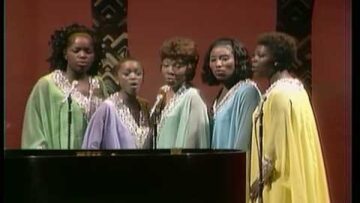 Watch LaterAdded
04:47
Watch LaterAdded
04:47