



Led Zeppelin – Kashmir (Live at Knebworth 1979)
A song with nothing to do with Kashmir, no chorus, no resolution, and an orchestra Led Zeppelin had to rent for the session — performed in 1979 at the last UK shows the four of them would ever play, and finally — 46 years later — released as an official single.
Robert Plant has been clear, in the fifty-plus years since the song came out, about what Kashmir is and is not. It is not about Kashmir. It does not contain a single image of the disputed mountain region of India and Pakistan from which it takes its name. The lyric came to Plant in the autumn of 1973 during a long drive across the Tan-Tan road in southern Morocco — a single-lane highway running through wasteland that goes on for hours, the sun bleaching everything, no other cars in sight. He wrote it down at the next stop. He liked the word “Kashmir.” He used it because he liked it. He has called the song “the definitive Led Zeppelin song.” On all of those points he has been impossible to budge.
The track that grew up around that lyric was, by some distance, the most carefully constructed thing Led Zeppelin ever recorded. The basic riff was a tuning cycle Jimmy Page had been turning over for years, in DADGAD, the open-tuning blues guitarists from John Renbourn onwards had used to imitate North African and Indian phrasing. Page brought it to Headley Grange in December 1973 and played it at John Bonham across the room; Bonham, with the slow heavy patience that defined his playing, found a way of leaving space inside it. “It was what he didn’t do that made it work,” Plant later said. They cut the song at Headley Grange and Olympic Studios across the next two months, using Ronnie Lane’s mobile studio, and laid down only the guitar, bass, and drums.
The orchestra was John Paul Jones’s idea. The Led Zeppelin bassist and keyboardist arranged the string and horn parts that would be overdubbed later by session players, drawing the ear toward the Middle Eastern modal scales Plant’s vocal kept circling. Jones also played the Mellotron string lines underneath. The song that emerged took up the central spread of Physical Graffiti, the band’s sixth studio album, released on February 24, 1975 in the United States and four days later in the UK. The album has since been certified seventeen times platinum by the RIAA. Kashmir, on a record full of celebrated tracks, became the one Page and Plant agreed was the band’s masterpiece. It runs eight minutes and thirty-two seconds on the album. There is no chorus. There is no real resolution. The song just keeps building, then stops.
Two nights at Knebworth, four years after Earl’s Court
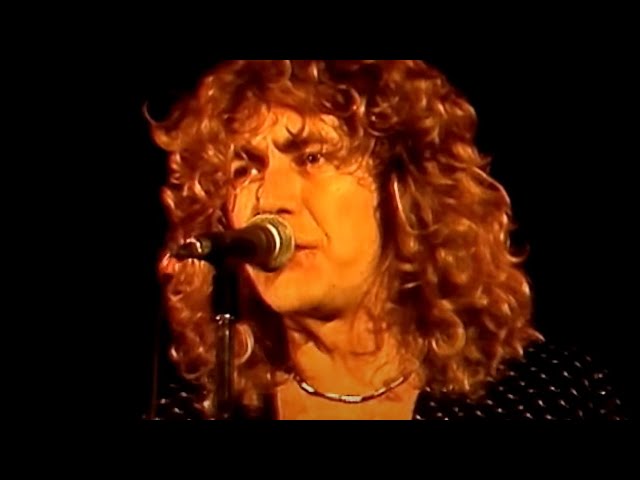
The performance featured here was filmed at Knebworth House in Hertfordshire on August 4, 1979 — the first night of the Knebworth Festival, the two shows the band agreed to play after two years out of the live circuit and four years out of the United Kingdom. The reasons for the long absence were grim. In July 1977, during the band’s North American tour, Plant’s five-year-old son Karac had died of a viral infection in England, and the tour was cancelled. Plant did not perform live again, anywhere, for almost two years. By the time manager Peter Grant convinced the four of them to come back at Knebworth, the band had also just finished In Through the Out Door, the album that would be their last. Roughly 100,000 to 150,000 people came to the first night on August 4; a slightly smaller crowd to the second on August 11. Both nights were recorded by the Rolling Stones Mobile Studio, with George Chkianz engineering, and professionally filmed for the backdrop video screens — the band wore the same clothes on both dates so the footage could be intercut for a planned TV special that never materialised.
The performance of Kashmir on this footage is not the studio version. It runs more than eleven minutes. The orchestra is replaced by Jones on synthesisers and Mellotron, doing the work of an entire string section live; the song is enormous in a different way, looser, more rhythmic, with Bonham leaning into the snare and Page extending the central guitar figure across the whole arrangement. By the closing minute the four of them are visibly aware of the size of what they are playing. The cameras catch Page glancing across at Plant and grinning. Plant is holding the microphone stand horizontal across his chest like a barbell.
None of them yet knew it would be their last UK show together. Bonham died on September 25, 1980, at Page’s house in Clewer, Windsor, after a long day of drinking that had begun in the late morning. He was thirty-two. The band issued a statement on December 4 confirming what everyone already understood: Led Zeppelin could not continue without him. The Knebworth tapes sat in the band’s archive for the next twenty-three years.
In 2003, Page and the documentary director Dick Carruthers compiled the Led Zeppelin DVD from the band’s historical footage, including a seven-song edit of the Knebworth shows — Page’s first major public re-engagement with the live material since Bonham’s death. The DVD remains, two decades on, the definitive visual document of the band. And then, last year, the band finally released the Knebworth audio as well. On August 29, 2025, “Kashmir (Live from Knebworth, 1979)” came out as a digital single — the first time the Knebworth recording had been available as audio outside the DVD. On September 12, the four-track Live E.P. followed on Atlantic, commemorating the fiftieth anniversary of Physical Graffiti by bringing the Knebworth and Earl’s Court recordings to CD, vinyl, and streaming for the first time. Forty-six years after the four of them walked off that Hertfordshire stage for the last time, Kashmir finally had an official live release. Watch the video.
SONG INFORMATION
Related videos
 Watch LaterAdded
04:53
Watch LaterAdded
04:53  Watch LaterAdded
04:22
Watch LaterAdded
04:22  Watch LaterAdded
03:21
Watch LaterAdded
03:21