

![Eric Clapton – I Shot The Sheriff [Crossroads 2010] (Official Live Video)](https://musicvideosclub.com/wp-content/uploads/2026/09/eric-clapton-i-shot-the-sheriff-360x203.jpg)
Boston – Don’t Look Back
The MIT Engineer Who Built Rock’s Most Impossible Debut — Then Was Forced To Follow It Up Before He Was Ready
Tom Scholz had a problem that most musicians would kill for, and he hated every second of it. His debut album had sold 20 million copies and was widely considered the greatest-selling first record in American music history. The label wanted a follow-up immediately. Scholz, the MIT-trained Polaroid engineer who had built a basement studio specifically to avoid the interference of record company executives, went back down the stairs, closed the door, and started working at exactly the pace that felt right to him — which was not, it turned out, anywhere near fast enough for Epic Records. “Don’t Look Back” was released on August 15, 1978, reached number four on the Billboard Hot 100, sold a million copies in its first two weeks, and was, by any commercially rational measure, an enormous success. Tom Scholz considered it unfinished. That tension — between what the world heard and what the perfectionist in the basement knew it could have been — is the defining story of the most paradoxically triumphant record of 1978.
The single peaked at number four on the Billboard Hot 100 in October 1978 and also reached the top ten in Canada, peaking at number six. CBS Records reported that the “Don’t Look Back” single sold more than a million copies in the first two weeks following its release. The album sold over four million copies in its first month and has since been certified 7× Platinum in the US. The album went straight to number one — a benchmark the debut had narrowly missed, peaking at three — and the title track remains Boston’s second biggest hit on the Billboard Hot 100, after 1986’s “Amanda,” which hit number one. By any objective standard, it was a triumph. The reviews were strong. The tour sold out arenas. Scholz released a statement complaining the whole thing was rushed. He was probably right.
The recording circumstances were, characteristically, extraordinary. Scholz was once again crafting Boston’s sophomore LP virtually by himself in his basement studio — a decision that baffled label executives who had, by this point, offered him access to the finest recording facilities on the planet. He didn’t want them. Tom Scholz has been on record stating that executives at Epic pushed him and the band into releasing the album before they felt it was ready. He said of Don’t Look Back: “It was ridiculously short. It needed another song.” The record barely eclipses the half-hour mark. The only piano on the entire album was recorded in a professional studio — simply because Scholz could not fit a piano in his basement. Everything else — guitars, organs, bass, keyboards, effects — came out of that room in Massachusetts where no label representative was permitted to set foot.
The title track itself arrived last of all. Although the first song on the album, “Don’t Look Back” was its final song to be written and recorded. According to Scholz: “It was one of those things where everything clicked. I didn’t even record a demo for that song. I came up with chord changes, melody, and the arrangement and put it right on the master tape.” For a man who routinely spent months revising single drum parts — Scholz made more than 60 edits to Sib Hashian’s drum parts on the title track alone before he was satisfied — skipping the demo entirely represents something close to spontaneous combustion. The riff that opens the song, the one that sounds like it was carved from solid rock, was placed directly onto the master without a safety net. The song that most thoroughly defines the Don’t Look Back sound was the one that came together the fastest. Brad Delp sang all the vocals, both lead and backing, while Fran Sheehan played only a few bass notes and Barry Goudreau handled the guitar solos in the intro and outro — parts Scholz specifically praised. For the rest of it, Scholz played everything himself.
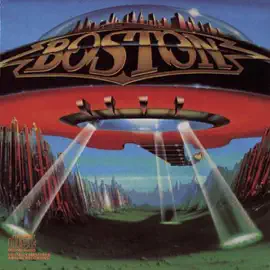
The album had originally been planned under a different name entirely. Don’t Look Back was originally to be titled Arrival, to continue the spaceship logo theme established by the debut. However, Boston discovered that Swedish pop group ABBA had released an album by that name two years prior, so the title was changed. The cover art — an upside-down guitar-shaped spaceship, designed after Scholz requested a guitar on the cover and product manager Paula Scher found a compromise — continued the visual language of the debut, giving the band a coherent visual identity at a time when most arena rock acts were still working with whatever the art department handed them. The theme was repeated for more records in the future.
The immediate aftermath of the album’s release was where the real drama began — and it would cast a shadow over the band for the better part of a decade. Scholz refused to be hurried in producing Boston’s third album, and CBS Records filed a lawsuit alleging breach of contract. A long court battle ensued, and that album, Third Stage, took more than eight years until it was finally released at the end of 1986. Don’t Look Back was among the first commercially produced compact discs when the format was introduced in 1983, but because of ongoing legal issues between Scholz and CBS Records, the title was pulled after a small production run and did not reappear on CD until three years later. The band that had become one of the fastest-rising acts in American rock history was effectively frozen in amber — their catalogue tied up in litigation while an entire generation of new bands arrived and departed. Boston ultimately won their court battle, but the years it consumed were years that could not be recovered.
The song’s pop culture longevity has been quiet but persistent. “Don’t Look Back” was used in the pilot episode of the ABC drama October Road, which aired on March 15, 2007, six days after the death of Brad Delp — Boston’s irreplaceable original lead singer. The timing felt less like coincidence than like fate making a grim editorial comment. The song also appeared in WKRP in Cincinnati and Cobra Kai — a span of appearances across four decades that speaks to its peculiar staying power. Tom Scholz has claimed in many interviews that he listens to the album track “The Journey” before he goes to bed each night.
Greil Marcus rated “Don’t Look Back” as one of three masterpieces on the album, alongside “A Man I’ll Never Be” and “Used to Bad News.” The man who built the record disagreed with the assessment — not because he thought the songs were bad, but because he knew what they could have been if the clock had been removed from the equation. That argument between an artist and his own standard of excellence produced a million-selling single, a number-one album, and one of the great what-ifs in classic rock: what would Tom Scholz have made, entirely on his own terms, entirely on his own schedule, with nobody knocking on the basement door? Third Stage, eight years later, gave a partial answer. The perfectionist’s curse is that the record you finish is never the record you imagined. Somehow, that basement in Massachusetts kept producing records that sounded pretty much like perfection to everyone else.
SONG INFORMATION