


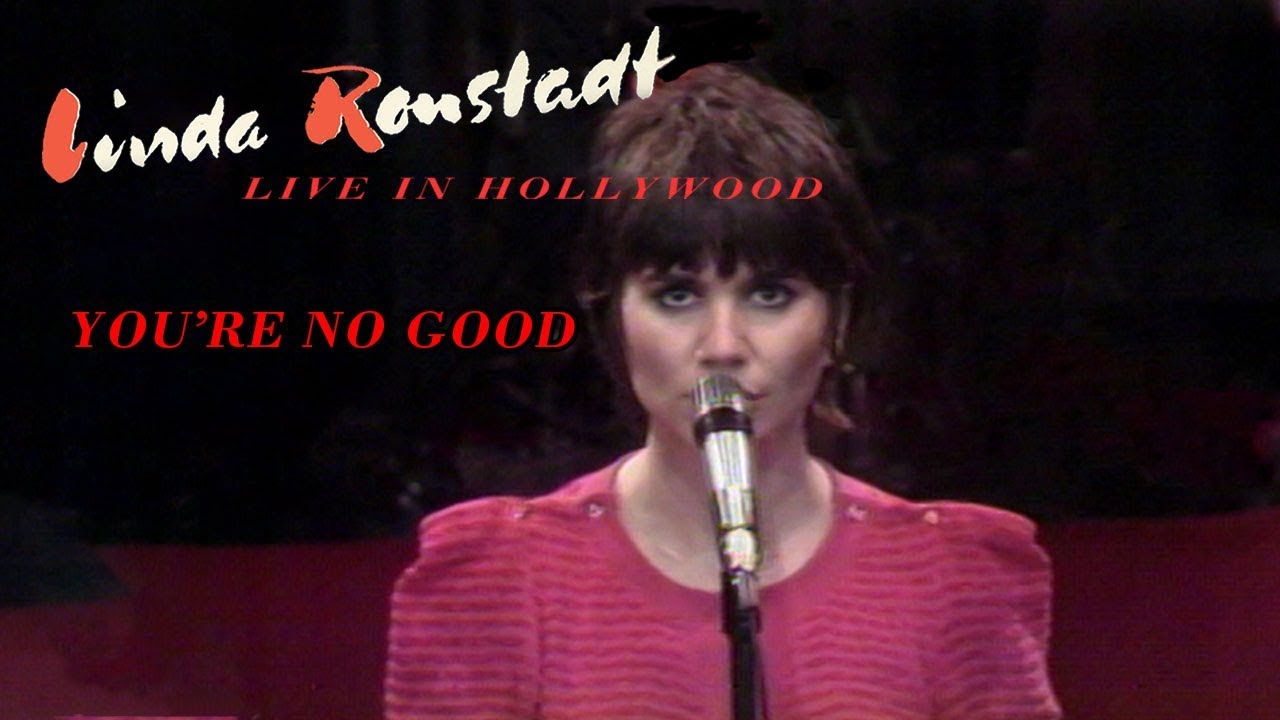



Linda Ronstadt – You’re No Good (Live)
Linda Ronstadt thought she sang it badly. America disagreed — it became her only No. 1, and the record that made her the biggest female rock star of the 1970s.
The song that made Linda Ronstadt a superstar is the one she never stopped criticizing. “It’s a live vocal, and it’s a terrible vocal,” she said of “You’re No Good” years later, complaining she’d rushed the phrasing on a night she was exhausted. The public heard something else entirely: a voice with the power of a freight train and the control of a surgeon, delivering the most satisfying kiss-off of the decade. In early 1975 it reached No. 1 on the Billboard Hot 100 — the only chart-topper of her entire career, and the record that opened the door to everything after.
Keep watching: Linda Ronstadt – Just One Look · more Linda Ronstadt →
The song came to her from the road. Written by Clint Ballard Jr. and first recorded by Dee Dee Warwick in 1963 — with a hit version soon after by Betty Everett, featuring a young Maurice White on drums years before he founded Earth, Wind & Fire — “You’re No Good” entered Ronstadt’s world in early 1973, when bassist Kenny Edwards suggested it as a closer for her ballad-heavy set on a tour opening for Neil Young. It worked so well she was performing it on national television by that December, on The Midnight Special. When she and producer Peter Asher assembled Heart Like a Wheel in mid-1974 — one last album owed to Capitol Records — the song was a late addition, something to layer in among the ballads. Nobody in the room knew they were about to cut the track of her life.
Three Rhythm Sections and One Erased Solo
Getting it on tape at Hollywood’s Sound Factory took stubbornness. The first attempt, cut on July 1, 1974, chased an R&B feel — with Fred White on drums, whose brother Maurice had drummed on the Betty Everett original, a coincidence nobody planned — and Ronstadt couldn’t find her footing in it. Asher rebuilt the track from scratch with a leaner band: Eddie Black on guitar, Kenny Edwards on bass, and the endlessly useful Andrew Gold playing drums, Wurlitzer electric piano, and eventually the song’s centerpiece — a multi-tracked, effects-laden guitar solo built deliberately in the style of the Beatles. Ronstadt busted him for it immediately, and came around by morning. She also remembers engineer Val Garay accidentally erasing that solo during a playback, forcing Gold and Asher to rebuild it from nothing — a story both men dispute to this day, one of those studio legends where every participant owns a different truth. Strings came last, arranged by Gregory Rose at AIR Studios in London, and the record’s famous ending — that impossibly long, slowly swelling final note — was Asher’s idea, executed by Garay riding the string faders during the final mix.
Heart Like a Wheel arrived in November 1974, and Capitol dithered for a week over the lead single before choosing “You’re No Good” over “When Will I Be Loved.” Both choices would have won. The single went to No. 1; the album became her first chart-topping record, sold more than two million copies, earned an Album of the Year nomination, and in 2013 was inducted into the Library of Congress National Recording Registry. It set the template for her imperial run: for the rest of the decade, Ronstadt took songs from every corner of American music and made them sound like they had always belonged to her, becoming the first female artist in history with four consecutive Platinum albums.
Eighty Years of That Voice
Linda Ronstadt was born on July 15, 1946 in Tucson, Arizona, on a ten-acre ranch where the family songbook ran from Mexican canciones to country and opera — a range she would eventually record in its entirety, from Nelson Riddle standards to mariachi to the Trio albums with Dolly Parton and Emmylou Harris. Her fingerprints are on more than her own catalog: the backing band she hired in the early 1970s included Glenn Frey and Don Henley, who left to become the Eagles. Eleven Grammys, roughly 100 million albums, the Rock and Roll Hall of Fame, the Kennedy Center Honors, and a Tucson concert hall renamed in her honor followed. She retired in 2011, and revealed two years later that a neurological condition — first diagnosed as Parkinson’s, later identified as progressive supranuclear palsy — had taken her singing voice. What it cannot take is the recorded evidence. July 15, 2026 marks her 80th birthday, and the performance on this page shows exactly what all the celebrating is about: the moment a self-critical perfectionist from the Sonoran desert stood in front of a band and casually owned the biggest song in America.