



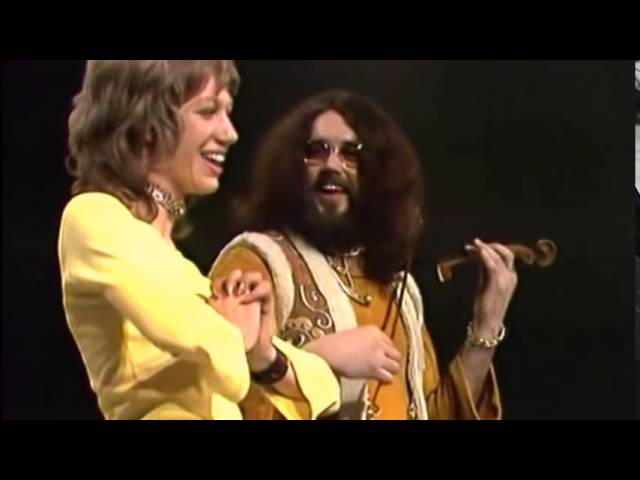






Mouth & MacNeal – How Do You Do
It was No.1 in five countries — and in two more, a copy of it beat the original.
The record was No.1 in the Netherlands, Belgium, Denmark, Switzerland and New Zealand. In West Germany it stopped at No.5, held off the top by a cover version cut by a Scots-German duo called Die Windows. In Australia, two readings of the song sat in the Top 40 at the same time, and the bigger seller belonged to a local band, Jigsaw. Very few hits are catchy enough to be outrun by their own imitators. How Do You Do managed it twice.
Keep watching: ABBA – Waterloo · more 70s music videos →
The act was assembled rather than discovered. Producer Hans van Hemert put it together in 1971 from two Dutch singers who had no obvious reason to share a microphone. Willem Duyn, born in Haarlem in 1937, had spent the 1960s cycling through bands that went nowhere — Whiskers, the Jay-Jays, Speedway — and had been working nightclubs as a DJ. Sjoukje van ‘t Spijker, born in Tilburg in 1950, was classically trained and had exactly one solo single to her name, a cover of Marvin Gaye’s I Heard It Through the Grapevine, also produced by van Hemert. He renamed them Big Mouth and Maggie MacNeal. One voice was a bark. The other was clear, patient and slightly amused. The mismatch was the product.
The song came from van Hemert and Harry van Hoof, a composer and arranger whose work runs through a great deal of Dutch pop from that decade. Decca released it in the Netherlands on January 22, 1971, backed with Land of Milk and Honey. The duo’s debut single, Hey You Love, had reached No.5 on the Dutch Top 40. This one went to the top, then kept going, taking Belgium, Denmark, Switzerland and, in time, New Zealand.
Fifteen months and one Boston disc jockey
America took considerably longer. The record reached the United States through the Philips and Polydor distribution chain at a moment when international acts got cautious treatment: anything that wasn’t British or Canadian rarely earned a serious push, and programmers doubted a Dutch record could work on American Top 40 radio. The song’s US breakthrough is generally credited to Jim Connors, the WMEX Boston personality who in the same period was pushing Chuck Berry’s My Ding-a-Ling toward a No.1. Connors worked it hard along the eastern seaboard until other stations followed.
It entered the Billboard Hot 100 in the spring of 1972 and peaked at No.8 that July, staying on the chart for nineteen weeks. The RIAA certified it gold on August 2, 1972; it passed a million copies in the United States and two million worldwide. In Canada it climbed to No.2, though not before an accident of promotion: Land of Milk and Honey charted first, spending two weeks at No.91 on the RPM listing before the other side of the record took over entirely. The album carrying it, Hey You Love / How Do You Do, reached No.77 on the Billboard 200.
That fifteen-month gap left behind a small permanent confusion. Dutch listeners file How Do You Do as a 1971 record, which it is. Americans remember it as a summer-of-1972 record, which is also true from where they were standing. Both dates are correct, and neither audience tends to know the other one exists.
The cover versions were a symptom of the same delay. A song moving that slowly across borders gave local acts time to record their own, and in two markets the copies won. Die Windows took the German No.1 while the original settled at five. Jigsaw’s Australian version outsold Mouth & MacNeal’s, which stalled at 32. None of it dented the accounting. The 1972 Buma Export Award — given for the most records sold abroad by a Dutch musical act that year — went to the duo and to both composers.
Third place, behind Waterloo
Two more Dutch No.1s followed, and in 1974 Mouth & MacNeal represented the Netherlands at the Eurovision Song Contest in Brighton with I See a Star. They finished third, behind Gigliola Cinquetti and behind ABBA’s Waterloo, which is a respectable way to lose. The song reached No.8 in Britain, the only UK Top 10 either of them ever had. That December the duo split.
Duyn carried on as Big Mouth & Little Eve with Ingrid Kup, and built a second career in Dutch voice work — he was King Louie in the Dutch Jungle Book and Scat Cat in The Aristocats. He died on December 4, 2004 at his home in Roswinkel, Drenthe, after a cardiac arrest. MacNeal returned to solo recording, went back to Eurovision on her own in 1980 with Amsterdam, and has kept performing.
What survives is a two-and-a-half-minute greeting sung by two people who sounded nothing alike, built plainly enough that it needed no translation in any market it entered. Mouth & MacNeal never charted in the United States again. They didn’t especially need to.
SONG INFORMATION
Related videos
 Watch LaterAdded
04:05
Watch LaterAdded
04:05  Watch LaterAdded
04:48
Watch LaterAdded
04:48  Watch LaterAdded
05:28
Watch LaterAdded
05:28