


![The Score – Revolution: Lyrics [Assassins Creed: Unity]](https://musicvideosclub.com/wp-content/uploads/2025/10/the-score-revolution-lyrics-assa-360x203.jpg)




![George Benson – Give Me The Night (Official Music Video) [HD Remaster]](https://musicvideosclub.com/wp-content/uploads/2026/02/george-benson-give-me-the-night-360x203.jpg)






Queen – Crazy Little Thing Called Love
Written Naked In A Munich Hotel Bath, Recorded Before Brian May Got There — Queen’s Most Unlikely Number One
The story of “Crazy Little Thing Called Love” begins exactly where you’d least expect it: in a hotel bathtub in Munich, with Freddie Mercury dripping wet, wrapped in a towel, demanding a guitar. Released on October 5, 1979 as Queen’s final single of the decade, it went on to become their first ever US number one — a wild, slapped-together rockabilly romp that sounded nothing like the band who had made “Bohemian Rhapsody” and “We Are the Champions.” That wasn’t a mistake. That was entirely the point.
Queen had been grinding through sessions for what would become their eighth album, The Game, at Musicland Studios in Munich — a process Brian May would later describe as them “bowling into the studio with no ideas and just doing it from scratch.” It was during those sessions, in May 1979, that Mercury stepped into a bath at the Bayerischer Hof Hotel and emerged ten minutes later with a finished song. Peter Hince, head of Queen’s road crew, was there. “The idea for the song came to him while he was in the bath,” he later told Mojo. “He emerged, wrapped in a towel. I handed him the guitar and he worked out the chords there and then. Fred had this knack of knowing a great pop song.” What Hince didn’t mention was that Mercury could barely play guitar. As it turned out, that was the secret.
“‘Crazy Little Thing Called Love’ took me five or ten minutes,” Mercury said in Melody Maker in 1981. “I did that on the guitar, which I can’t play for nuts, and in one way it was quite a good thing because I was restricted, knowing only a few chords. It’s a good discipline, because I simply had to write within a small framework. I couldn’t work through too many chords and because of that restriction I wrote a good song, I think.” The song was a deliberate tribute to Elvis Presley and Cliff Richard — the heroes of Mercury’s musical adolescence — and the limitation of his playing kept it honest. No overworked chord sequences. Just momentum, instinct, and a hip-shaking rockabilly groove.
He rushed it straight to the studio. There’s a reason for that. Producer Reinhold Mack recalled that Mercury told him they should record the song as quickly as possible, otherwise May would “make things take a little longer.” Mercury presented the sketch to Roger Taylor and John Deacon, and the three of them laid it down immediately. May arrived later to find the backing track already done: “That rhythm guitar is Freddie. I don’t think I played any of that,” he said. When May finally heard what they’d captured, he had one job left — the guitar solo. Mack insisted he put down his beloved homemade Red Special and pick up a Fender Telecaster instead, the vintage instrument that defined the sound of early rock and roll. May reluctantly agreed, and the result — widely considered one of his finest solos — was a deliberate salute to Scotty Moore, Elvis Presley’s longtime guitarist. Mercury had even recorded his own guitar solo for the song, but that version was lost; May’s replacement is what the world heard. The whole thing was finished — depending on who you believe — in either half an hour or six hours. Mack insists the latter. Mercury himself later said: “The finished version sounded like the bathroom version.”
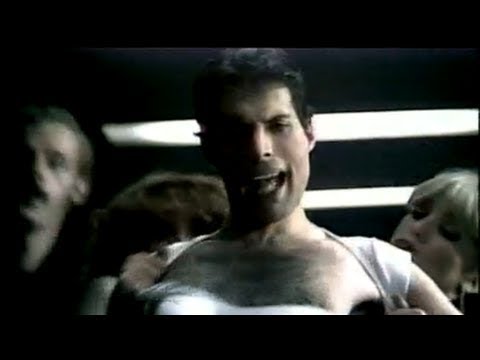
The music video, shot at Trillion Studios in London on September 21, 1979, was directed by Dennis De Vallance and leaned hard into the 50s aesthetic Mercury had drawn from. The band dressed in black leather jackets, Mercury already sporting his shorter new haircut but still without his soon-to-be-signature moustache. Queen used a professional backing dancer for the first time in this clip. The video has an effortlessly cool, monochrome energy — a stark contrast to Queen’s more theatrical previous efforts. It was the visual equivalent of the song: stripped back, confident, fun.
In the UK, the single spent two weeks at number two, held off the top by Dr. Hook’s “When You’re In Love With A Beautiful Woman.” In the US, the journey took longer and was even more unlikely. Queen’s American label, Elektra, were less than enthused about releasing it as a single, but their hand was forced when radio DJs started playing the import. Once released, the record entered the Billboard Hot 100 at number 58 in December 1979 and reached number one on February 23, 1980, staying there for four weeks. Queen heard the news while still in Munich, finishing The Game. “We were still making the record and were out in Munich, and somebody came up and said it had gone to number one in America,” Taylor recalled. In Australia, it went further still — seven consecutive weeks at the top. It was certified gold in the US, UK, and the Netherlands.
Live, the song transformed completely. The under-three-minute studio recording regularly stretched past five minutes in concert, with May adding an extended solo while Mercury strapped on a guitar — something he’d never done on a Queen stage before. Over time, the call-and-response moment in the lyric — “Are you ready?” / “Ready, Freddie!” — became one of the great crowd rituals of a Queen show. After Mercury’s death in November 1991, the line took on an entirely different resonance. Every guest vocalist since has kept it unchanged. The crowd still shouts “Ready, Freddie!” — every single time. At the Freddie Mercury Tribute Concert in April 1992, Robert Plant performed the song with the remaining members of Queen. Dwight Yoakam covered it in 1999, taking it to number twelve on the US country chart — proof that its rockabilly roots ran deep enough to be claimed back by the genre that inspired it.
Brian May described it simply: “Freddie’s tribute to Elvis, in a way. He was very fond of Elvis and of Cliff. Freddie wrote it very quickly, rushed in and put it down with the boys. The sounds Mack managed to get were very elemental. Everything about it is original rock ‘n’ roll sounding.” In a catalogue full of operatic bombast and stadium grandeur, “Crazy Little Thing Called Love” remains Queen’s most joyful, least premeditated moment — a song that achieved more by accident than most artists manage on purpose. A man in a bath, a borrowed guitar, and ten minutes of inspiration. Sometimes that’s all it takes.
SONG INFORMATION
Related videos
![Commodores – Three Times A Lady [Live]](https://musicvideosclub.com/wp-content/uploads/2025/06/commodores-three-times-a-lady-li-360x203.jpg) Watch LaterAdded
06:28
Watch LaterAdded
06:28  Watch LaterAdded
03:00
Watch LaterAdded
03:00  Watch LaterAdded
04:11
Watch LaterAdded
04:11