



Rush – The Spirit Of Radio
Alex Lifeson built the opening riff to sound like a radio dial hunting for a station — then Rush used the song to attack what radio had become.
The song opens with a sound before it opens with a note. Alex Lifeson’s introduction to “The Spirit of Radio” was engineered to imitate a radio being tuned — the rapid, skittering blur of frequencies as a hand rolls across the dial, hunting for something worth stopping on. It sounds like hammer-ons delivered at impossible speed. It is actually extremely fast picking, a deliberate sleight of hand, and it is the first joke in a song built almost entirely on a contradiction: a loving tribute to radio that doubles as an indictment of it.
Keep watching: Rush – Tom Sawyer · Rush – Xanadu (Live, 1981)
Rush released “The Spirit of Radio” in February 1980 as the first single from Permanent Waves, the band’s seventh studio album, recorded through late 1979 at Le Studio in Morin-Heights, Quebec. The title came from the slogan of CFNY, a maverick Toronto-area station out of Brampton, Ontario, whose fiercely loyal listeners had themselves named it “the spirit of radio.” For a Canadian progressive rock trio known for side-long conceptual suites, a bright, tightly built four-minute single was a departure — and it worked. The song reached number 51 on the Billboard Hot 100 and number 22 in Canada, and in Britain it climbed to number 13, becoming the band’s biggest UK hit and their commercial breakthrough there.
The words of the profits are written on the studio wall
Neil Peart, Rush’s drummer and lyricist, wrote the song as two things at once: a celebration of the magic of hearing the right song at the right moment, and a critique of what commercial radio had done to that magic. In a 2009 interview he framed the tension plainly — the song honors the “magical moments” of the medium while condemning the formulaic, mercenary programming that had come to dominate it. The sharpest line hides in plain sight. Where a listener hears “the words of the prophets,” the printed lyric sheet reads “profits” — Peart’s pun on an industry increasingly organized around money rather than meaning. Another barb, aimed at concert halls echoing with “the sound of salesmen,” came from watching other bands work crowds with rehearsed, disingenuous stage patter. Peart later named Kiss as his model for that salesmanship, a band Rush had toured with in 1974 and stayed on friendly terms with, despite standing on the opposite side of nearly every question about what a rock band owed its audience.
There is an irony Peart understood from the start. A song attacking commercial radio became, itself, a radio hit — which he treated as a kind of test. The stations that grasped the song’s argument were exactly the ones worth playing it; the ones that missed it and heard only an upbeat rock single were proving his point. That double edge is why the song has outlasted its moment. It flatters and scolds the same listener in the same four minutes.
Musically it is a small anthology of everything Rush could do, compressed. The shifting time signatures and instrumental precision are all there, but bent toward economy rather than sprawl. There is even a brief reggae-flavored breakdown near the end — a genuine studio in-joke. The band had long messed around with reggae between takes, and dropped a few bars into the arrangement, as Lifeson recalled, simply to make themselves smile. On a song this pointed about authenticity, a moment of pure play lands as its own argument.
Live, and louder, in Birmingham
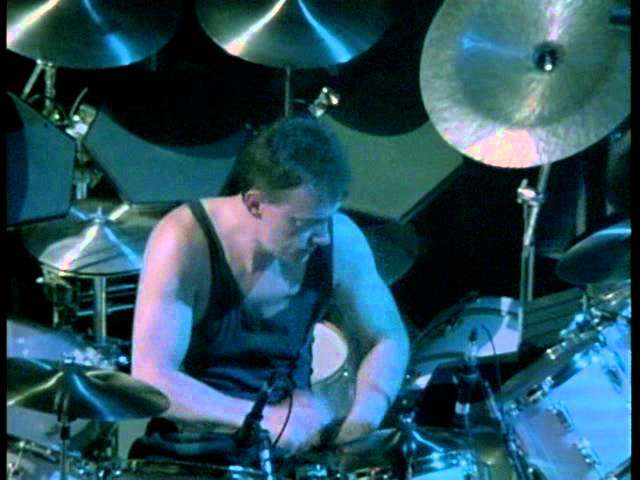
Almost immediately, “The Spirit of Radio” became a fixture of Rush’s live show, frequently the opener — the tuning-dial riff functioning as a house-lights-down signal that the band had arrived. The performance widely circulated as the “1989” version comes from A Show of Hands, the concert film shot over several April 1988 nights at the National Exhibition Centre in Birmingham, England, on the Hold Your Fire tour, and released on VHS and Laserdisc in February 1989. By then the trio had spent years teaching themselves to reproduce the density of their studio recordings on stage; Geddy Lee triggered his own sequenced samples live rather than hand the job to anyone offstage, and the Birmingham footage captures a band operating at the height of that discipline.
The recognition followed. In 2010 the song was inducted into the Canadian Songwriters Hall of Fame, and it remains the only Rush track named to the Rock and Roll Hall of Fame’s “500 Songs That Shaped Rock and Roll.” Peart died in January 2020; that same year, for the 40th anniversary of Permanent Waves, the surviving band released a new animated video for the song as a tribute to him. In October 2025, Lee and Lifeson announced a 2026–2027 Rush reunion tour, with Anika Nilles taking the drum chair — the first time the band would play under its own name since Peart’s death. Whatever those shows open with, a song about the strange grace of the right music at the right time will still be doing exactly what it was built to do.