



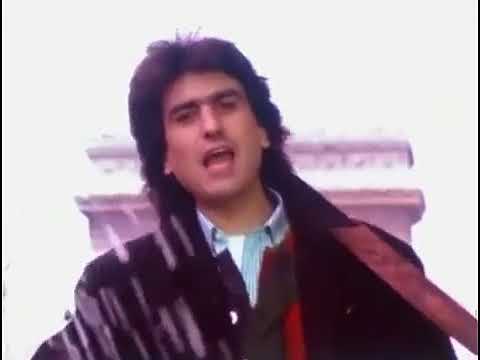
Toto Cutugno – L’italiano
Adriano Celentano said no, Sanremo voted it fifth, and “L’italiano” still became the song Italians abroad sing as their own
Midway through a concert in Toronto, in what he remembered as the biggest theater in the city, Toto Cutugno asked for the house lights. Some 3,500 faces looked back at him, and he saw Italians in every row, people who had built their lives an ocean away from where they were born. He promised them a song of their own. Later, at dinner in a restaurant, he rested a hand on an A minor chord, hummed a melody and wrote it on a scrap of paper. That melody became L’italiano, and everything that happened to it afterward traces back to where it started: a song about Italy, written for Italians who no longer lived there.
Keep watching: explore more →
Cutugno took the tune home to Milan and to Cristiano Minellono, the lyricist friend everyone called Popy. Minellono needed three days. The song arrived with a working title, Con quella faccia da italiano, “with that Italian face,” and Minellono thought it was too long. Cut it to one word, he told Cutugno, and leave it there. Cutugno later said he heard the finished lyric and considered it a masterpiece. The words work like a postcard rack: small, ordinary pieces of Italian life, set out one after another, with a guitar in the singer’s hand and a refrain that states, plainly, who he is.
“I will never sing it”
That refrain is what cost the song its first singer. L’italiano was meant for Adriano Celentano, who was filming Il bisbetico domato with Ornella Muti when Cutugno and Minellono brought it to him. Celentano listened in a film studio and told them he would never sing it. He liked the song. He did not like the idea of standing up and announcing himself as a true Italian, and he later explained that the public already knew he was one. He asked them for something else instead, a song for the end of the film, and Cutugno’s team wrote Innamorata, incavolata a vita for the closing credits.
That left a finished song with nobody to sing it. Cutugno’s first plan was to hand it to the impressionist Gigi Sabani and have him perform it in Celentano’s voice. Gianni Ravera, who ran the Sanremo festival, heard the song and refused to let that happen. He wanted Cutugno himself. Cutugno resisted, since he had already won Sanremo in 1980 with Solo noi and saw little to gain by going back. Ravera told him the song was a show all by itself. Cutugno gave in.
At the 33rd festival in February 1983, L’italiano finished fifth. Tiziana Rivale won with Sarà quel che sarà, and the critics’ prize went to Matia Bazar’s Vacanze romane, with Cutugno second. Viewers at home saw it differently, voting through Totip coupons to give him the Cantanti e vincenti prize. Carosello released the single, catalog CI 20513, arranged by Pinuccio Pirazzoli with Sarà on the B-side, and made it the title track of the album L’italiano. On March 12, 1983, Hit Parade Italia ranked it No. 2, directly behind Vacanze romane. The critics’ pick and the public’s pick ended up one place apart.
Italy, as seen from abroad
The promotional film made the emigrant point without spelling it out. Cutugno shot it in Paris rather than in Rome or Milan, on the Champs-Élysées, with the indoor scenes in an Italian restaurant: breadsticks on the tables, an aquarium against the wall, waitresses in uniforms in the colors of the flag, Cutugno twirling pasta and joking with the staff. Forty years on, the Swiss paper laRegione found the clip a little quaint. It also fits the song exactly. This is Italy as it looks from a restaurant in another country, and that is the Italy the song was written for.
France took it to heart. InfoDisc’s reconstruction of the French singles chart lists it at No. 1 for 13 weeks from June 4, 1983. Translations followed almost at once, and nearly every version kept the structure and swapped the country. Kari Tapio made it a Finnish hit in 1983 as Olen suomalainen, “I am Finnish.” A Hebrew version followed in 1984. Lara Scandar sang it in Arabic in 2013. In India, the 1999 film Mann turned the melody into Nasha Yeh Pyar Ka Nasha Hai, sung by Udit Narayan. Cutugno brought it back to Sanremo in 2013, singing it with the Red Army choir.
Cutugno won Eurovision in 1990 with Insieme: 1992, and he died in Milan on August 22, 2023, at 80. After his death, Celentano said he regretted that no. He shouldn’t have. The song did not need Italy’s biggest star or a festival jury’s blessing, because it was never really addressed to either of them. It was written for a Toronto theater full of people who had left home, and it found its audience wherever such people gathered: in Paris, in Helsinki, in Mumbai, and in every Italian restaurant with a guitar in the corner.
SONG INFORMATION
Enjoyed this one? New forgotten gems every day — tap Music Videos Club below to visit and follow us on Facebook: