



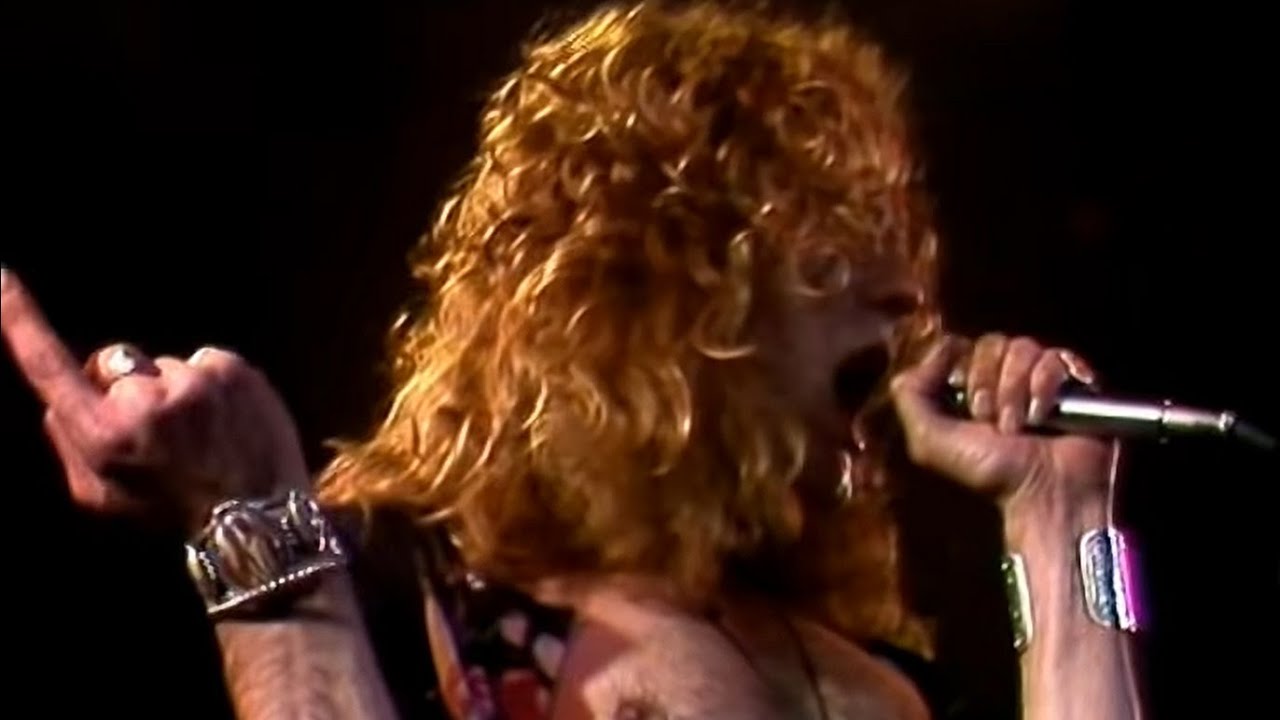


Led Zeppelin – Stairway To Heaven (Live at Earls Court 1975)
Plant’s Hand Wrote The Words Before His Brain Knew What Was Happening
Released on 8 November 1971 on Led Zeppelin’s untitled fourth album, commonly known as Led Zeppelin IV, “Stairway To Heaven” was never released as a single despite Atlantic Records’ repeated requests. Manager Peter Grant refused in both 1972 and 1973, insisting people experience the eight-minute epic in the context of the album. The strategy worked spectacularly. By its twentieth anniversary in 1991, the song had logged an estimated 2,874,000 US radio plays, making it the most requested song on FM radio despite zero commercial single release. The album topped the Billboard 200 and eventually sold over thirty-seven million copies worldwide. When the band debuted the song live at Ulster Hall in Belfast on 5 March 1971, the crowd sat bored waiting to hear something they knew. Decades later, it became the standard by which all epic rock performances are measured, with Guitar World ranking Page’s solo as the greatest of all time.
The chart story reveals how thoroughly the band rewrote the rules. Never officially released as a single in the UK, it finally entered the UK Singles Chart at number thirty-seven in November 2007 when Zeppelin’s catalogue became available digitally, thirty-six years after its original album release. Earlier covers had charted, with Far Corporation reaching number eight in 1985, Dread Zeppelin crawling to number sixty-two in 1991, and Rolf Harris peaking at number seven in 1993. VH1 ranked it number three on their 100 Greatest Rock Songs list in 2000. Rolling Stone placed it at number thirty-one on their 500 Greatest Songs of All Time in 2004, later revising to number 403 in 2021. The Library of Congress selected it for preservation in the National Recording Registry in 2023. The song entered the Grammy Hall of Fame in 2008, solidifying its status as culturally and historically significant. Plant’s relationship with the song grew complicated, eventually leading him to donate ten thousand dollars to Portland’s KBOO radio station in 2002 after they promised never to play it again.
The song originated in 1970 when Jimmy Page and Robert Plant spent time at Bron-Yr-Aur, a remote cottage in Wales following Led Zeppelin’s fifth American tour. Page wrote the music over a long period, keeping a cassette recorder around to capture bits of taped music that eventually formed “Stairway To Heaven.” The first attempts at lyrics came at Headley Grange, a huge, old, dusty mansion in Hampshire with no electricity but great acoustics. Plant sat next to an evening log fire with a pencil and paper while Page strummed the chords. Plant later described what happened as almost supernatural, recalling he was in a very bad mood when suddenly his hand started writing out the words about a lady who’s sure all that glitters is gold. He just sat there, looked at the words, and almost leapt out of his seat. Page claimed a huge percentage of the lyrics were written there and then, with Plant getting up and singing along with another run-through with maybe eighty percent of the words already complete.
Recording began in December 1970 at Island Records’ new Basing Street Studios in London. The song was completed during sessions for Led Zeppelin IV at Headley Grange in 1971, with Page returning to Island Studios to record his guitar solo. The basic backing track featured John Bonham on drums, John Paul Jones on electric piano, and Page on acoustic guitar. Jones traded his bass for recorders in the opening section, playing with medieval flourish what Page later called a poor man’s version of Bach’s Bourrée in E minor. Page used a Gibson EDS-1275 double-neck guitar for live performances to switch seamlessly from six to twelve-string. The guitar solo, ranked by Guitar World as the greatest ever, was pure improvisation. Page told Rolling Stone in 2008 that he did three takes, all different, and picked the best one, flying within the context of the song. For the live shows, Page would extend it beyond ten minutes while Plant added ad-libs like “Does anybody remember laughter?” and “I hope so.”
“Stairway To Heaven” became the centerpiece of Led Zeppelin IV, the album that cemented the band’s legend. Following lukewarm reviews of Led Zeppelin III, the band decided their fourth album would be untitled, represented by four symbols chosen by each member, with no name or details on the cover. The informal recording environment at Headley Grange inspired experimentation with different arrangements and styles. The album also featured “Black Dog,” “Rock and Roll,” “When the Levee Breaks,” and “The Battle of Evermore” with Sandy Denny providing the only female voice ever heard on a Led Zeppelin recording. The artwork showed an old man carrying sticks, a picture Plant bought in an antique shop in Reading, Berkshire, affixed to a partly demolished suburban house. Research in 2023 revealed the image was actually a hand-colored 1892 black and white photograph by Ernest Howard Farmer.
The song was performed at almost every Led Zeppelin concert, extended to over ten minutes with Page’s guitar work and Plant’s improvised lines. Their final performance of it came in Berlin on 7 July 1980, which was also their last full-length concert until the 10 December 2007 reunion at London’s O2 Arena for the Ahmet Ertegun Tribute Concert. The surviving members performed it at Live Aid in 1985, with Plant later citing that performance with two drummers, Phil Collins and Tony Thompson, while Duran Duran cried at the side of the stage, as the most surreal version ever. The 2012 Kennedy Center Honors tribute by Heart, featuring Ann Wilson’s vocals, Jason Bonham on drums, and a full choir wearing bowler hats as tribute to John Bonham, brought Page, Plant, and Jones to tears and received a standing ovation. Plant performed the song publicly in October 2023 for the first time since 2007, at a charity gig organized by Andy Taylor in Oxfordshire, telling Rolling Stone he just blurted it out because it remained such an important song to him.
The covers span genres and generations, each adding unique interpretations. Dolly Parton recorded a bluegrass rendition. Symphonic orchestras worldwide have reimagined it. The song’s influence permeated popular culture so thoroughly that it became unofficially banned from being played in guitar shops worldwide, immortalized in the 1992 comedy Wayne’s World when Mike Myers’ character gets denied by a cranky salesman. The banned-from-guitar-stores phenomenon emerged because nearly every budding guitarist attempted to learn Page’s intro, creating endless repetition. Plant’s ten-thousand-dollar donation to KBOO came after he pulled over along the Oregon coast in 2002, hearing the station play amazing music including sad doo-wop outtakes. When the DJ said they’d never play “Stairway To Heaven” again for ten thousand dollars, Plant whipped out his credit card. He told NPR it wasn’t that he didn’t like it, he’d just heard it before.
Controversies added to the mystique. The opening acoustic guitar arpeggios bore resemblance to Spirit’s 1968 instrumental “Taurus,” written by guitarist Randy California. Spirit had opened for Led Zeppelin’s first American tour, and California wrote in 1996 that people always asked why “Stairway” sounded exactly like “Taurus,” released two years earlier. In May 2014, Spirit bassist Mark Andes and a trust acting on behalf of California, who died in 1997, filed copyright infringement. The band mostly ignored such claims, with Swan Song Records stating their turntables only play in one direction—forwards. Engineer Eddie Kramer called the allegations totally and utterly ridiculous. The backward satanic messages theory persisted for years, fueled by Page’s purchase of Aleister Crowley’s Boleskine House in Scotland and Crowley’s advocacy for learning to read and speak backwards. Plant addressed it in Musician magazine, expressing frustration that the song was written with every best intention, not for reversing tapes and putting messages on the end.
Plant has offered various explanations for the lyrics over decades. He told Total Guitar the song was some cynical aside about a woman getting everything she wanted without giving back any thought or consideration, though he never specified whether he had a particular woman in mind. He cited Lewis Spence’s Magic Arts in Celtic Britain as inspiration. Many Tolkien fans believed the lyrics echoed “The Tale of Aragorn and Arwen” from The Lord of the Rings appendix, pointing to lines about the spirit crying for leaving as referencing Arwen’s choice between immortality with elves or mortality with Aragorn. Plant admitted talking about C.S. Lewis and Tolkien elsewhere on Led Zeppelin IV. When asked why the song remained so popular, he credited its abstraction, noting that depending on what day it was, he still interpreted it differently, and he wrote the lyrics. The power lay in what listeners brought to it rather than any fixed meaning.
Looking back, “Stairway To Heaven” represents Led Zeppelin at their creative peak, crystallizing everything that made them legendary. Page said it crystallized the essence of the band, showing them at their best, a milestone proving every musician’s desire to do something of lasting quality. The song that Atlantic desperately wanted as a single became more powerful by remaining an album track, forcing fans to buy Led Zeppelin IV as if it were the single. The Belfast crowd that sat bored during the world premiere couldn’t have imagined it would become rock’s most enduring epic. Plant’s complicated relationship with his most famous song, culminating in paying a radio station to never play it, only adds to its mythology. The lady who’s sure all that glitters is gold keeps buying her stairway to heaven, and despite Plant’s weariness, the world keeps listening. As he reflected, there’s only so many times you can sing it and mean it, but the song transcended its creator’s intentions long ago, becoming something larger than any single performance or interpretation—a cultural touchstone that defines what rock music can achieve when ambition, craft, and mysterious inspiration align.
SONG INFORMATION
Chart Performance: No.37 in UK (2007 digital release), 2,874,000 US radio plays by 1991, No.3 VH1 100 Greatest Rock Songs (2000), No.31 Rolling Stone 500 Greatest Songs (2004), Library of Congress National Recording Registry (2023), Grammy Hall of Fame (2008)
Stairway to Heaven (Live at Earls Court, London, England, 5/24/1975)
Enjoyed this one? New forgotten gems every day — tap Music Videos Club below to visit and follow us on Facebook:
Related videos
 Watch LaterAdded
04:11
Watch LaterAdded
04:11  Watch LaterAdded
04:17
Watch LaterAdded
04:17  Watch LaterAdded
04:11
Watch LaterAdded
04:11