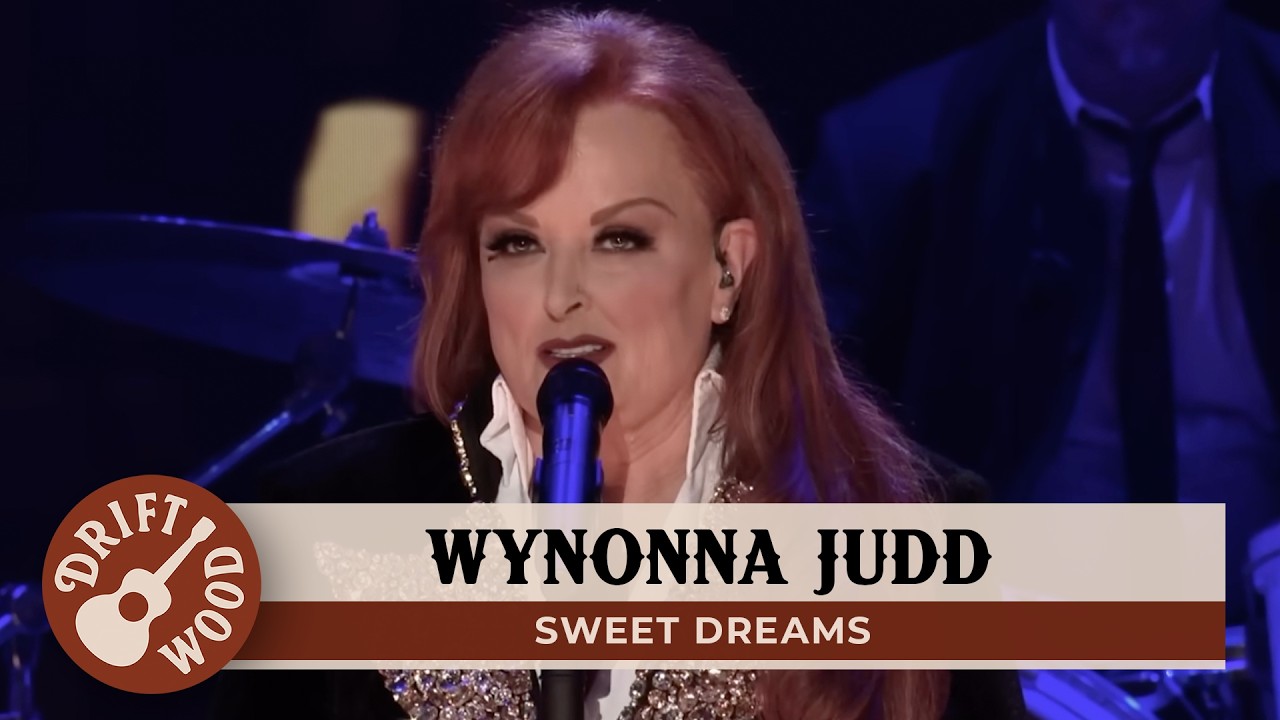
The night Patsy Cline recorded it in 1963, she called it “the first and the last” — and never lived to hear it released; sixty-one years later, Wynonna stood in Cline’s home venue and sang it back to her.
Some songs carry their whole history in a single performance. When Wynonna Judd stepped to the microphone at the Ryman Auditorium on April 22, 2024, to sing Sweet Dreams, she was reaching back through three distinct lives the song had already lived — and standing in the exact room where the most famous of them had taken root.
The song was not Patsy Cline’s to begin with. Sweet Dreams was written by Don Gibson — the Nashville songwriter known as the “Sad Poet,” the man who also wrote I Can’t Stop Loving You and Oh, Lonesome Me — who first recorded it himself in 1955. Faron Young took it to number 2 on the country chart in 1956, and Gibson cut a second version of his own in 1960. It was already a country standard by the time Cline got to it.
Then came the recording that fixed it in memory forever. Patsy Cline cut Sweet Dreams on February 5, 1963, at Bradley Studios in Nashville, with producer Owen Bradley layering in the lush strings she half-feared were making her too pop. The story passed down is that the night she recorded it, she held up a copy of her first record alongside this new one and said, “Well, here it is: the first and the last.” A month later, on March 5, 1963, she was killed in a plane crash. Sweet Dreams was released that April, after her death, and climbed to number 5 on the country chart and number 44 on the Hot 100. She never heard it on the radio.
A homecoming sixty-one years in the making
That weight is what Wynonna Judd carried onto the Ryman stage. The concert — “Walkin’ After Midnight: The Music of Patsy Cline,” an all-star Mercury Studios production later broadcast as part of PBS’s Great Performances — gathered a generation-spanning cast to honor Cline at the venue she had called home as a member of the Grand Ole Opry. Wynonna, whom Rolling Stone once called the greatest female country singer since Cline herself, was handed the song that asks the most of a voice. She did not imitate Cline; she met her, bringing the cavernous, soulful ache that has defined her own four decades in country music. Critics singled out the performance as a high point of the night, and she returned later to close the show with Crazy.
There is a rightness to it that goes beyond programming. Cline made Sweet Dreams in Nashville and never got to perform it for the public. Six decades on, in the same city, on the same stage, another woman built for big emotion gave the song the live homecoming its most famous singer never had. The performance is a tribute in the truest sense — not a copy, but a conversation across time, conducted in the one room where Patsy Cline’s voice still seems to hang in the rafters.
SONG INFORMATION
Performance: Wynonna Judd, live at the Ryman Auditorium, Nashville, April 22, 2024
Song: “Sweet Dreams (of You)”
Songwriter: Don Gibson
Concert: Walkin’ After Midnight: The Music of Patsy Cline (Mercury Studios; PBS Great Performances)
Original Artist: Don Gibson (1955); definitive version by Patsy Cline (1963)
Patsy Cline Recording: February 5, 1963, Bradley Studios, Nashville
Patsy Cline Producer: Owen Bradley
Patsy Cline Label: Decca
Original Chart Performance: Patsy Cline version No. 5 (US Hot Country Songs), No. 44 (Billboard Hot 100), released April 1963