








Lady Gaga – Poker Face
The Opening Hook Was Stolen from a 1977 German Disco Record — and Gaga Wrote the Rest in an Hour
The first sound you hear in “Poker Face” is not Lady Gaga’s voice. It is a deep, murmuring chant — “mum-mum-mum-mah” — that RedOne had lifted wholesale from “Ma Baker,” a 1977 single by Boney M, the gloriously absurd German disco project whose records he had grown up loving. In their first week working together, Gaga and RedOne wrote and recorded “Just Dance,” “Poker Face,” and at least one other song. RedOne later said that both singles took roughly an hour apiece. For a song that would go on to become one of the twenty best-selling physical singles in the history of recorded music, the gestation period was extraordinary in its brevity. The opening stolen from Boney M. The title from a poker metaphor. The rest written in a rush. And underneath all of it, a subject that Gaga wouldn’t publicly discuss for months after release.
The single reached number one in more than seventeen countries — the United States, United Kingdom, Australia, New Zealand, Canada, and the majority of Western Europe among them. It spent ten consecutive weeks at the top of the New Zealand chart, became the most downloaded song in British chart history at the time of its release, and simultaneously occupied the Hot 100’s top positions alongside “Just Dance,” making Gaga only the third act ever to place their first two singles simultaneously in the top ten. At the 52nd Grammy Awards it won Best Dance Recording and was nominated for both Song of the Year and Record of the Year — the full sweep of the Recording Academy’s major categories for a debut single that had been written and tracked in sixty minutes in Hollywood.
The subject matter, Gaga explained to a live audience in Palm Springs in April 2009, was bisexuality: the experience of being with a man while thinking about a woman, and keeping that internal reality hidden behind an unreadable expression. She had told interviewers initially that the song was “about sex and gambling” and “a tribute to my rock and roll boyfriends” — both true, neither the complete picture. The poker face of the title was her own: a performance of heterosexual desire concealing something more complicated underneath. The line “bluffin’ with my muffin,” she confirmed to Rolling Stone, was exactly the anatomical metaphor it sounded like, borrowed from an unreleased song called “Blueberry Kisses.” What makes the lyric work is that none of this clarification is necessary to feel its charge. The song communicates desire and concealment without needing you to decode the specifics.
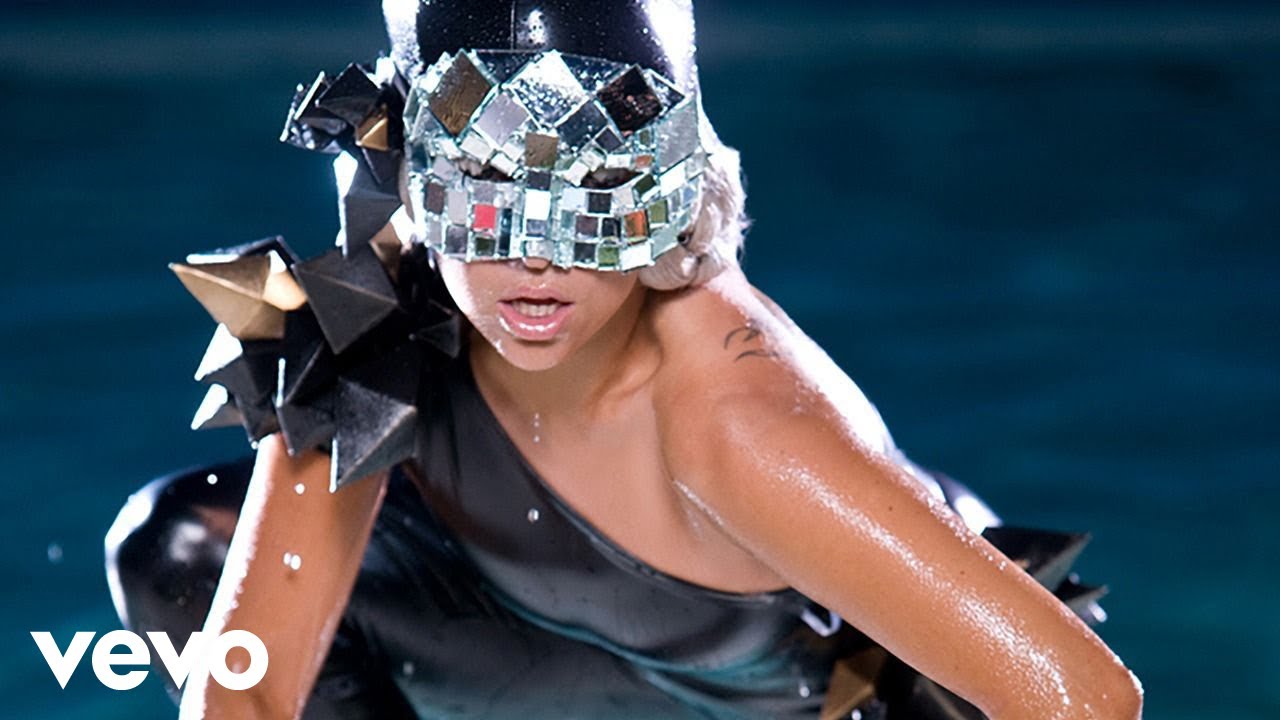
Director Ray Kay had originally planned to shoot the official video on a beach in Ibiza, with Gaga emerging from the surf in an homage to Halle Berry’s famous Die Another Day entrance. That plan was abandoned at the last minute, leaving him scrambling. He found a Malibu mansion — branded for the shoot as bwin PokerIsland, the poker platform having provided equipment in exchange for product placement — and on October 3, 2008, filmed the entire video in a single very long day. Gaga’s instructions to herself were characteristically direct: “I knew I wanted it to be sexy, so I thought no pants, because that’s sexy, and I knew I wanted it to be futuristic, so I thought shoulder pads, because that’s my thing.” The costumes — a mirrored masquerade mask, a black latex bodysuit with a jagged shoulder pad, a turquoise leotard — were Haus of Gaga originals. The two Great Danes at the opening were not props. They were hers.
The Fame, released in August 2008, had been two and a half years in the making by the time it reached the public — the majority of that time spent writing, demoing, and trying to get anyone in the American music industry to pay attention to a twenty-two-year-old from the Lower East Side who wanted to make something that sounded like downtown New York dragged onto the FM dial. Gaga had been dropped by one label, signed to another through a deal brokered partly by Akon, and was performing in small venues and showcases while simultaneously writing for other artists to stay solvent. The sudden global scale of “Poker Face” — number one, then number one again, then Grammy nominations, then a world tour — arrived faster than anyone involved had planned for or fully processed.
The song’s cultural spread has been relentless. Faith No More performed it live throughout 2009 and 2010. Christopher Walken delivered an a cappella version on BBC One’s Friday Night with Jonathan Ross for Halloween 2009 that became its own small cultural event. Eric Cartman sang it on South Park. Gaga herself performed an acoustic blues version on her Fame Ball Tour that Rolling Stone compared to Amy Winehouse. In June 2022, the official music video crossed one billion views on YouTube, making it her third to reach that milestone after “Bad Romance” and “Shallow.”
What “Poker Face” established — in that first week in a Hollywood studio, in an hour, by two people who had just met — is that pop music’s most durable achievements often arrive without ceremony. The Boney M sample makes it camp. The production makes it sinister. The vocal makes it personal in a way that dance-floor music rarely manages. Rolling Stone placed it at number 96 on their list of the best songs of the 2000s, which probably undersells it: this is one of the records that made the decade’s pop sound possible, written fast, filmed faster, and built to last considerably longer than either.
SONG INFORMATION
Related videos
 Watch LaterAdded
04:56
Watch LaterAdded
04:56  Watch LaterAdded
![Three Degrees – When Will I See You Again [HQ stereo]](https://musicvideosclub.com/wp-content/uploads/2024/10/three-degrees-when-will-i-see-yo-360x203.jpg) Watch LaterAdded
02:57
Watch LaterAdded
02:57