







![The Beatles – The Beatles – Eleanor Rigby (From Yellow Submarine) [Official Music Video]](https://musicvideosclub.com/wp-content/uploads/2026/08/the-beatles-the-beatles-eleanor-360x203.jpg)

Aphrodite’s Child – Rain and Tears
A record company asked three stranded Greeks for a copy of “A Whiter Shade of Pale” and got a 17th-century canon instead
By the end of the summer of 1968 the song was everywhere in France — No.1, half a million copies sold there and half a million more in Italy, and a fixture in a city that had spent May tearing up its own streets. What nobody singing it knew was how it had been commissioned. Mercury’s people had asked for something that would do in 1968 what A Whiter Shade of Pale had done the year before, and the band they asked were three Greek musicians who had never intended to be in Paris at all.
Keep watching: Demis Roussos – My Friend the Wind · explore more →
They had formed in Athens in 1967: Vangelis Papathanassiou on keyboards, out of the Forminx; Demis Roussos on bass and vocals, out of the Idols; Loukas Sideras on drums; and Silver Koulouris on guitar. Greece had fallen to a military dictatorship in April of that year, and the plan was to get to London, where the music they wanted to make had somewhere to go. It did not work. Koulouris never left — the army called him up before the others set out, which is why the guitarist of the band is not on the band’s most famous record. The remaining three got as far as Paris and stopped, held there by the absence of work permits and then by a general strike that shut down the country around them. Lou Reizner at Mercury signed them and gave them a name, borrowed from a song title in another act’s catalog.
The label had a specific job in mind. Producer Pierre Sberro suggested building the single on Pachelbel’s Canon in D, a piece of 17th-century chamber music with a bass line that repeats until it hypnotizes, and Vangelis arranged it into a pop record. Boris Bergman, a French lyricist, supplied English words for a Greek singer to deliver. The sessions ran on May 10 and May 18, 1968 — a fortnight when Paris was closing down around the studio, the strikes spreading outward until the city stopped working. The band have since been candid that this was a commission rather than an inspiration: they needed a hit in order to exist, and the one thing they brought to the brief that nobody had asked for was where they came from.
The voice was the part that couldn’t be commissioned
That turned out to be the whole record. The arrangement is a decorous English chamber-pop production of the kind Britain was making by the dozen in 1968, and then Roussos opens his mouth and something else entirely comes out — a high, unguarded, faintly liturgical sound with no equivalent anywhere in the charts. Mercury released the single in June. It went to No.1 in France, No.2 in the Netherlands, Switzerland and Norway, and into the top 30 in Britain and West Germany, which for a band singing in a borrowed language on a borrowed melody was an extraordinary first showing. The lyric is not political and the language is not French, and students in Paris sang it anyway. A song built out of a repeating figure that never resolves suited a summer that did not resolve either.
France, autumn 1968
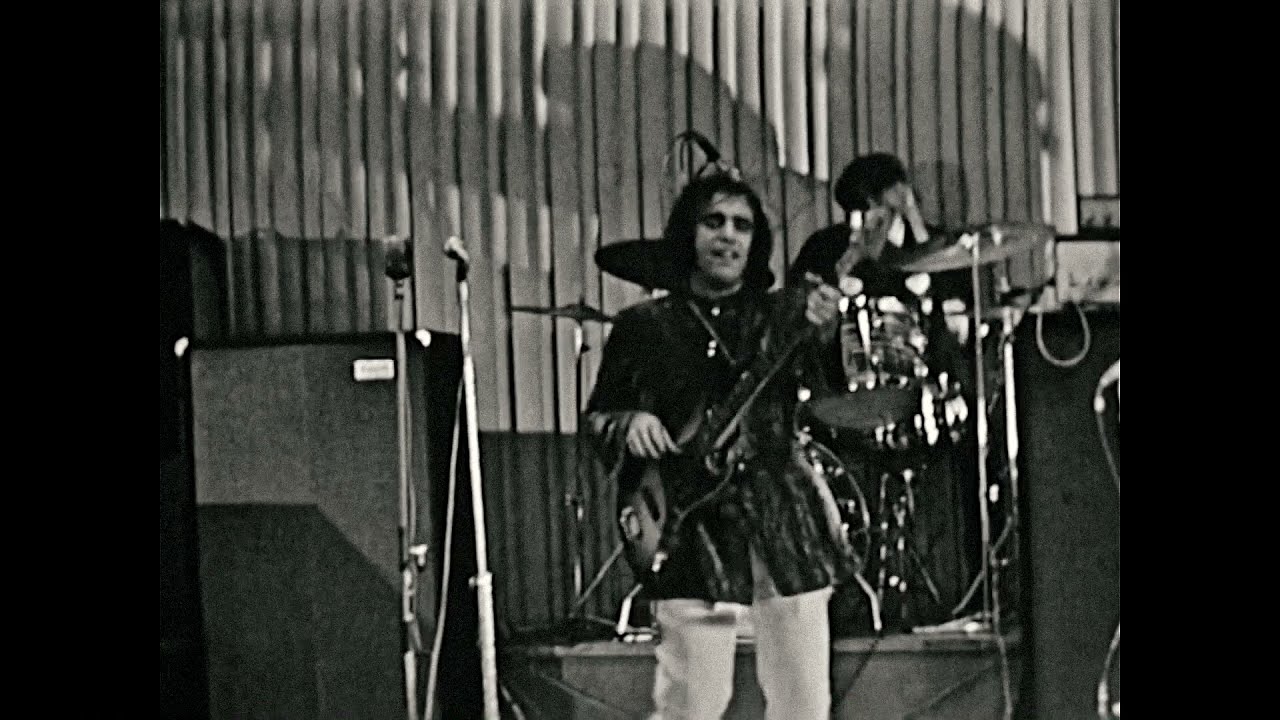
The performance on this page comes from Lille, filmed during the band’s first year on stage, when the single was still working its way across Europe and the three of them were playing to French audiences who had adopted them without quite knowing where they were from. End of the World followed in November. It’s Five O’Clock and I Want to Live came in 1969, and by then Aphrodite’s Child were one of the biggest groups in continental Europe and almost unknown in America.
It ended quickly. Vangelis wanted to go somewhere the others did not, and 666, a double album built on the Book of Revelation, took nearly two years to appear; by the time it did in June 1972 the band had already broken up. They had sold more than 20 million records. Vangelis went on to the score for Chariots of Fire and an Academy Award, and died in 2022. Roussos became a solo star in a kaftan and died in 2015. Sideras, born in 1944, is still playing in Athens. The commission they took because they needed the money outlasted the band, the label, and the summer it was built for — a piece of music written around 1690, sung by a Greek in English, in a city none of them had meant to stay in.
SONG INFORMATION
Enjoyed this one? New forgotten gems every day — tap Music Videos Club below to visit and follow us on Facebook:
Related videos
 Watch LaterAdded
04:17
Watch LaterAdded
04:17  Watch LaterAdded
03:04
Watch LaterAdded
03:04  Watch LaterAdded
03:03
Watch LaterAdded
03:03