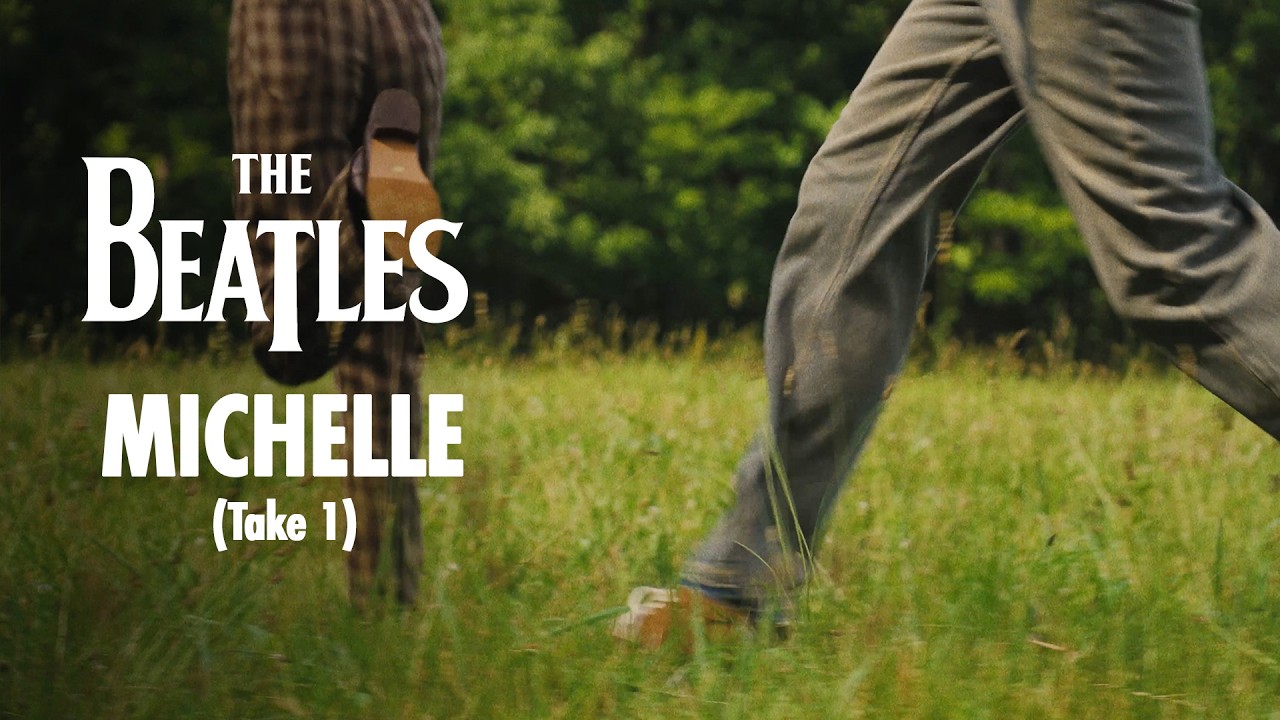
The only complete take of “Michelle” to survive its 1965 session has just been released — and the song it captures started life as Paul McCartney’s joke about pretentious French folk singers.
On a single reel of four-track tape from November 3, 1965, one complete performance of “Michelle” survived. Around it sit fragments of earlier attempts, recorded over and half-erased, the ghosts of a song still finding its shape. That surviving performance — Take 1, stripped of the overdubs that would finish the master — has now been released by The Beatles ahead of the Rubber Soul Special Editions, and it opens a window onto one of the most covered songs the band ever made, at the moment before it was quite finished.
“Michelle” did not begin as a love song. It began as a joke. Years earlier, at parties thrown by one of John Lennon’s tutors from Liverpool College of Art, McCartney would watch the room’s resident bohemian — a troubadour in a black sweater, working through Jacques Brel numbers — and amuse himself by pretending to be French, humming a mock-continental tune with nonsense syllables for words. That party piece sat dormant until 1965, when Lennon suggested Paul turn the old spoof into a real song for Rubber Soul. The melody itself came from another source entirely: McCartney had been teaching himself the fingerpicking style of Chet Atkins, whose “Trambone” ran a melody and a bass line at the same time, and he built “Michelle” around that same simultaneous, contrapuntal approach.
The French words he couldn’t write himself
Committing to the French feeling meant actually producing some French, and McCartney, by his own admission, couldn’t. So he turned to Jan Vaughan, a French teacher and the wife of his old friend Ivan Vaughan. She supplied the line everyone now knows, “Michelle, ma belle,” and a few days later McCartney went back for more, asking her to translate “these are words that go together well” — which became “sont des mots qui vont très bien ensemble.” The most famous French lyric in the Beatles catalog was, in effect, homework, sourced from a friend’s wife who taught the language for a living.
The song’s other signature moment came from Lennon, and from somewhere unexpected. The night before Paul brought the tune over, John had been listening to Nina Simone’s 1965 recording of “I Put a Spell on You,” and one phrase had lodged in his head: a repeated “I love you,” with the weight landing hard on the final word. When McCartney played him “Michelle” and asked where it should go next, Lennon handed him that bridge. It is the bluesy grit in an otherwise gentle ballad — Lennon’s instinct for the sad and the discordant grafted onto McCartney’s lightness, the same division of labor that ran through much of their best work.
Nine hours, one surviving take
The Beatles recorded “Michelle” in a single nine-hour session at EMI Studios on November 3, 1965, with George Martin producing. They laid the rhythm track down quickly, using all four available tracks, then mixed down to free space for overdubbed vocals and guitar — and it is that first complete pass, before the overdubs, that the new visualiser presents. The finished song appeared on Rubber Soul on December 3, 1965. The Beatles never released it as a single in Britain or America, yet it reached No. 1 for them across much of Europe — Belgium, France, Norway, the Netherlands — while cover versions carried it up the charts at home, the Overlanders taking their reading to the top in the UK. In 1967 it won the Grammy Award for Song of the Year, honoring 1966, and it has since become one of the most recorded songs the band ever wrote. Take 1 is where all of that begins: a parody of a French folk singer, caught on tape before anyone was sure it would become something serious.
SONG INFORMATION
Artist: The Beatles
Song: “Michelle”
Album:Rubber Soul
Released: December 3, 1965 (album)
Recorded: November 3, 1965
Studio: EMI Studios (Abbey Road), London
Label: Parlophone
Songwriter(s): Lennon–McCartney
Producer(s): George Martin
Length: 2:33 (mono); 2:40 (stereo)
Key / Tempo: F major (capo on the fifth fret)
Chart Performance: No. 1 for the Beatles in Belgium, France, Norway, the Netherlands, and New Zealand (single release)
Awards: Grammy Award for Song of the Year (awarded 1967, for 1966)
Lineup: Paul McCartney — vocals, bass, guitar; John Lennon — guitar, vocals; George Harrison — guitar; Ringo Starr — drums